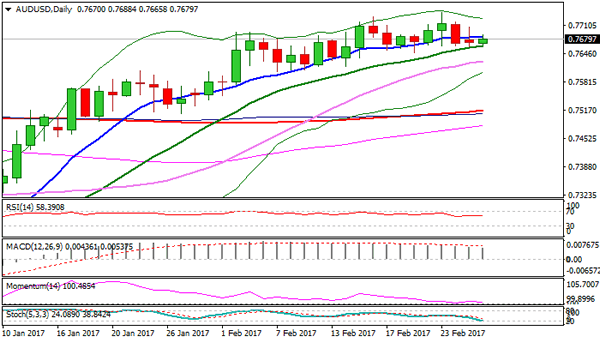
2012 Forecast: AUD Boosted By Speculations Over Fed's QE3 In The Near-Term
The dovish January FOMC statement thrilled investors and boosted higher-yield currencies. Australian dollar was one of the beneficiaries. AUD soared against USD after the Fed pushed back the first expected rate hike to late-2014, from mid-2013 as projected in previous statements. Moreover, renewed speculations on QE3 have boosted AUD as well as other cyclical currencies. Australian dollar is expected to rise further in the near-term amid rising likelihood of monetary easing. In the medium- term, AUD will likely trade sub-parity against the USD but upside risks remain there for the commodity currency and any accommodative policy from China should help push the currency higher.
Australia's GDP grew +1.0% in 3Q11, after gaining an upwardly revised +1.4% the second quarter. The country's job market softened in the second half of the year. While the jobless rate remained at 5.2% in December, it was due to a drop in the participation rate, rather than a rise in the number of payrolls. Headline CPI was flat over 4Q11, following a +0.6% gain in the prior quarter. Moderation in inflation was driven by the decline in fruit and vegetable prices. Core CPI climbed +0.6% q/q, from an upwardly revised 0.4% in 3Q11, bringing inflation up +2.6% over the year.
The external environment is still highly uncertain. The sovereign debt crisis in the Eurozone remains a serious concern and it's not just an issue for the 17 nations in the region but with huge spillover effect. At the Annual Meeting of the World Economic Forum, the IMF director Lagarde warned that 'no one is immune in the current situation. It's not just a Eurozone crisis, it's a crisis that could have spillover effects around the world. No country is immune and everyone has an interest in making sure that this crisis is resolved adequately'.
Monetary policy would affect currency movement. There have been increasing speculations that the RBA will cut the cash rate by -25 bps to 4% in February to stimulate the Australian economy. Whether the RBA would implement a rate cut depends on the Australia's inflationary outlook as well as the global economic prospect. Although core inflation in the second half of last year has been revised higher, it is still low and sits comfortably within the central bank's medium-term inflation target of 2-3%. This gives the RBA flexibility to loosen further.
After two consecutive rate cuts in November and December, the cash rate is currently staying at a neutral territory of 4.25%. A fall below 4% is not impossible but it would require debt problems in the Eurozone to deteriorate more significantly.
|
Dec-11 |
1Q12 |
2Q12 |
3Q12 |
4Q12 |
| AUDUSD |
1.02 |
0.96 |
0.97 |
0.98 |
1.00 |
| EURAUD |
1.27 |
1.32 |
1.31 |
1.31 |
1.30 |
| AUDJPY |
79.00 |
72.00 |
74.00 |
75.00 |
77.00 |
| GBPAUD |
81.91 |
78.54 |
77.96 |
78.77 |
79.53 |
| AUDCHF |
0.96 |
0.92 |
0.94 |
0.95 |
0.96 |
| AUDNZD |
1.34 |
1.27 |
1.25 |
1.24 |
1.23 |
| AUDCAD |
1.04 |
1.01 |
1.01 |
1.01 |
1.00 |


|