Sample Category Title
Euro Slips On Draghi’s Dovish Tone
The euro has edged lower in the Thursday session. Currently, EUR/USD is trading at 1.2295, down 0.14% on the day. On the release front, German Industrial Production declined 0.1%, missing the estimate of 0.6%. This marked the fourth decline in the past five months. In the US, the focus is on employment reports. Wage growth is expected to tick lower to 0.2%, while Nonfarm Payrolls are forecast to improve to 20 thousand.
The ECB sent a mixed message on Thursday, triggering strong movement from the euro. As expected, the ECB dropped its easing bias, which was the option to increase monthly purchases if the economy softens. This sent the euro higher, but only briefly, as ECB President Mario Draghi was decidedly dovish at his press conference. Draghi said that eurozone inflation could remain subdued, so the Bank's monetary policy would remain ‘reactive'. The comments were not well received by investors, as the euro slipped close to 1 percent on Thursday.
The EU is seeing red after US President Trump made good on his threat, and signed an order imposing 25% tariffs on steel imports. EU policymakers have threatened to retaliate with tariffs on US goods, and European Commission President Jean-Claude Juncker was particularly blunt, saying “we can also do stupid”. Fears of an all-out global trade war are weighing on the US dollar and the stock markets, and the resignation of Gary Cohn, a senior economist in the White House who opposed the tariffs, will only dampen investor risk appetite. The ball is now in the EU court, and if the Europeans retaliate and Trump responds with further tariffs, we could see some sharp movement from EUR/USD.
USDMXN Posts 11-Day Low, Bearish Cross In Place
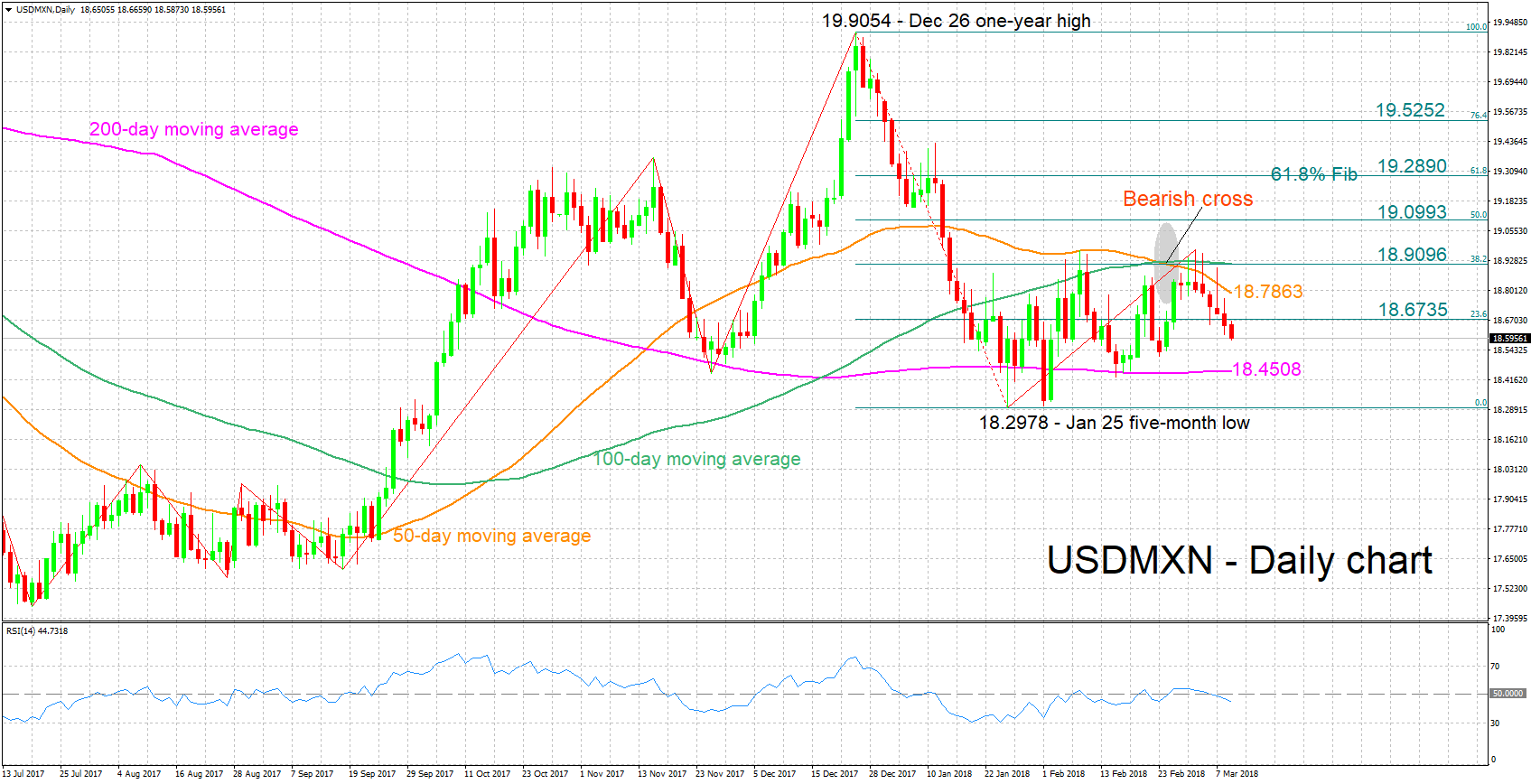
USDMXN is extending its declines for the sixth straight day, hitting an 11-day low of 18.5853 earlier on Friday.
The RSI has moved below the 50 neutral-perceived level and continues to decline. This is indicative of bearish short-term momentum for the pair.
Additional losses could meet support around the current level of the 200-day moving average at 18.4508, with a downside violation bringing into view the five-month low of 18.2978 that was recorded in late January.
On the upside, the range around the 23.6% Fibonacci retracement level of the December 26 to January 25 downleg at 18.6735 might be currently providing resistance. Further above, a resistance area could be formed around the 50-day MA at 18.7863 and the 38.2% Fibonacci mark at 18.9096 (this is where the 100-day MA also lies at the moment).
The medium-term picture is looking mostly bearish, with price action taking place below the 50- and 100-day MA lines, while a bearish cross was also recorded in late February when the 50-day MA moved below the 100-day one.
Overall, both the short- and medium-term outlooks are looking negative at the moment.
Technical Outlook: COPPER Bounces From New 1-Mth Low But Could Fall Further On Strong US Jobs Data
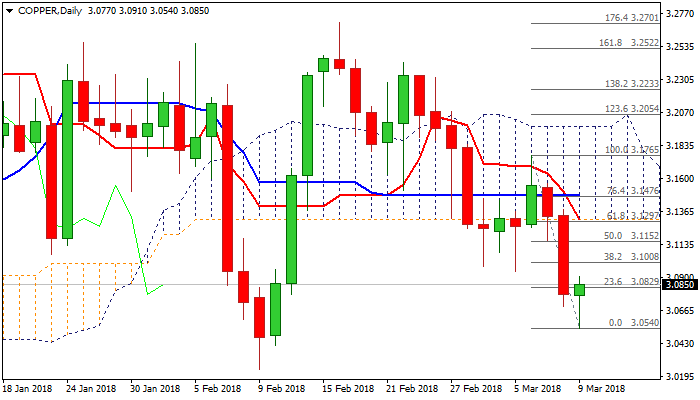
Copper hit one-month low at $3.0540 on Friday, in extension of strong fall in past two days which accelerated on Thursday as the greenback rallied across the board.
Traders are estimating possible impact on US tariffs on metal imports, which is one of the key factors that keeps the metal price under pressure.
Friday’s dip was so far limited as subsequent bounce reduced persisting downside pressure, however, risk of fresh weakness which could result I final push towards key s/t support at 3.0250 (09 Feb low) remains in play.
Firm bearish setup of daily techs supports scenario, seeing recovery attempts as positioning for fresh leg lower, with upticks to face solid resistance at $3.10 zone (Fibo 38.2% of $3.1765/$3.0540) where corrective rallies should be ideally capped.
Expectations for strong US jobs data which could firm dollar, support negative near-term scenario for copper price.
Alternative scenario sees rally through $3.10 pivot and bullish acceleration towards daily cloud base at $3.1312.
Res: 3.0910, 3.1000, 3.1152, 3.1312
Sup: 3.0695, 3.0540, 3.0415, 3.0250
US And Canadian Jobs Data In Focus
- Investors Unimpressed With Tariffs Despite Softening of Measures;
- US Wages Eyed as Latest Jobs Data is Released;
- Labour Market Remains Strong in Cooling Canadian Economy.
Investors Unimpressed With Tariffs Despite Softening of Measures
Donald Trump’s tariffs on steel and aluminium are weighing on European markets a little this morning while US futures are pointing to a relatively flat open which suggests investors everywhere aren’t particularly thrilled by the prospects of retaliatory measures.
With NAFTA negotiations taking place, the decision to temporarily exempt Canada and Mexico from the tariffs, while leaving the door open for others to join them, has eased some concerns about the impact of the tariffs. The tariffs appear more a tool to bring countries to the negotiating table and address trade imbalances than the start of a trade war, despite Trump’s comments earlier in the week, but investors remain alert to the threat regardless.
US Wages Eyed as Latest Jobs Data is Released
The week so far has been dominated to such an extent by political stories and central bank announcements that the US jobs report, which is often the standout event of the week, has gone a little under the radar. This should not be taken as a sign that traders are not as focused on or bothered by it, they absolutely are. In fact, with the Federal Reserve pondering more rate hikes than previously hinted at, today’s jobs data could trigger quite a reaction in the markets.
The economy has been heating up for some time, which is why the central bank has been gradually raising interest rates in order to manage the situation before numerous sudden rate hikes are needed. The tax reform bill that was passed at the end of 2017 which will, at least in the near term, act as a stimulus for an already relatively hot economy and likely necessitate that the Fed raises interest rates faster than it was planning.
We now hear Fed officials talking about the possibility of four rate hikes this year, whereas before it was more like two or three. Gradually, investors are coming around to the idea of more hikes and this has contributed to the market becoming a little more volatile and unsettled. We’ve already had one correction of around 10% and stocks are yet to regain the heights they reached in January. They have stabilised though which is encouraging, given everything that’s happening at the moment.
Three rate hikes are now heavily priced in but there’s some way still to go on a fourth so this data will be important. While jobs growth of around 200,000 and unemployment falling to 4% is encouraging from an economic standpoint, it’s the wages number that will be of most interest to traders as this will have greater implications for inflation and spending. It’s expected to drop a little to 2.8% which is still up there with the highest we’ve seen since the financial crisis but if it can go above 3%, rate hike expectations could start to tick up again.
Labour Market Remains Strong in Cooling Canadian Economy
We’ll also get the Canadian jobs report today, which comes as the economy faces numerous challenges in the face of protectionism and NAFTA negotiations. The central bank has raised interest rates three times since the middle of last year and is likely to be active again this year, although they may be tempted to take their foot off the gas a little in the current environment.
Canadian unemployment has continued to fall and is now at pre-financial crisis lows, but growth and consumer spending has been falling since the middle of last year while inflation is below target and is not at a level that necessitates immediate action. Canada is expected to have created 20,000 jobs last year, with unemployment remaining at 5.9%.
Key EURUSD Levels Ahead Of U.S. Job Report
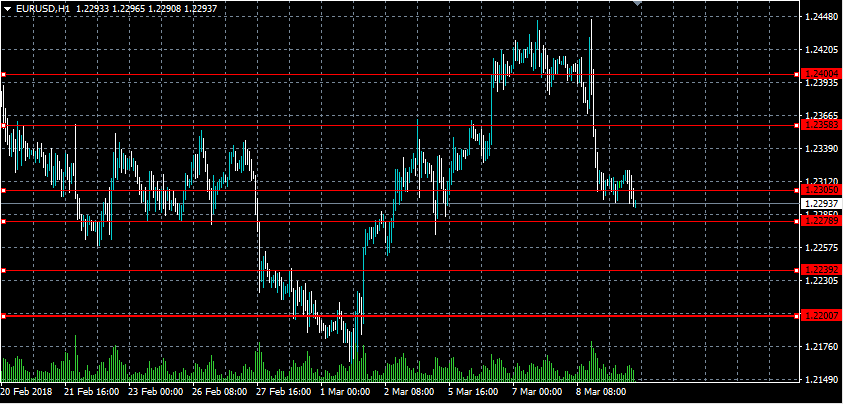
The euro has slipped to fresh daily trading-lows against the greenback during the European trading session, as market participants remains cautious ahead of today’s Non-farm payrolls job report. Bearish momentum is still largely intact in the pair from Thursday, as investors fear a potential Trade War between the EU and U.S economies. The EURUSD risks further intraday losses on a solid U.S Non-farm payrolls job report, with investors focused on the headline figure and U.S wage earnings data.
The EURUSD pair will turn strongly bearish below the 1.2278 level, with further selling towards 1.2239 and 1.220 then likely.
Should the EURUSD pair find bullish momentum above the 1.2305 level, buyers will likely target the 1.2358 and 1.2400 resistance levels.
USDJPY Bullish Recovery Above 106.45 Level
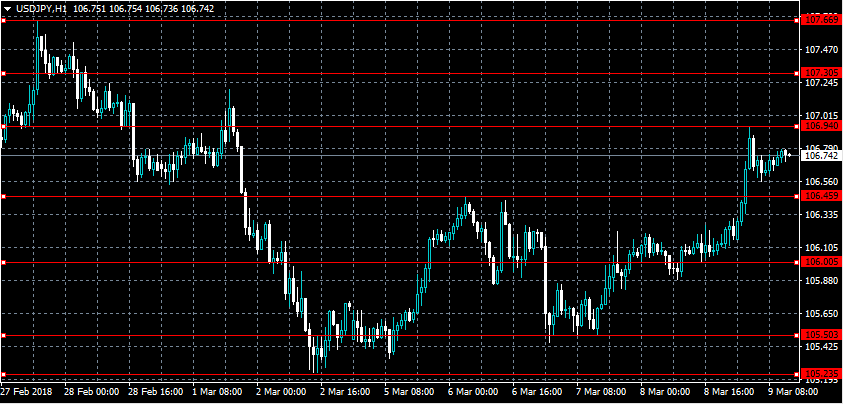
The U.S dollar has surged higher against the Japanese yen currency, hitting 106.94, as the Bank of Japan policy meeting revealed Japanese policy makers commitment to monetary easing. The USDJPY pair currently trades around the 106.70 level, with risk-sentiment buoyant after U.S President Donald Trump agreed to meet North Korean leader Kim Jong-Un. Traders now look to the release of the U.S Non-farm payrolls job report this afternoon, with market participants expecting 200,000 new U.S jobs were creating during the month of February.
The USDJPY pair is likely to see further upside whilst trading above the 106.45 level, further gains towards 107.30 and 107.66 seem possible.
If the USDJPY pair moves below the 106.45 level, a technical correction back towards the 106.00 handle may occur.
BTC: Bearish Momentum Continues
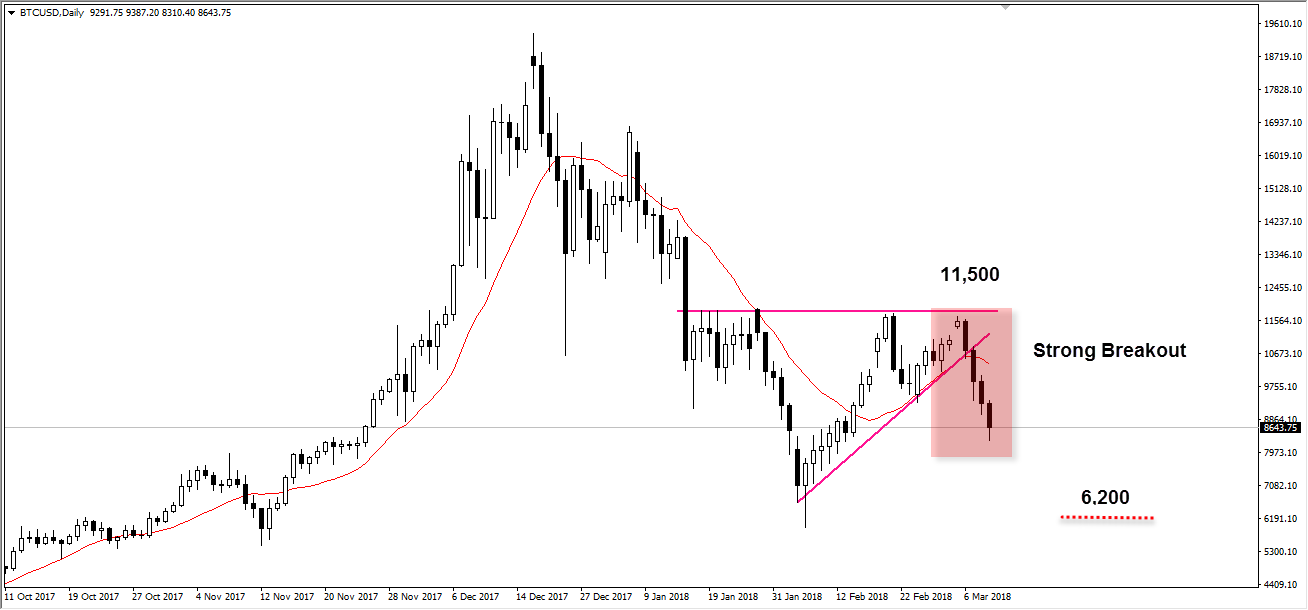
BTC was trading within a ascending triangle, However last Tuesday markets broke this patterns.
As shown on the daily chart bellow for Bitcoin, There high selling pressure and markets targeting the support level (and the bottom) at 6200.
USDJPY Rebound From The Bottom Of The Descending Channel
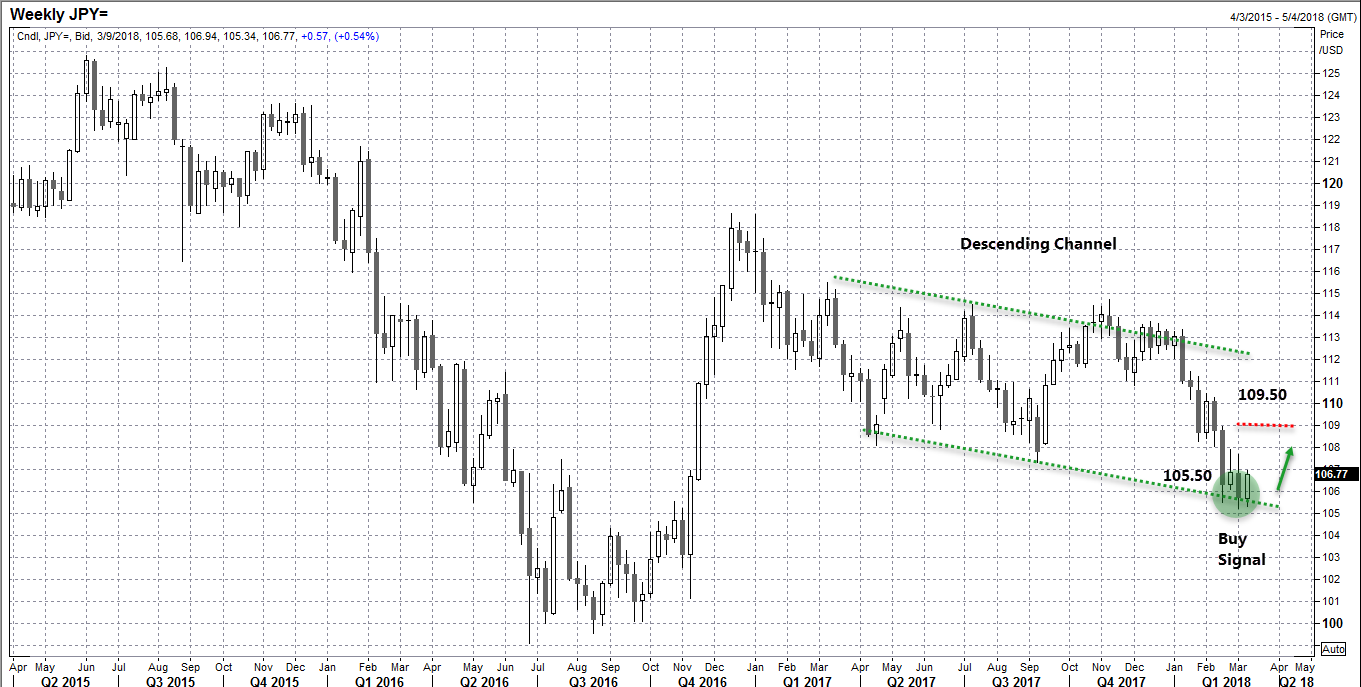
As we can see from the chart below the USDJPY is rebounding from the bottom of the channel with a buying signal.
Targeting 109 is the most possible scenario if the market is trading above 105.50
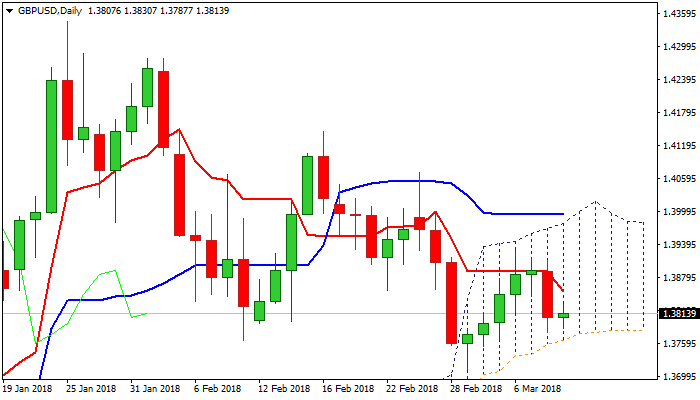
Technical Outlook: GBPUSD – Test Of 100SMA At 1.3580 Or Rally Towards 1.40 Barrier Could Be Likely Post NFP...
Cable showed no reaction on release of batch of weaker than expected UK data on Friday, remaining within previously established narrow consolidation range between 1.3878 and 1.3830, awaiting US jobs report.
Near-term structure remains weak after Thursday’s fall, as recovery attempts were so far capped by broken 55SMA but strong support, provided by base of rising daily cloud (1.3795) keeps the downside protected for now.
Negative daily techs continue to point lower, but direction signals are expected from US data today.
Strong numbers from US labor sector are needed to boost dollar and send pound through cloud base and recent low at 1.3711 towards rising 100SMA at 1.3580.
Bullish scenario on US jobs data miss would send pound higher, with break of 20SMA pivot at 1.3905, to expose psychological 1.40 barrier.
Res: 1.3830, 1.3845, 1.3890, 1.3905
Sup: 1.3780, 1.3765, 1.3711, 1.3660
Forex Analysis: Why Is Bitcoin Falling?
Cryptocurrencies are in decline, falling under pressure following the release of two particularly negative news stories, the first being the revelation that Nobuaki Kobayashi, the Mt. Gox. Trustee, sold off $400 million of Bitcoin and Bitcoin Cash in the last few months. What's most alarming is that he still has at his disposal $1.7 billion worth of Bitcoins.
This news was followed by rumours of a hack of popular crypto exchange Binance in an attempt to influence the price of Viacoin.
The second news story that has affected the price of Bitcoin is the SEC comment regarding cryptocurrency platforms, namely that they shouldn't be called exchanges since this term creates the illusion of regulated activity. “The SEC staff has concerns that many online trading platforms appear to investors as SEC-registered and regulated marketplaces when they are not”, the SEC said.
What's more, the Financial Services Agency (FSA) announced that it is suspending domestic cryptocurrency exchanges, while recently hacked Coincheck has been ordered to improve its risk management.
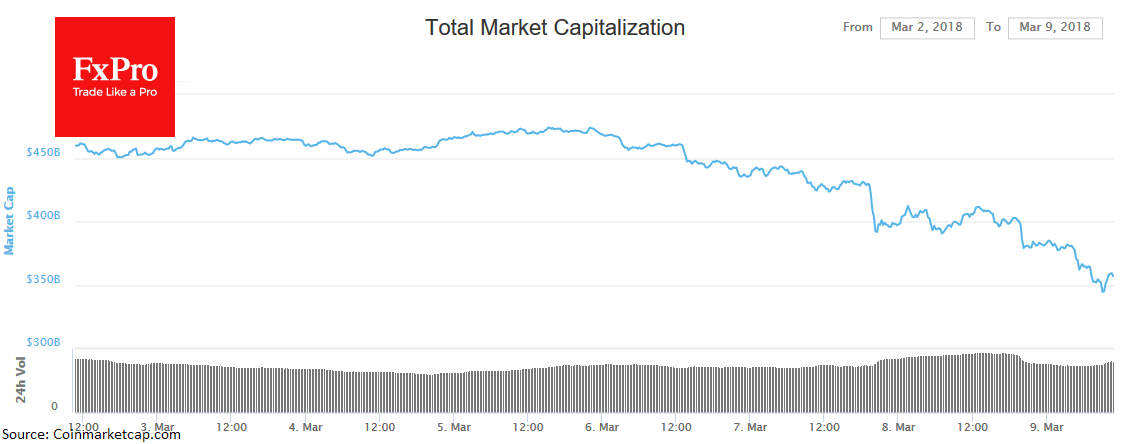
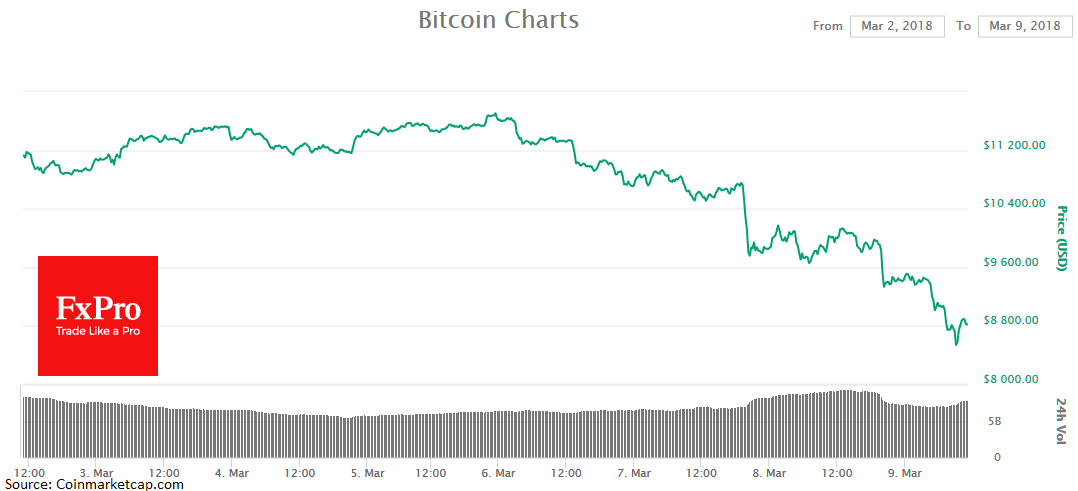
These factors triggered a 11% drop in Bitcoin, with the cryptocurrency falling to $8,800. Major altcoins quickly followed, displaying two-digit decline.
The sheer number of sellers on the crypto market is particularly notable. Yesterday we observed an increase in volume amid falling prices, which might be a sign of increased interest in selling, that often precedes further decline.