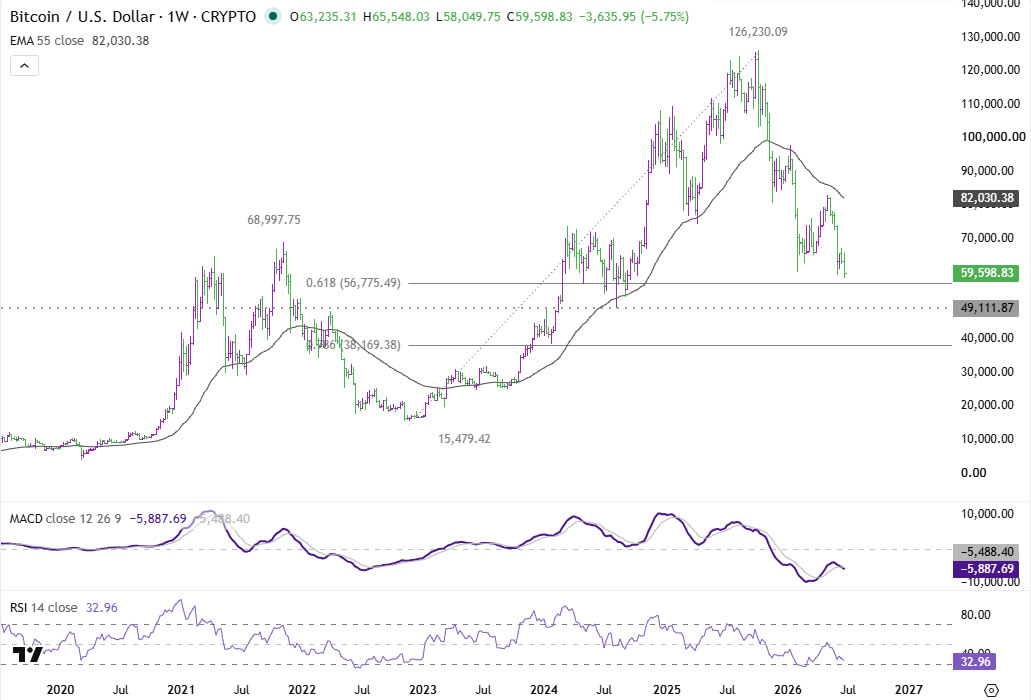
Bitcoin’s brief rebound following Micron’s blockbuster earnings proved remarkably short-lived. While the chipmaker surged more than 15% after issuing massive revenue guidance, the improvement in market sentiment evaporated almost as quickly as it arrived. Bitcoin is once again trading under heavy pressure as it struggles to defend the psychologically important 60,000 level. More importantly, if that support ultimately gives way, the next major downside target could emerge much closer to 40,000 than many investors currently expect.
The rapid fading of the so-called “Micron bump” illustrates that the problem extends well beyond day-to-day swings in risk sentiment. Although Micron itself rallied sharply, the broader technology sector continued to show signs of exhaustion. NASDAQ finished -0.46% lower overnight despite the earnings surprise, while Asian markets resumed their selloff with Nikkei dropping around -4.7% and KOSPI plunging more than -8% at the time of writing. The AI trade that has dominated markets throughout the year is increasingly selective, with investors becoming far less willing to indiscriminately chase high-beta assets.
AI Has Become Crypto’s Biggest Competitor
That presents a unique challenge for Bitcoin because its traditional role within the risk spectrum has fundamentally changed. The cryptocurrency has now lost more than half its value from the October 2025 record high above 126,000. Rather than reflecting a temporary correction, the decline resembles a structural shift driven by institutional portfolio rotation and shrinking speculative liquidity.
In previous market cycles, Bitcoin was often one of the primary destinations whenever investors embraced aggressive risk-taking. That relationship appears to be breaking down. Today’s speculative capital is increasingly flowing toward artificial intelligence instead. Landmark listings such as SpaceX and growing anticipation surrounding future IPOs from OpenAI and Anthropic have created an entirely new destination for high-growth capital. Institutional investors increasingly prefer businesses capable of generating strong earnings, expanding cash flows and dominant competitive positions over non-yielding digital assets. Simply put, AI has replaced crypto as the market’s preferred speculative vehicle.
When Markets Turn Defensive, Bitcoin Doesn’t Benefit Either
Unfortunately for Bitcoin, the opposite market environment offers little relief either. When inflation surprises to the upside—as highlighted by this week’s 4.1% annual PCE inflation reading—and equities come under pressure, Bitcoin has failed to behave like digital gold. Instead, it has traded like a highly leveraged technology stock. The rapid expansion of US spot Bitcoin ETFs has integrated cryptocurrencies much more deeply into institutional portfolio management. During periods of macro stress, systematic investors often reduce exposure to their most volatile holdings first, while capital fleeing risk assets typically seeks refuge in cash, short-duration US Treasuries and traditional safe havens rather than cryptocurrencies. Bitcoin therefore finds itself losing both when risk appetite improves and when it deteriorates—a market with no obvious winning scenario.
The broader liquidity backdrop only compounds the challenge. Bitcoin has historically thrived when abundant global liquidity encouraged speculative investment. Today, the opposite forces are at work. The Federal Reserve is maintaining restrictive monetary policy to combat persistent inflation, shrinking the overall pool of speculative capital available to financial markets. At the same time, the AI revolution is absorbing an outsized share of whatever risk capital remains. With less liquidity overall and AI attracting an increasing proportion of investor flows, Bitcoin is struggling to generate the sustained buying needed to reverse its longer-term decline.
Technical Breakdown Brings $40K Into Focus
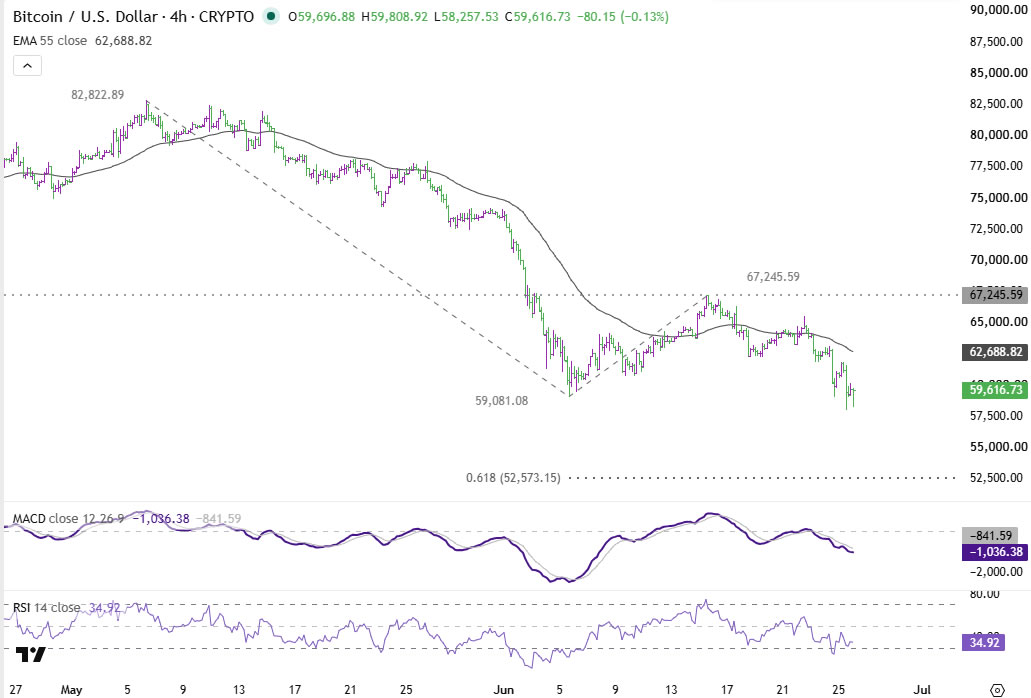
Technically, the outlook has deteriorated further. This week’s break below 59,081 confirmed resumption of the medium-term down trend from the 126,230 record high. As long as 67,245 caps any recovery, downside pressure is expected to persist toward 61.8% projection of 82,822 to 59,081 from 67,245 at 52,573.
More importantly, the decisive break below the long-term at 56,775, 61.8% retracement of 15,479 (2022 low) to 126,230, significantly increases the risk of a move toward the major structural support around 49,111. Should that level also fail, there is considerable room for the decline to extend toward the 40,000 region, with the 78.6% retracement at 38,169 emerging as the next major long-term support capable of producing a more durable bottom.