USD/JPY is once again knocking on the door of Japan’s intervention zone, but this week’s battle is about far more than whether Tokyo steps into the market. It has become a high-stakes game of chicken. Traders believe Japan is reluctant to intervene before Thursday’s US Non-Farm Payrolls report. Japan knows traders believe that. The result is a dangerous window where both sides may be waiting for the other to blink first.
The Ministry of Finance has good reason to stay patient. Launching a massive intervention just days before one of the most important US data releases of the year would be a costly gamble. If Tokyo spent USD 30-40 billion pushing USD/JPY from back below 160.00, only to see payrolls smash expectations and send the Dollar soaring again, those reserves could be wiped out within hours. Worse still, a failed intervention would damage the psychological deterrent that has become one of Japan’s most valuable policy tools.
Japan also has little incentive to fight a market that is still moving in a relatively orderly fashion. Officials have repeatedly stressed that intervention is designed to smooth excessive, one-sided volatility rather than defend a particular exchange rate. A steady climb driven by pre-positioning ahead of payrolls is very different from the kind of disorderly spike that typically justifies official action.
That hesitation is precisely what emboldens Dollar bulls. Hedge funds, carry traders and momentum accounts know Tokyo is unlikely to waste ammunition before such a major macro event. With the Federal Reserve maintaining a policy rate of 3.50%-3.75% after June’s hawkish hold and the Bank of Japan only recently lifting rates to 1.00%, the yield advantage still overwhelmingly favors the Dollar. As long as that interest rate gap exceeds 350 basis points, traders have every incentive to keep testing resistance around 162.00.
Ironically, the most dangerous period for Dollar bulls may begin after the payrolls report rather than before it. If the data simply meets expectations—or even disappoints slightly—the Dollar could begin retreating on its own. That would give Tokyo a far better opportunity to intervene because it would no longer be fighting a powerful macro trend. Instead, officials could use the market’s own momentum against speculative positioning.
Timing could further amplify the impact. With US markets closing for the Independence Day holiday, foreign exchange liquidity is expected to thin sharply. Under those conditions, a routine yen-buying operation that might normally move the market by around 100 pips could instead trigger a violent 400-500 pip slide as stop-loss orders cascade through an empty market. The biggest intervention risk this week may therefore come after payrolls, not before them.
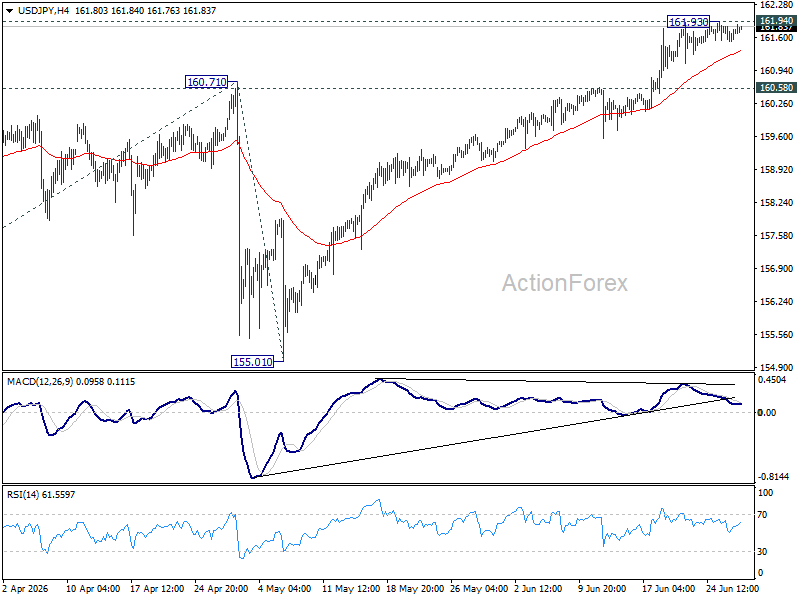
Technically, USD/JPY remains trapped in very tight range below 161.94 (2024’s multi decade high). Further rise remains in favor as long as 160.58 support holds. Firm break of 161.94 will target 100% projection of 152.25 to 160.71 from 155.01 at 163.47 next.
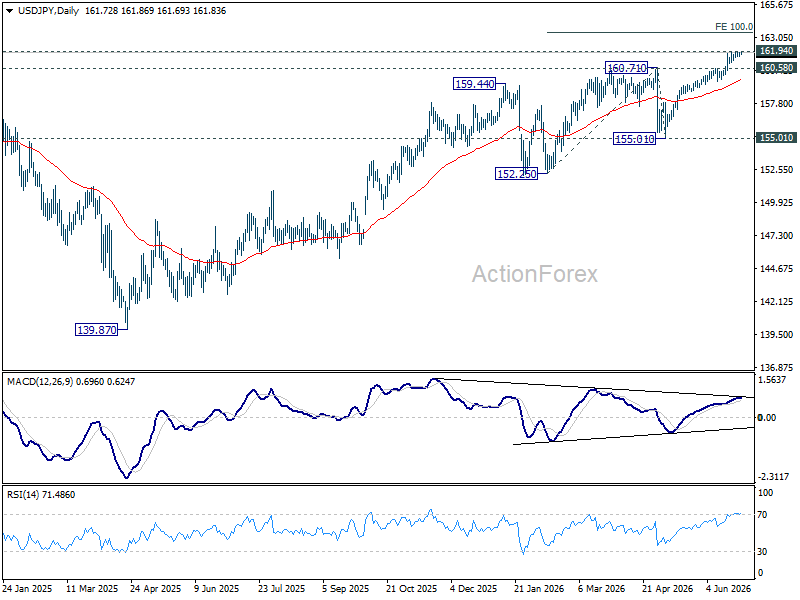
However, firm break of 160.58 should confirm short term topping, and quickly bring USD/JPY below 55 D EMA (now at 159.71)