


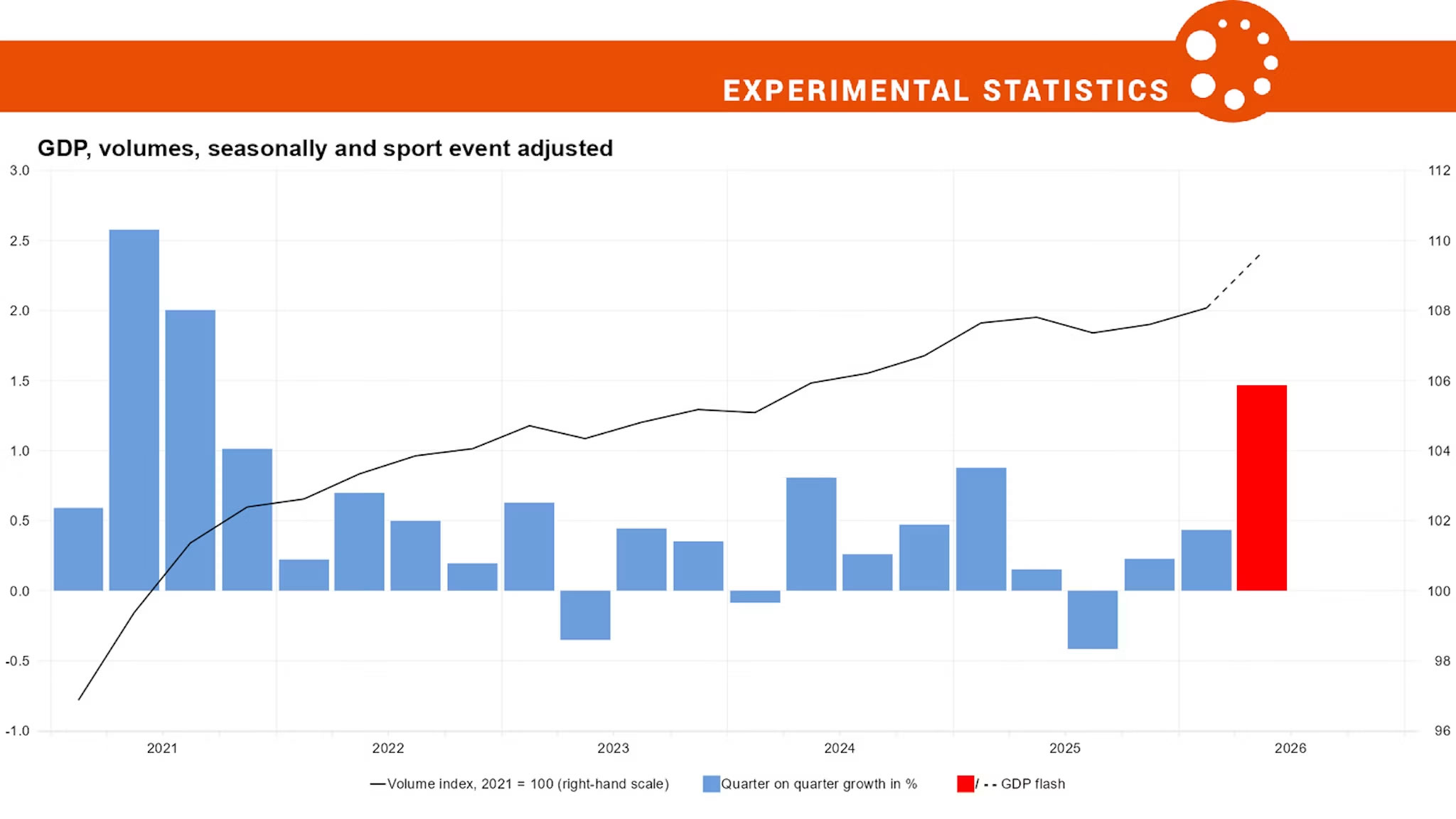
Swiss economy accelerated sharply in Q2, with sport-event-adjusted real GDP growth rising from 0.4% to an estimated 1.5% q/q, according to SECO’s flash estimate. That would mark strongest quarterly expansion since 2021 based on current series. SECO said industrial sector made largest contribution to growth, driven particularly by chemicals and pharmaceuticals, while services also expanded overall.
Strength extends rebound already visible in Q1, when manufacturing grew 1.5% q/q after contracting 3.0% in Q4. But Q2 flash provides no detailed sector breakdown beyond SECO’s broad assessment, so it is too early to judge how widely expansion spread beyond chemicals and pharmaceuticals. Flash estimate is also based partly on estimated inputs and may be revised when full quarterly GDP data are released.
Still, headline result points to considerably stronger Swiss growth momentum than previously evident. A 1.5% quarterly expansion led by industry reduces concern that economy is being materially constrained by current financial conditions and gives SNB less reason to respond to growth weakness. Key question for final release will be whether exceptional industrial contribution was accompanied by broad gains elsewhere or whether Q2 strength was concentrated in a narrow group of export-heavy sectors.
Key Takeaways
- Swiss sport-event-adjusted GDP growth accelerated from 0.4% to an estimated 1.5% q/q in Q2, potentially strongest quarterly expansion since 2021.
- Industry made largest contribution, led especially by chemicals and pharmaceuticals, while services also expanded.
- Q2 strength builds on manufacturing rebound already seen in Q1, when output rose 1.5% after a 3.0% contraction in Q4.
- Flash estimate is based on incomplete early data and may be revised, while detailed sector breakdown is not yet available.
- Headline result points to a much stronger Swiss growth backdrop, reducing concern that economy is being materially constrained by current financial conditions.
- For SNB, stronger growth lowers urgency to respond to economic weakness, though final policy implications depend on whether expansion proves broad based rather than concentrated in pharma-led industry.





