


USD/JPY held around 159.53, with the Japanese yen trading sideways for more than a week. The currency has lost approximately half of the gains made following the joint intervention by Tokyo and Washington at the end of July.
Pressure on the yen persists due to a wide interest rate differential, rising fiscal risks, and elevated energy and import costs.
At the same time, markets are increasingly pricing in a Bank of Japan rate hike in September to support the yen and contain inflation. The yield on 10-year Japanese government bonds climbed to 30-year highs this week, reflecting expectations of near-term policy tightening and concerns over the state of public finances.
Core machinery orders rose 9.7% in June, significantly exceeding forecasts and providing further support for expectations of tighter policy while signalling robust business capital expenditure.
Technical Analysis
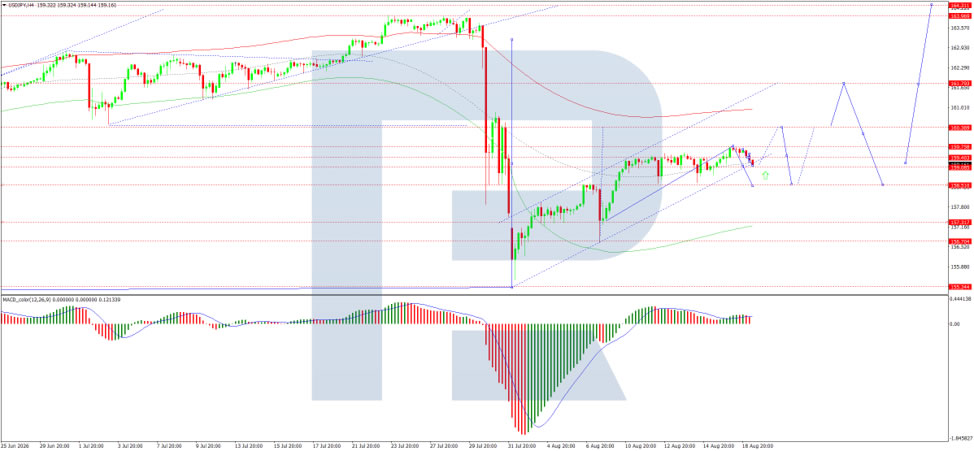
On the H4 USD/JPY chart, the market is forming a consolidation range around the 159.49 level, currently extending down to 159.20. A move higher to 159.49 is expected today, followed by a decline to 159.00. A break below this level would open the way for a correction towards 158.54. The MACD indicator supports this scenario, with its signal line above zero and trending downward.
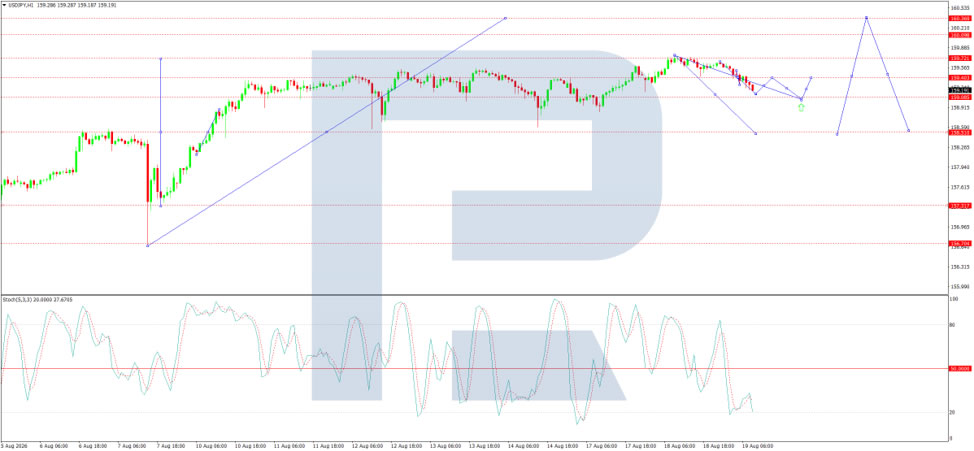
On the H1 chart, USD/JPY has moved up to 159.65. A consolidation range is currently forming below this level. A downside breakout would open the way for a move lower to at least 159.00. The Stochastic oscillator confirms this scenario, with its signal line below 50 and trending downward towards 20, indicating short-term downside pressure.
Conclusion
USD/JPY remains range-bound as the yen struggles to sustain gains from the late-July intervention. The currency has given back roughly half of its post-intervention appreciation, weighed down by persistent fundamental headwinds. However, markets are increasingly pricing in a September rate hike from the Bank of Japan, supported by rising bond yields and stronger-than-expected machinery orders data. Technically, the pair may see a short-term pullback towards 159.00 and potentially 158.54 before its next directional move. The yen’s outlook will depend on Bank of Japan policy signals, US economic data, and the trajectory of energy prices.





