


Eurozone private-sector growth held firm in August, with PMI Composite unchanged at 52.0, matching July’s eight-month high and remaining close to long-run average of 52.3. New orders increased at same solid pace as July, jointly strongest since November, while employment rose for first time this year. Export orders also returned to growth for first time in four-and-a-half years, driven by manufacturing. Regionally, Spain and Italy led expansion, Germany posted its fastest growth since March, while France contracted for an eighth straight month.
Services activity softened only marginally, with PMI Services easing from 51.7 to 51.6, still signaling a second consecutive month of expansion. New business rose solidly on stronger domestic sales, while services export demand slipped slightly. Hiring strengthened further, with job creation accelerating to an eight-month high, even as business expectations moderated. Price pressures also picked up in services, with both input-cost and output-charge inflation rising to three-month highs.
S&P Global’s Joe Hayes said August data put Eurozone on track for “a solid quarter of growth in Q3”, while also highlighting a stalling of the disinflationary trend. With activity holding up and price pressures still elevated compared with levels before Middle East war, Hayes said ECB “may feel a tightening of policy at next week’s meeting is now justified.” That leaves August PMI mix moderately hawkish: growth remains resilient, employment is improving, and disinflation has stopped making further progress.
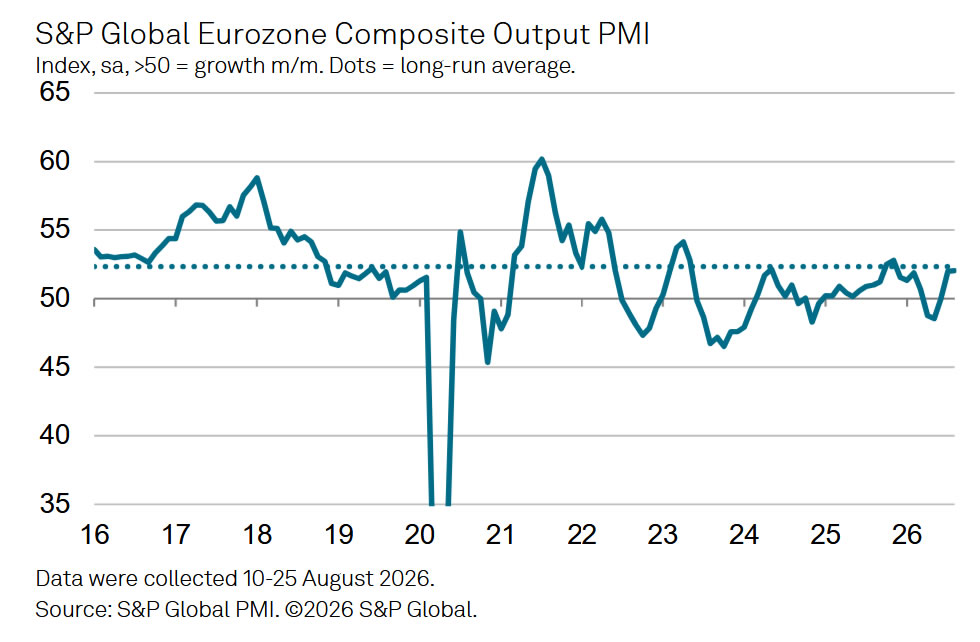
Data Summary
| Indicator | August | July | Trend |
|---|---|---|---|
| PMI Composite | 52.0 | 52.0 | Growth held at eight-month high |
| PMI Services | 51.6 | 51.7 | Expansion eased slightly |
Components
| Component | Trend |
|---|---|
| Composite new orders | Rose at same solid pace as July; joint-strongest since November |
| Composite export orders | Increased for first time in four-and-a-half years |
| Composite employment | Rose for first time in 2026 |
| Composite backlogs | Fell only marginally; weakest reduction since March |
| Composite input prices | Inflation eased fractionally |
| Composite output prices | Inflation unchanged from July |
| Composite business confidence | Steady, above Q2 levels but weak historically |
| Services new business | Solid increase, supported by stronger domestic sales |
| Services export demand | Fell marginally |
| Services employment | Growth accelerated to eight-month high |
| Services backlogs | Reduced slightly |
| Services business expectations | Moderated |
| Services input prices | Inflation rose to three-month high |
| Services output prices | Inflation rose to three-month high |
Key Takeaways
- Eurozone PMI Composite held at 52.0, matching July’s eight-month high and signaling another solid expansion in private-sector activity.
- PMI Services eased only marginally from 51.7 to 51.6, extending services growth for a second straight month.
- New orders remained solid, while employment increased for first time this year.
- Export orders rose across private sector for first time in four-and-a-half years, driven by manufacturing as services export demand weakened slightly.
- Spain and Italy led growth, Germany recorded its fastest expansion since March, while France remained in contraction for an eighth consecutive month.
- Disinflation stalled. Composite output-price inflation was unchanged from July, while services input and output price inflation both rose to three-month highs.
- S&P Global’s Joe Hayes said data point to “a solid quarter of growth in Q3” and that ECB “may feel a tightening of policy at next week’s meeting is now justified.”





