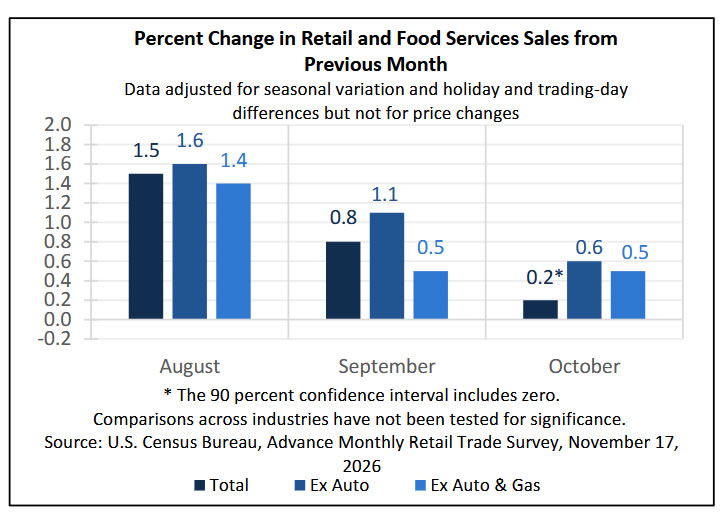
US retail sales growth slowed from 0.8% to 0.2% mom in October, matching market expectations and signaling a moderation in consumer spending momentum. Total retail and food services sales reached USD 748.2B, up 6.8% from a year earlier. However, underlying spending proved firmer than the headline suggested, with sales excluding autos rising 0.6%, above consensus of 0.4%, after a 1.1% increase in September. Sales excluding both autos and gasoline stations also rose 0.5%, matching the previous month’s pace. The Census Bureau noted that the headline monthly increase was not statistically distinguishable from zero at the 90% confidence level, adding caution to the interpretation of October’s modest gain.
Motor vehicle sales were the principal drag, falling 1.6% after a 0.2% decline in September. Weakness also extended to several discretionary categories, with furniture and home furnishings sales dropping 2.3%, clothing and accessories declining 0.7%, and sporting goods, hobbies and books sales falling 0.7%. Food services and drinking places recorded a smaller 0.2% increase, down from 0.9% previously, suggesting more subdued growth in dining expenditure. However, the weakness was not uniform. Nonstore retailers posted another solid 1.2% gain following September’s 1.1% increase, while health and personal care stores and gasoline stations each recorded growth of 1.5%. The contrasting performances highlight uneven spending patterns across retail categories.
Despite the slowdown, October’s figures point to moderating rather than broadly contracting consumer demand. Total sales remained 6.8% above their year-earlier level, while sales over August–October increased 6.4% compared with the same period of 2025. More importantly, the continued 0.5% monthly increase excluding autos and gasoline suggests that underlying spending retained momentum despite weakness in major discretionary categories. Nevertheless, the figures measure nominal sales rather than inflation-adjusted consumption, limiting conclusions about changes in real purchasing activity. Overall, the report suggests that US consumers remain willing to spend, but growth is becoming more selective as strength in nonstore retailing contrasts with softer demand for vehicles, household furnishings and dining services.
Data Summary — US Retail Sales, October 2026
Retail Sales (M/M)
| Indicator | Oct | Exp. | Sep |
|---|---|---|---|
| Retail Sales | 0.2% | 0.2% | 0.8% |
| Retail Sales ex Autos | 0.6% | 0.4% | 1.1% |
| Retail Sales ex Autos and Gas | 0.5% | — | 0.5% |
Selected Retail Categories (M/M)
| Category | Oct | Sep |
|---|---|---|
| Motor Vehicles and Parts | -1.6% | -0.2% |
| Furniture and Home Furnishings | -2.3% | 3.6% |
| Clothing and Accessories | -0.7% | 0.3% |
| Sporting Goods, Hobbies and Books | -0.7% | 0.0% |
| Food Services and Drinking Places | 0.2% | 0.9% |
| Nonstore Retailers | 1.2% | 1.1% |
| Health and Personal Care | 1.5% | 1.0% |
| Gasoline Stations | 1.5% | 6.0% |
Source: US Census Bureau, Advance Monthly Retail Trade Survey, November 17, 2026. September comparisons follow the official Census release.
Key Takeaways
- Headline growth slows, but underlying spending beats forecasts: Retail sales moderated from 0.8% to 0.2% in October, matching expectations, while ex-auto sales rose a stronger-than-expected 0.6%. Sales excluding autos and gasoline maintained 0.5% growth.
- Weakness is concentrated in autos and discretionary categories: Motor vehicle sales contracted 1.6%, furniture sales fell 2.3%, and clothing and sporting goods declined. Meanwhile, nonstore retailers recorded another solid 1.2% increase, highlighting uneven demand.
- Consumer demand moderates without broad contraction: Total retail sales remained 6.8% higher yoy, but the divergent category performance suggests increasingly selective spending. As the figures are nominal, they do not establish equivalent growth in real consumption.