

Live Comments
RBA Accepts Softer Inflation but Still Leaves Scope for One More Hike
RBA accepted that inflation has improved, but refused to turn that improvement into a declaration that rate hikes are finished. Cash rate was left unchanged at 4.35% unanimously, yet Board described policy as only “somewhat restrictive” and explicitly kept another increase on table, saying it could still raise rates “if upside risks materialise.” That is the clearest way to read Tuesday’s decision: softer inflation bought RBA time, not an all-clear.
New forecasts make that tension unusually visible. RBA cut June 2026 headline CPI forecast from 4.8% to 3.9% and December projection from 4.0% to 3.6%. Trimmed mean was lowered from 3.8% to 3.6% for June and from 3.5% to 3.3% for December. But Board did not carry that improvement forward aggressively. June 2027 headline inflation was revised up from 2.4% to 2.8%, with December raised from 2.4% to 2.6%. Trimmed mean was only marginally lowered from 3.1% to 3.0% for June 2027 and stayed at 2.6% for December. In other words, RBA believes current inflation picture is better than feared, but still does not trust disinflation enough to bring target return materially forward.
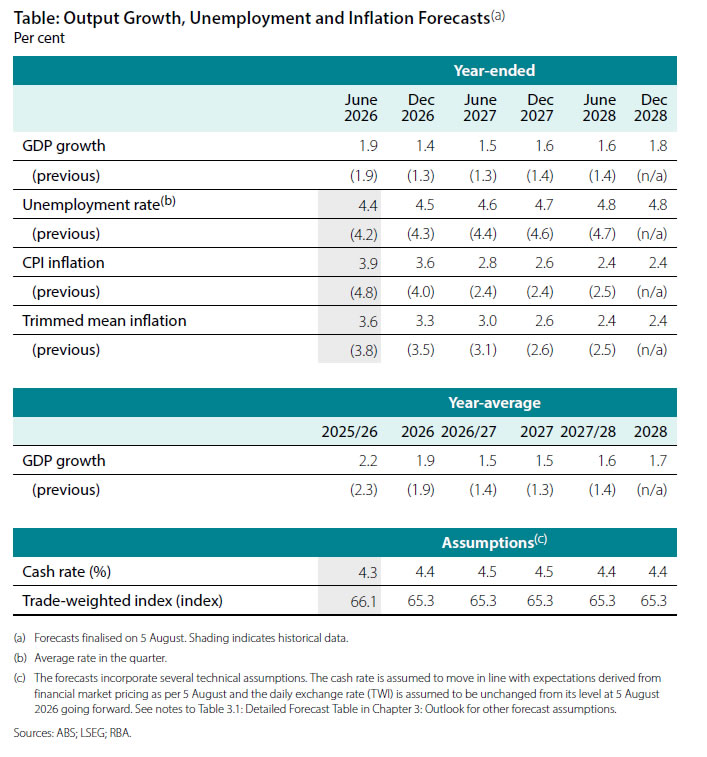
That explains why statement retained a tightening bias despite signs economy is responding. RBA said “headline inflation is still too high”, warned higher oil costs are feeding through to other prices, and noted inflation is not expected to return to around midpoint of target band until late 2027. Yet there is also clear evidence previous hikes are biting: consumer spending is slowing, housing prices have fallen in some capitals, new housing lending has weakened and labour conditions have eased more than expected. Unemployment forecasts were lifted from 4.2% to 4.4% for June 2026 and from 4.3% to 4.5% for December, even as later GDP forecasts were nudged higher.
The technical cash-rate assumption completes picture. RBA projections are built around a market path that rises toward 4.5%, meaning forecast convergence of inflation toward target is not based on 4.35% being held forever. That is a meaningful hawkish signal. RBA is saying current rate is restrictive enough to pause and watch, but not restrictive enough to declare victory.
For markets, that means tightening bias clearly survived Tuesday’s meeting. AUD bulls did not get a fresh hike signal, but AUD bears also did not get confirmation that peak rates are firmly in place.
Summary
RBA Decision
| Item | Decision / View |
|---|---|
| Cash rate | Held at 4.35% |
| Decision | Unanimous |
| Policy stance | “Somewhat restrictive” |
| Inflation assessment | “Still too high” |
| Tightening bias | Further hike possible if upside risks materialise |
| Technical cash-rate assumption | Rises toward 4.5% |
Key Forecast Revisions
| Forecast | August SoMP | Previous |
|---|---|---|
| CPI — Jun 2026 | 3.9% | 4.8% |
| CPI — Dec 2026 | 3.6% | 4.0% |
| CPI — Jun 2027 | 2.8% | 2.4% |
| CPI — Dec 2027 | 2.6% | 2.4% |
| Trimmed mean — Jun 2026 | 3.6% | 3.8% |
| Trimmed mean — Dec 2026 | 3.3% | 3.5% |
| Trimmed mean — Jun 2027 | 3.0% | 3.1% |
| Trimmed mean — Dec 2027 | 2.6% | 2.6% |
| Unemployment — Jun 2026 | 4.4% | 4.2% |
| Unemployment — Dec 2026 | 4.5% | 4.3% |
| Unemployment — Jun 2027 | 4.6% | 4.4% |
Key Takeaways
- RBA unanimously held cash rate at 4.35%, but tightening bias clearly survived.
- Board accepted softer near-term inflation, cutting June 2026 CPI forecast from 4.8% to 3.9% and trimmed mean from 3.8% to 3.6%.
- However, RBA did not translate softer inflation into a substantially faster return to target. June 2027 headline CPI was actually revised from 2.4% to 2.8%.
- Policy was described as only “somewhat restrictive”, rather than sufficiently restrictive, while Board explicitly retained option of raising rates again if upside risks materialise.
- Technical forecast assumption has cash rate moving toward 4.5%, reinforcing that projected disinflation is not based on 4.35% being held indefinitely.
- Labour outlook weakened, with unemployment forecasts raised across near-term horizon, confirming previous tightening is already slowing economy.
- Overall message is a hawkish hold: RBA accepted better inflation data but is not yet prepared to declare tightening cycle finished.
Fed’s Hammack Sees Multiple Hikes, Says Current Rates Aren’t Restrictive Enough
Cleveland Fed President Beth Hammack made one of clearest cases yet for renewed tightening, saying in a Yahoo Finance interview on Monday, that more than one rate hike may ultimately be needed to return inflation to target. Hammack, who dissented from July decision to hold rates at 3.50–3.75% in favor of a 25bp increase, argued that a single move would have limited impact. “One 25 basis point move probably doesn’t do a whole lot for the economy,” she said, adding that “it’s probably some number of [movements],” although she would not prejudge how many or where rates would ultimately peak.
Her argument rests partly on view that current policy is not restrictive enough. Hammack said she does not believe rates at 3.50–3.75% are “meaningfully restricting” economy, noting that businesses are not reporting restraint on investment or growth because of borrowing costs. “So to me that says that now is the time to act,” she said. Hammack compared gradual tightening with pumping brakes before reaching a stop sign rather than waiting to slam them on later, warning that delaying action would leave inflation above 2% for longer and risk making eventual disinflation more costly.
Importantly, July’s weak employment report has not shifted her focus away from inflation. Despite payrolls contracting -23K, Hammack pointed to unemployment at 4.1%, around her estimate of full employment, and said, “I’m still not seeing a problem” in labor market. She was similarly skeptical that inflation will return to target without additional policy restraint: “From where I sit, I just don’t see it coming back on its own.” That puts Wednesday’s July CPI in sharper focus. Core CPI slowed from 2.6% in June and is expected to ease to 2.5% in July; a meaningful downside surprise would challenge Hammack’s assessment, while sticky or stronger inflation would reinforce her case for multiple hikes.
Hammack also pushed back against idea that higher market yields can substitute for Fed action. “Markets are a complement for the Fed. They’re not a substitute,” she said, adding that policymakers must “stand behind our words with our actions when appropriate.” On communication, she argued credibility comes not from extensive forward guidance but from explaining Fed’s reaction function and commitment to 2% inflation. Her remarks underline growing divide ahead of September: weak employment has raised hurdle for another hike, but hawks such as Hammack argue inflation still requires not merely one additional move, but potentially a renewed tightening sequence.
Key Takeaways
- Cleveland Fed President Beth Hammack said more than one rate hike will likely be needed, arguing that “one 25 basis point move probably doesn’t do a whole lot for the economy.”
- Hammack does not view current 3.50–3.75% policy rate as “meaningfully restricting” activity and said “now is the time to act.”
- She remains focused on inflation despite July payrolls falling 23K, saying unemployment at 4.1% is around full employment and “I’m still not seeing a problem” with labor market.
- Hammack also rejected idea that inflation will return to target without further restraint: “From where I sit, I just don’t see it coming back on its own.”
- Her remarks make Wednesday’s July CPI an important test. Softer core inflation would weaken case for renewed tightening, while sticky inflation would strengthen hawkish argument.
- She stressed that “markets are a complement for the Fed. They’re not a substitute,” pushing back against idea that higher bond yields can replace Fed action.
- Comments reinforce widening policy split: weak labor data have raised hurdle for another hike, but some officials still see inflation as requiring a multi-step tightening response.
Eurozone Sentix Confidence Turns Positive, but Inflation Concerns Return
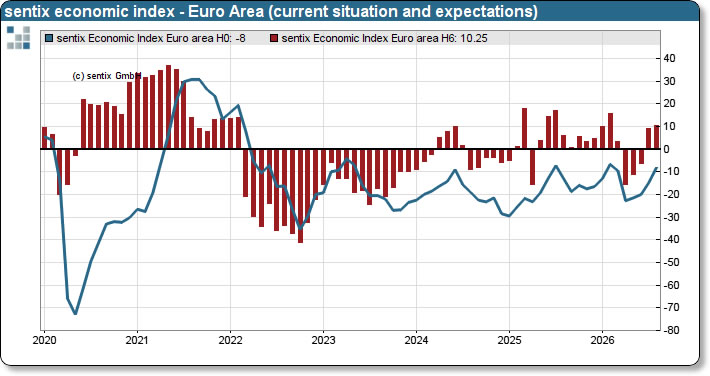
Eurozone investor confidence improved for a fourth straight month in August, reinforcing signs that sentiment is recovering alongside firmer economic data. Sentix Overall Index rose from -3.1 to 0.9, beating expectations of -1.3 and reaching highest level since February. Current Situation improved from -14.8 to -8.0, while Expectations edged up from 9.3 to 10.3. Sentix linked improvement to stronger-than-expected Q2 growth, recovering industrial production and confidence indicators, rising investment and government spending, as well as partial absorption of confidence shock from Iran war. Still, high energy costs and subdued order books continue to constrain recovery.
Improving growth picture is being accompanied by renewed inflation concern. Sentix Inflation Barometer deteriorated sharply from -13.75 to -29.25, indicating investors are again becoming more worried about price pressures after previous month’s improvement, although concern remains below extremes seen during height of Iran conflict. ECB Policy Barometer likewise fell from -8.25 to -15.25, showing markets expect a more restrictive policy environment. Combination of stronger activity and renewed inflation risks therefore argues against an early monetary-policy “all-clear.”
Germany showed a similar but more fragile improvement. Sentix Overall Index rose for a third month from -19.4 to -11.9, while Current Situation jumped from -39.8 to -28.3 and Expectations improved from 3.5 to 6.0. Recent 0.2% Q2 growth and firmer ifo confidence support stabilization case, but deeply negative current-condition reading shows underlying economy is still weak.
For ECB, broader message is two-sided: growth fears are easing just as inflation concerns are rebuilding, reducing urgency for a more accommodative policy turn.
Data Summary
Euro Area Sentix Investor Confidence
| Component | Current | Previous | Trend |
|---|---|---|---|
| Overall Index | 0.9 | -3.1 | Improved |
| Current Situation | -8.0 | -14.8 | Improved |
| Expectations | 10.3 | 9.3 | Improved |
Germany Sentix Investor Confidence
| Component | Current | Previous | Trend |
|---|---|---|---|
| Overall Index | -11.9 | -19.4 | Improved |
| Current Situation | -28.3 | -39.8 | Improved |
| Expectations | 6.0 | 3.5 | Improved |
Key Takeaways
- Eurozone Sentix Overall Index improved from -3.1 to 0.9 in August, marking a fourth consecutive monthly rise and highest level since February.
- Current Situation also strengthened from -14.8 to -8.0, while Expectations edged higher from 9.3 to 10.3, showing recovery is becoming broader but still led by forward-looking optimism.
- Sentix cited stronger Q2 growth, improving industrial production and confidence indicators, rising investment and government spending, and partial absorption of Iran-war confidence shock.
- Inflation concerns resurfaced sharply, with Sentix Inflation Barometer falling from -13.75 to -29.25, while Central Bank Policy Barometer weakened from -8.25 to -15.25.
- That combination of better growth and renewed inflation concern argues against an early monetary-policy “all-clear” from ECB.
- Germany also improved for a third consecutive month, but Current Situation at -28.3 still points to weak underlying conditions despite better expectations.