Eurozone Sentix Investor Confidence rose to -8.7, negative momentum weakening

    Eurozone Sentix Investor Confidence increased from -11.1 to -8.7 in April, surpassing the expected -14.0. The Current Situation index experienced its sixth consecutive rise, moving from -9.3 to -4.3, reaching its highest level since March 2022. The Expectations index, however, remained unchanged at -13.0.

    Sentix commented on the data, stating, “There is no doubt that the Eurozone economy has come through the winter months better than many feared in the autumn.” However, when considering the future, investors are less optimistic, citing “still considerable uncertainty about the further course of the Ukraine war, concerns about a lasting burden on the energy-intensive industrial sector, and – new – question marks about the state of the US economy.”

    Despite these concerns, the Sentix Theme Barometer indicates that negative expectations regarding inflation and central bank policy have noticeably decreased. While not an all-clear signal, the negative momentum seems to be weakening.

    Full Eurozone Sentix release here.

    China PPI slowed to 8.8% yoy in Feb, CPI unchanged at 0.9% yoy

      China PPI slowed from 9.1% yoy to 8.8% yoy in February, above expectation of 0.8% yoy. Senior National Bureau of Statistics statistician Dong Lijuan said, PPI was “affected by the increased commodity prices globally such as crude oil and non-ferrous metals”.

      CPI was unchanged at 0.9% yoy, above expectation of 0.8% yoy. affected by the Chinese New Year holiday and the fluctuation of international energy prices, CPI saw a bigger month on month increase,” added Dong after CPI rose by 0.6 per cent month on month.

      UK retail sales dropped -0.6%, all sectors contracted

        In November, UK retail sales came in at -0.6% mom, 1.0% yoy, well below expectation of 0.5% mom, 2.4% yoy. Retail sales ex-fuel came in at -0.6% mom, 0.8% yoy, also well below expectation of 0.3% mom, 1.6% yoy. Total retail sales for the three months to November dropped -0.4% over the previous three months.

        All sectors contributed negatively to the month-on-month figures. With fuel contributed -0.1%, non-store retailing -0.2%, non-food stores -0.1%, food stores -0.2%.

        Full release here.

        US initial jobless claims surged to 253, highest since Sep 2017

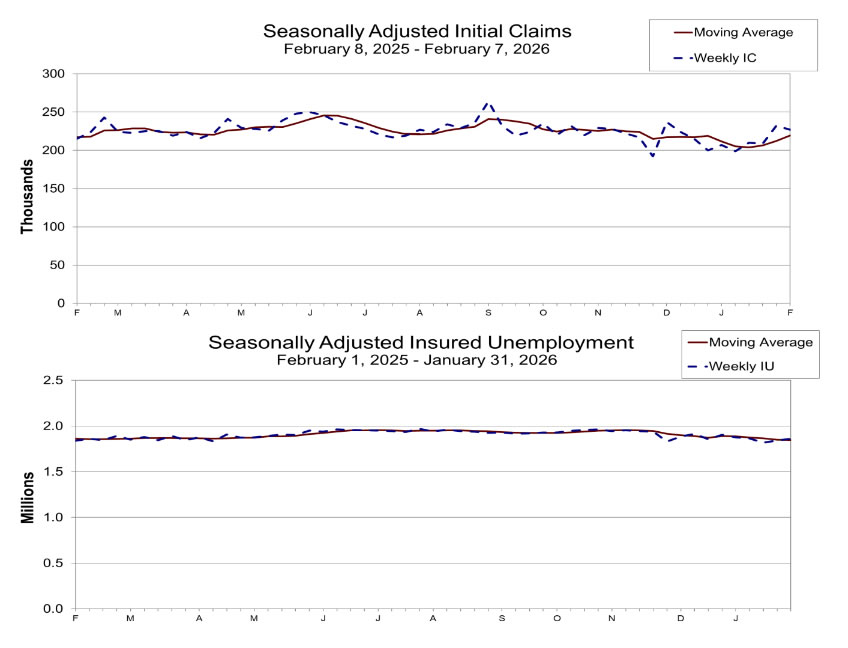
          US initial jobless claims surged 49k to 253k in the week ending December 7, well above expectation of 211k. That’s also the highest level since September 30, 2017. Four-week moving average of initial claims rose 6.25k to 224k.

          Continuing claims dropped -31k to 1.667m in the week ending November 30. Four-week moving average of continuing claims dropped -6.25k to 1.676m.

          PPI came in at 0.0% mom, 1.1% yoy in November, below expectation of 0.2% mom, 1.2% yoy. Core PPI was at -0.2% mom, 1.3% yoy, below expectation of 0.2% mom, 1.6% yoy.

          St. Louis Fed Bullard hearing full-throated angst about trade disputes

            St. Louis Fed President James Bullard said he’s “hearing full-throated angst” regarding escalating trade disputes across his district. He added that “all aspects of the economy are affected, but agriculture is certainly” being hit.

            He pointed to some suppliers using threat of new tariffs to raise prices, even though their businesses are not directly targeted. And to Bullard, “that shows you how uncertainty over trade policy can feed back” into business decision-making.”

            Japan’s industrial production falls -0.9% mom in April, but May rebound expected

              Japan’s industrial production fell by -0.9% mom in April, a milder decline than the expected -1.4%. The Ministry of Economy, Trade and Industry maintained its view that production “fluctuates indecisively,” reflecting ongoing uncertainty, particularly around global trade developments.

              While the ministry said the impact of US tariffs was limited in April, some firms have voiced concern about the manufacturing outlook as policy risks persist.

              The breakdown of the data shows a mixed picture: six of 15 industrial sectors saw declines, including production machinery, fabricated metals, and transport equipment excluding motor vehicles. However, eight sectors recorded gains, with electronic parts and business-oriented machinery showing notable strength.

              Manufacturers surveyed expect a sharp 9.0% rebound in May, followed by a -3.4% dip in June.

              Also released, Japan’s retail sales grew by a stronger-than-expected 3.3% yoy in April, outpacing the consensus of 2.9% yoy. Meanwhile, the unemployment rate remained steady at 2.5%.

              UK Lidington: Services must diverge from EU after Brexit

                UK Cabinet Office Minister David Lidington, Prime Minister Theresa May’s effective second-in-command, said the services industry must diverge from EU rules after Brexit.

                He said that “the reason why we are proposing to treat services differently is because it is in services where regulatory flexibility matters most for both current and future trading opportunities.”

                And, “while the EU acquis on goods has been stable for about 30 years, the EU acquis on services has not been and the risk of unwelcome EU measures coming into play through the acquis on services is much greater.”

                Separealy, European Commission Vice President Valdis Dombrovskis said “overall, even after Brexit, the performance of existing obligations can generally continue.” Therefore, existing financial contracts are unlikely to be affected.

                DIHK: Germany to see little real growth this year

                  Germany’s DIHK Chambers of Industry and Commerce said that the country’s economy would growth 0.7% in 2020, slightly higher than 0.6% in 2019. However, it also pointed out that around 0.5% of growth is due to “statistical effects” such as the overhang from the previous year and four additional working days this year. Hence,  CEO Martin Wansleben said “that is why we currently see little real growth.”

                  He added: “It is worrying: A whole host of data, particularly from industry, suggest that structural challenges, such as e-mobility, digitization, the energy turnaround and further the shortage of skilled workers, are adding to the current economic downturn. Some regions are particularly affected.”

                  Full release here.

                  Trump confirms there is no agricultural purchase from China yet

                    Trump complains with his tweet that China is “letting us down” for not buying agricultural products from the US yet. But he added “hopefully they will start soon”. Separately, White House economic adviser Larry Kudlow also said today that he expected China to start purchasing farm products soon.

                    It’s unsure how “soon” China will start the purchase. But comments from both Trump and Kudlow confirmed that the purchase hasn’t even started yet even though trade teams on both sides have resumed communications.

                    It’s reported earlier that China is linking the purchases to lift of Huawei’s sanctions. That is, if China won’t start the purchases if Xi is unhappy with how the restrictions in supplying US tech products to Huawei are removed. It seems that the communications between the trade team haven’t enter into something of substance yet.

                    Twitter

                    By loading the tweet, you agree to Twitter’s privacy policy.
                    Learn more

                    Load tweet

                    US initial jobless claims dropped to 375k, above expectation

                      US initial jobless claims dropped -12k to 375k in the week ending August 7, above expectation of 367k. Four-week moving average of initial claims rose 1.75k to 396k.

                      Continuing claims dropped -114k to 2866k in the week ending July 31, lowest since March 14, 2020. Four-week moving average of continuing claims dropped -100k to 3101k, lowest since March 21, 2020.

                      Full release here.

                      German PMI services revised up to 54.4, renewed vigour at the end of Q2

                        Germany PMI services was revised up to 54.4 in June, from initial estimate of 53.9. It’s also notably better than May’s reading at 52.1 and hit a 4-month high.

                        Commenting on the final PMI® survey data, Phil Smith, Principal Economist at IHS Markit said:

                        “The service sector showed renewed vigour at the end of the second quarter, with the final PMI data indicating an even stronger rebound in business activity growth than was signalled by the earlier ‘flash’ estimate.

                        “June’s increase in activity in the largely domestically-focussed service sector was the steepest seen since February and strong enough to offset a further loss of momentum across manufacturing, where slowing global trade has weighed on growth.

                        “There was more good news for the German labour market in June as the rate of service sector employment growth picked up to the fastest since January. An expanding workforce base represents another factor supporting household spending, alongside upward wage pressures and still-elevated consumer confidence.”

                        Full Germany PMI services release.

                        US Q3 GDP growth revised slightly up to 2.1% annualized

                          According to the second estimate, US real GDP grew at annualized rate of 2.1% in Q3, comparing to Q2’s 6.7%. The upward revision from advance estimate of 2.0% primarily reflects upward revisions to personal consumption expenditures (PCE) and private inventory investment.

                          Full release here.

                          ECB Knot: Normalization the appropriate response with dominant worry in inflation

                            ECB Governing Council member Klaas Knot said, “At this point, the dominant worry is inflation. That is why normalization of policy, the withdrawal of stimulus is the appropriate policy response.”

                            He expected the asset purchases to end by the end of the year. “That means September should be available (for a rate hike),” Knot said. “Not that I expect rates will have to go up in September.”

                            “A rate hike in the fourth quarter to me still is a realistic expectation… but by no means a certainty, he added.

                            Bank of Spain slashes 2019 growth forecasts to 2% on weak investment and consumption

                              Bank of Spain lowered 2019 growth forecasts to 2.0%, sharply lower than June’s projection of 2.4%. For 2020, growth projection was downgraded to 1.7%, from 1.9%. For 2021, growth forecast was also downgraded to 1.6%, from 1.7%. Weaker investment and private consumption were the main factor for the downgrades.

                              Meanwhile, the central bank also noted risks including European slowdown, Brexit, US-China trade tension as well as domestic political uncertainties. Spain is going to have the fourth parliamentary elections in four years on November 10.

                              Oscar Arce, the Bank of Spain’s director general for economics, statistics and research said, “Also worth mentioning as a possible risk element is the continuation of uncertainty on the domestic front about the course of main economic policies in this country in the future.”

                              Japan PPI rose record 9.3% yoy in Feb, led by energy and commodities

                                Japan corporate goods price index rose 9.3% yoy in February, above expectation of 8.7% yoy. At 110.7, the index hit the highest level marked since 1985. That’s also the highest rise on record, as led by skyrocketing energy prices. Coal and petroleum prices jumped 34.2% yoy. Electricity, city gas and water prices also surged 27.5% yoy.

                                Commodity prices also surged with iron and steel up 24.5% yoy. Nonferrous metal rose 24.9% yoy. Lumber and wood products rose 58.0% yoy.

                                Import prices rose 34.0% yoy while export prices rose 12.7% yoy.

                                WTI oil breaks 70, focus shits to 63/67 support zone

                                  WTI crude oil fell sharply overnight, breaking 70 psychological level for the first time since June. Further decline is expected in the short-term from technical perspective. But 63/67 support zone is expected to provide a floor to contain this downtrend.

                                  This selloff is driven by several key factors. The primary concern is demand destruction in the fuel market, underscored by EIA reporting a larger-than-expected increase in US gasoline inventories. Additionally, persistent worries about China’s economic health are adding to the bearish sentiment in the oil market. This concern is exacerbated by Moody’s downgrade of China’s A1 rating outlook from stable to negative. Market skepticism regarding the effectiveness of OPEC+’s production cuts also plays a role.

                                  Technically, WTI’s strong break of 72.65 support confirms resumption of the fall from 95.50. Further decline is expected as long as 74.23 resistance holds. Break of 61.8% projection of 91.07 to 72.65 from 79.77 at 68.38 is envisaged.

                                  Strong support is expected from 63.67/66.94 zone to contain downside to complete the five wave sequence from 95.50, and bring sustainable rebound. Even if 63.67 is breached, 100% projection at 61.35 should provide the floor, preventing further substantial drops in oil price.

                                  World Bank downgrades 2020 global growth forecast to 2.5% as downside risks predominate

                                    In its January 2020 Global Economic Prospects report, World Bank forecasts global growth to pick up by 0.1% to 2.5% as “investment and trade gradually recover from last year’s significant weakness”. Even so, that was a -0.2% downgrade from June’s projection of 2.7%. Growth in US is expected slow from 2.3% to 1.8% (revised down by -0.2%). Eurozone growth is projected to slow from 1.1% to 1.0% (revised down by -0.1%). Japan’s growth is estimated to slow from 1.1% to 0.7% (revised up from 0.3%). China’s growth is projected to slow from 6.1% to 5.9% (revised down by -0.1%).

                                    World Bank also warned: “Downside risks to the global outlook predominate, and their materialization could slow growth substantially. These risks include a re-escalation of trade tensions and trade policy uncertainty, a sharper-than expected downturn in major economies, and financial turmoil in emerging market and developing economies. Even if the recovery in emerging and developing economy growth takes place as expected, per capita growth would remain well below long-term averages and well below levels necessary to achieve poverty alleviation goals.”

                                    US PPI up 0.3% mom, 0.9% yoy in Jan

                                      US PPI rose 0.3% mom in January above expectation of 0.1% mom. PPI goods declined -0.2% mom while PPI services rose 0.6% mom. PPI less foods, energy, and trade services rose 0.6% mom, the largest advance since January 2023.

                                      For the 12-month period, PPI slowed from 1.0% yoy to 0.9% yoy, above expectation of 0.7% yoy. PPI less foods, energy, and trade services was unchanged at 2.6% yoy.

                                      Full US PPI release here.

                                      Gold breaks key resistance as up trend resumes finally

                                        Gold finally resumes recent up trend by breaking through 1346.71 resistance decisively and reaches as high as 1358.16 so far. Further rise should now be seen to 61.8% projection of 1160.17 to 1346.71 from 1266.26 at 1381.54 next. And in any case, near term outlook will remain bullish as long as 1319.95 support holds, in case of retreat.

                                        More importantly, upside re-acceleration is seen in weekly MACD after drawing support from 55 week EMA. The development is rather medium term bullish. Rise from 1160.17 could indeed be resuming whole rise from 1046.37 (2015 low) as consolidation from 1375.17 completed with three waves to 1160.17. That is, we’d likely see decisive break of 38.2% retracement of 1920.70 (2011 high) to 1046.37 (2015 low) at 1380.36 finally. In that case, further rise should be seen to 61.8% retracement at 1586.70 in medium to long term.

                                        Australia AiG services dropped to 48.8, two-speed pattern to gather pace

                                          Australia AiG Performance of Services Index dropped -0.4 to 48.8 in June. Looking at some details, sales plummeted by -8.8 to 41.9. Employment surged 7.9 to 55.3. New orders ticked down by -0.8 to 58.9. Input prices rose 0.3 to 69.0. Selling prices rose 5.3 to 67.2. Averages jumped 10.3 to 67.7.

                                          Innes Willox, Chief Executive Ai Group, said: “With interest rates rising for the first time in a decade, we have seen a ‘two-speed’ services sector emerge in June. Industries which are sensitive to sentiment changes – such as business & property, and personal & recreational services – declined into contraction. Less interest-rate-exposed services remained in a growth phase. With the RBA increasing rates by 50 basis points again this week, we would expect this two-speed pattern to gather pace.”

                                          Full release here.