

Live Comments
UK PMI Services Strengthen in August, but Manufacturing Momentum Fades
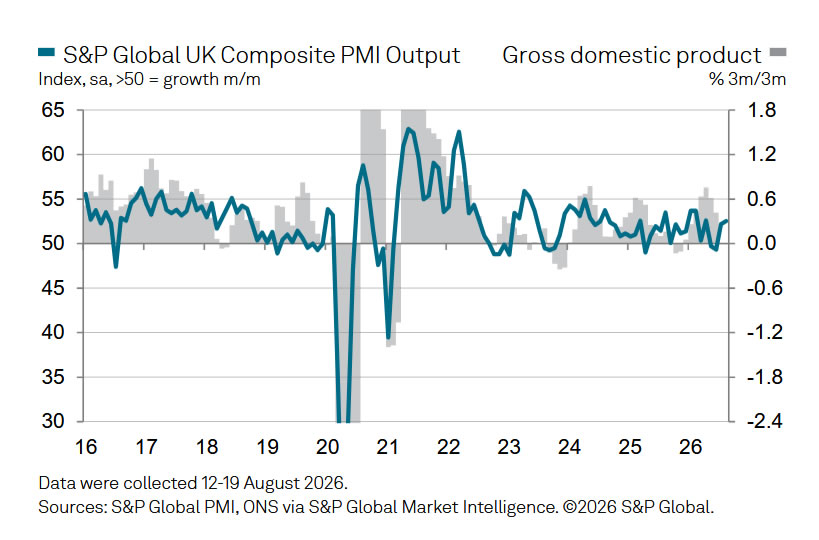
UK private-sector growth strengthened modestly in August, with PMI Composite Output rising from 52.2 to 52.5, a four-month high. PMI Services Business Activity improved from 52.1 to 52.8, reaching a six-month high and providing the main lift. Manufacturing moved the other way. PMI Manufacturing eased from 51.9 to 51.5, while PMI Manufacturing Output fell from 52.9 to 51.2, both five-month lows.
S&P Global said sunny weather and technology investment supported activity, while manufacturing lost some momentum as precautionary stock building faded. Business confidence improved to its strongest since Middle East war began, and job losses moderated. But cost pressures remained elevated, driven by energy prices, supply-chain disruption and high staffing costs. S&P Global estimated the survey was consistent with around 0.3% q/q GDP growth in Q3.
For BoE, August PMI points to resilient growth but an uncomfortable inflation backdrop. Stronger services activity reduces urgency to support economy, while persistent cost pressure argues against an early dovish turn. S&P Global said Bank is likely to retain a hawkish bias but stay cautious, holding off on further hikes until growth and inflation signals become clearer.
Data Summary
| Component | Current | Previous | Trend |
|---|---|---|---|
| PMI Composite Output | 52.5 | 52.2 | 4-month high |
| PMI Services Business Activity | 52.8 | 52.1 | 6-month high |
| PMI Manufacturing | 51.5 | 51.9 | 5-month low |
| PMI Manufacturing Output | 51.2 | 52.9 | 5-month low |
Key Takeaways
- UK PMI Composite Output rose from 52.2 to 52.5 in August, reaching a four-month high.
- PMI Services Business Activity strengthened from 52.1 to 52.8, a six-month high and main driver of faster overall growth.
- Manufacturing lost momentum. PMI Manufacturing fell from 51.9 to 51.5, while PMI Manufacturing Output dropped from 52.9 to 51.2.
- S&P Global said sunny weather and technology investment supported activity. Earlier precautionary stock building in manufacturing started to fade.
- Business confidence improved to its strongest level since Middle East war began, while job losses became less severe.
- Cost pressures remained high due to energy prices, Middle East-related supply disruption and staffing costs.
- Survey was consistent with around 0.3% q/q GDP growth in Q3.
- For BoE, resilient growth and elevated costs support a hawkish bias, but softer manufacturing and lingering uncertainty argue for patience before another hike.
Eurozone PMI Composite Hits Nine-Month High, Reinforces ECB Hawkish Bias
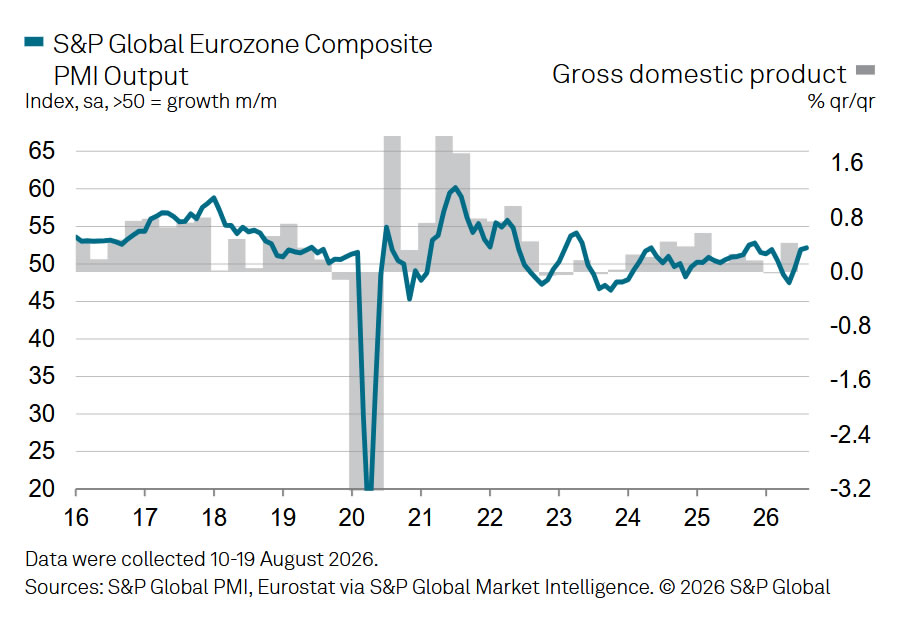
Eurozone private-sector growth strengthened slightly in August, with PMI Composite Output edging from 52.0 to 52.1, its highest in nine months. PMI Manufacturing rose more clearly from 51.9 to 52.8, while PMI Manufacturing Output increased from 52.9 to 53.4, marking its strongest expansion in four-and-a-half years. PMI Services Business Activity was unchanged at 51.7, keeping services in moderate expansion. S&P Global said the readings were consistent with roughly 0.3% q/q GDP growth in Q3.
Manufacturing was the standout, helped by precautionary inventory building amid Middle East supply disruptions and stronger demand for AI-related technology and defence equipment. Germany benefited particularly strongly: PMI Manufacturing rose from 52.2 to 54.1, while PMI Manufacturing Output jumped from 54.7 to 56.7, a 55-month high. But services remained weak, falling from 49.8 to 48.5. France showed a similar split in reverse form: PMI Manufacturing improved from 49.8 to 51.5, but PMI Services fell from 49.6 to 48.4, pulling PMI Composite Output down from 49.4 to 48.8.
Growth outside France and Germany was firmer, with tourism helping services activity across rest of region expand at its fastest pace in more than three years. There were also encouraging signs from employment, with companies returning to hiring for first time this year. Price pressures moved in a more favorable direction. Services selling-price inflation eased to joint-lowest pace this year, while goods-price inflation moderated further.
For ECB, August PMIs reinforce a relatively hawkish growth-inflation mix. Activity is expanding at a solid pace, manufacturing momentum is strengthening, and hiring has resumed. Easing selling-price pressures are welcome, but inflation remains elevated by historical standards. S&P Global concluded that a hawkish bias is likely to be maintained, with further near-term rate hikes still possible if stronger activity prevents inflation from cooling sufficiently.
Data Summary
| Component | Current | Previous | Trend |
|---|---|---|---|
| Eurozone PMI Composite Output | 52.1 | 52.0 | 9-month high |
| Eurozone PMI Services Business Activity | 51.7 | 51.7 | Growth unchanged |
| Eurozone PMI Manufacturing | 52.8 | 51.9 | 51-month high |
| Eurozone PMI Manufacturing Output | 53.4 | 52.9 | 54-month high |
| Germany PMI Composite Output | 51.0 | 51.3 | Growth eased |
| Germany PMI Services Business Activity | 48.5 | 49.8 | Deeper contraction |
| Germany PMI Manufacturing | 54.1 | 52.2 | 51-month high |
| Germany PMI Manufacturing Output | 56.7 | 54.7 | 55-month high |
| France PMI Composite Output | 48.8 | 49.4 | 2-month low |
| France PMI Services Business Activity | 48.4 | 49.6 | 2-month low |
| France PMI Manufacturing | 51.5 | 49.8 | Returned to expansion |
| France PMI Manufacturing Output | 50.7 | 48.5 | 4-month high |
Key Takeaways
- Eurozone PMI Composite Output edged from 52.0 to 52.1 in August, reaching a nine-month high and signaling continued solid private-sector expansion.
- Manufacturing was main driver. PMI Manufacturing rose from 51.9 to 52.8, while PMI Manufacturing Output climbed from 52.9 to 53.4, strongest in four-and-a-half years.
- PMI Services Business Activity held at 51.7, keeping services in expansion without further acceleration.
- S&P Global said survey was consistent with around 0.3% q/q GDP growth in Q3.
- Germany showed a sharp sector split. Manufacturing strengthened strongly, but services fell deeper into contraction at 48.5.
- France remained weak overall, with PMI Composite Output dropping to 48.8 and services at 48.4, even as manufacturing returned to expansion.
- Growth outside France and Germany was stronger, with tourism helping services activity reach its fastest pace in more than three years.
- Employment improved, with firms adding staff for first time this year.
- Price pressures eased, particularly in services selling prices, but inflation remained elevated by historical standards.
- For ECB, resilient growth, stronger manufacturing and renewed hiring reinforce a hawkish bias, even as softer selling-price inflation provides some relief.
UK Retail Sales Fall -0.5% in July, but Three-Month Trend Stays Positive
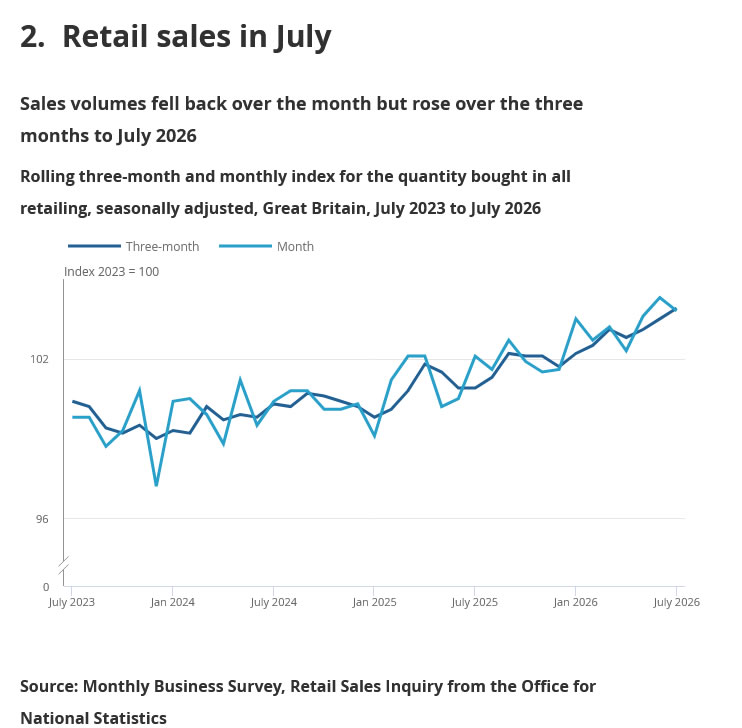
UK retail sales volumes fell -0.5% m/m in July, matching expectations, after June growth was revised down from 1.0% to 0.7%. May was revised slightly higher to 1.3%. On an annual basis, sales growth slowed from a revised 3.8% to 1.6%, missing expectations for 2.2%. Despite July’s setback, volumes were still up 1.1% in the three months to July compared with the previous three-month period.
Weakness was concentrated in non-food categories. Non-food store sales fell 1.3%, with clothing, household goods and department stores all softer. Retailers said earlier promotions had pulled some demand forward into June, while hot weather reduced footfall and weighed on demand for certain products. Non-store retailing also fell back after a promotion-heavy June, although volumes remained above May levels. Food stores provided some offset, helped by hot weather and World Cup-related demand for supermarket goods, alcoholic drinks and beverages.
Overall, July looks more like a payback after a strong June than a sharp deterioration in consumer spending. Sales volumes remained at their second-highest level since April 2022, while the positive three-month trend suggests underlying consumption is still holding up despite weaker monthly momentum.
Data Summary
| Indicator | Actual | Expected | Previous |
|---|---|---|---|
| Retail Sales m/m | -0.5% | -0.5% | +0.7% |
| Retail Sales y/y | +1.6% | +2.2% | +3.8% |
| Retail Sales, 3m/3m | +1.1% | — | — |
| Non-Food Store Sales m/m | -1.3% | — | — |
June monthly growth was revised from +1.0% to +0.7%. June annual growth was revised from +4.2% to +3.8%.
Key Takeaways
- UK retail sales volumes fell 0.5% m/m in July, matching expectations after June growth was revised down to 0.7%.
- Annual growth slowed from a revised 3.8% to 1.6%, missing expectations for 2.2%.
- Broader trend remained firmer than monthly headline. Sales volumes rose 1.1% over three months to July compared with previous three months.
- Non-food store volumes fell 1.3%, with weakness in clothing, household goods and department stores.
- Earlier promotions brought some spending forward into June, making July decline partly a timing effect rather than clear deterioration in demand.
- Hot weather also weighed on clothing footfall and some furniture demand.
- Food-store volumes rose, helped by hot weather and World Cup-related spending.
- Total retail volumes remained at their second-highest level since April 2022, supporting view that July was a pullback after strong May and June rather than start of a sharp consumer downturn.