

Live Comments
US PCE Inflation Holds at 3.7%, Core Stays at 3.3%
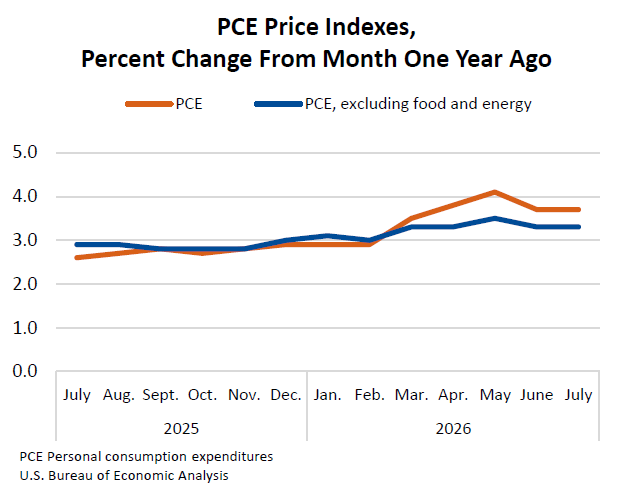
US inflation stayed sticky in July while household income and spending both came in stronger than expected. Headline PCE Price Index rose 0.2% m/m, up from -0.1% in June and above 0.1% consensus, while annual rate held at 3.7%, slightly above 3.6% expected. Core PCE increased 0.2% m/m, up from 0.1%, while annual core inflation was unchanged at 3.3%, both exactly in line with expectations.
Household data were firmer. Personal income growth accelerated from 0.2% to 0.4% m/m, twice 0.2% consensus, while personal spending slowed from 0.3% to 0.2% but still beat 0.1% expected. Combination suggests consumers retained some spending power even as inflation continued to run well above Fed’s 2% objective.
For Fed, report offers little evidence that underlying inflation is breaking higher, with core readings matching forecasts, but neither does it provide much additional disinflation comfort. Slightly hotter headline inflation and stronger income and spending point to resilient demand alongside persistent price pressure. That keeps focus on whether upcoming data reinforce case for maintaining current policy stance or revive debate over further tightening.
Data Summary
| Indicator | Actual | Expected | Previous |
|---|---|---|---|
| Personal Income m/m | +0.4% | +0.2% | +0.2% |
| Personal Spending m/m | +0.2% | +0.1% | +0.3% |
| PCE Price Index m/m | +0.2% | +0.1% | -0.1% |
| PCE Price Index y/y | 3.7% | 3.6% | 3.7% |
| Core PCE Price Index m/m | +0.2% | +0.2% | +0.1% |
| Core PCE Price Index y/y | 3.3% | 3.3% | 3.3% |
Key Takeaways
- Headline PCE inflation accelerated from -0.1% to +0.2% m/m, slightly above 0.1% consensus.
- Annual headline PCE held at 3.7%, also a touch firmer than 3.6% expected.
- Core PCE rose from 0.1% to 0.2% m/m, while annual core inflation stayed at 3.3%. Both matched forecasts.
- Personal income growth strengthened from 0.2% to 0.4% m/m, doubling consensus.
- Personal spending slowed from 0.3% to 0.2%, but still beat expectations for 0.1%.
- Overall report points to persistent inflation alongside resilient household demand, rather than a fresh core inflation shock.
- For Fed, core inflation offered little reason for immediate hawkish repricing, but stronger income, spending and slightly firmer headline prices also provided limited disinflation relief.
ECB’s Schnabel Sees Inflation Above 2% for Extended Period, Backs More Tightening
ECB Executive Board member Isabel Schnabel said further tightening will be necessary as energy-driven inflation risks persist and euro area economy stays resilient. In an interview with Bloomberg News published Wednesday, Aug. 26, Schnabel said, “At the current policy rate, inflation is unlikely to return to target over the medium term, and therefore further tightening will be necessary.” Her remarks reinforce expectations for another ECB move after June’s rate increase and go beyond simply keeping September hike on table.
Schnabel also warned that inflation is likely to stay above 2% for an “extended period” because of elevated energy costs. She argued that waiting for those pressures to feed fully into wages would risk leaving policymakers “behind the curve.” That language points to a pre-emptive reaction function: ECB does not need to wait for second-round effects to become entrenched before tightening further.
While Schnabel did not specify how many additional hikes may be required, she said markets “seem to understand our reaction function very well.” Her message therefore supports a hawkish near-term bias without committing ECB to a predetermined path beyond the next move. September remains the obvious focus, but Schnabel’s argument is broader: current rate setting is not yet sufficient to bring inflation sustainably back to target.
Key Takeaways
- ECB Executive Board member Isabel Schnabel said “further tightening will be necessary” because inflation is unlikely to return to target over medium term at current policy rate.
- She expects inflation to remain above 2% for an “extended period”, largely because of elevated energy costs.
- Schnabel warned that waiting until higher energy prices feed into wages could leave ECB “behind the curve.”
- Her comments point to a pre-emptive policy stance, with ECB willing to act before second-round inflation effects are fully visible.
- Schnabel did not specify how many additional hikes may be needed, preserving flexibility beyond next move.
- She said markets “seem to understand our reaction function very well,” suggesting current pricing broadly reflects ECB’s policy framework.
- September remains immediate focus, but Schnabel’s argument is broader: current rate setting is not yet sufficient in her view.
Australia CPI Eases to 3.5%, but Sticky Trimmed Mean Keeps September RBA Hike Live
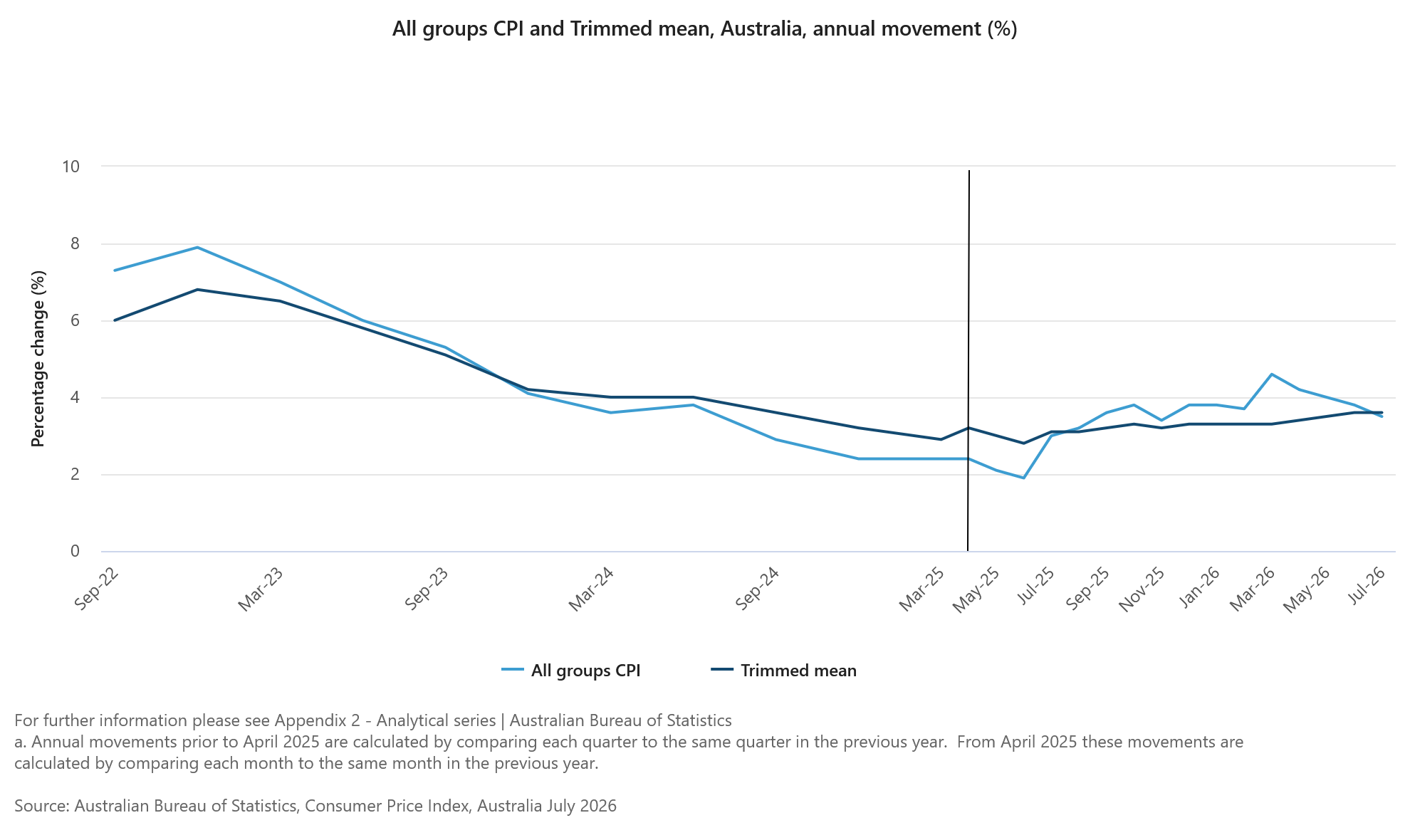
Australia’s headline CPI eased from 3.8% to 3.5% y/y in July, but still came in above 3.2% consensus. Monthly CPI rose 1.0% m/m, after a -0.1% decline in June, also slightly above 0.9% expected. More importantly for RBA, Trimmed Mean CPI held at 3.6% y/y, above 3.5% consensus, while monthly trimmed mean accelerated from 0.3% m/m to 0.5%, against expectations for another 0.3% increase.
Inflation pressure was not confined to one category. Housing was the largest annual contributor, rising 5.0% y/y, with new dwelling prices up 5.7% as builders passed through higher material and labour costs. Food and non-alcoholic beverages rose 3.2%, including a 4.5% increase in meals out and takeaway, while recreation and culture gained 2.6%. Transport inflation accelerated sharply from 0.1% to 1.6% y/y, with automotive fuel jumping 7.5% m/m as world oil prices rose and part of federal fuel-excise relief was unwound.
For RBA, sticky underlying inflation is the more important signal than decline in headline rate. Minutes released a day earlier showed Board explicitly considered whether it might be appropriate to tighten “pre-emptively” if upside inflation risks strengthened, while several members saw further tightening as “quite possible.” July data now give that camp fresh evidence: headline inflation is easing, but trimmed mean has stopped improving and monthly underlying momentum has strengthened. That keeps September meeting firmly live.
Data Summary
| Indicator | July | Expected | June |
|---|---|---|---|
| CPI y/y | 3.5% | 3.2% | 3.8% |
| CPI m/m, original | +1.0% | +0.9% | -0.1% |
| Trimmed Mean CPI y/y | 3.6% | 3.5% | 3.6% |
| Trimmed Mean CPI m/m | +0.5% | +0.3% | +0.3% |
Key Takeaways
- Australia headline CPI eased from 3.8% to 3.5% y/y in July, but still exceeded 3.2% consensus.
- More important for RBA, Trimmed Mean CPI stayed at 3.6% y/y and monthly trimmed mean accelerated from 0.3% to 0.5%, above 0.3% expected.
- Housing remained largest annual contributor at 5.0%, with new dwelling prices up 5.7% as builders passed through higher labour and material costs.
- Transport inflation accelerated from 0.1% to 1.6% y/y, while automotive fuel jumped 7.5% m/m on higher global oil prices and partial unwinding of fuel-excise relief.
- Report reinforces concern that underlying inflation is not cooling as quickly as headline rate suggests.
- Combined with RBA’s recent discussion of pre-emptive tightening and explicit focus on monthly inflation data, July CPI keeps September meeting firmly live.
Full Australia CPI release here.