

Live Comments
Fed’s Warsh Didn’t Signal a Hike—But Almost Everything Else Sounded Hawkish
Fed Chair Kevin Warsh stopped short of signaling a September rate hike at Jackson Hole on Friday, but his assessment of economy left little comfort for doves. Warsh said Fed’s 2% PCE inflation objective is a “firm, fixed target” and stressed that price stability is “not self-executing.” With labor market still consistent with full employment and inflation running well above target, his conclusion was direct: “The Fed’s predominant focus right now should be on prices.”
Warsh also questioned whether current 3.50–3.75% policy rate is imposing much restraint at all. He pointed to rapid capital spending, strong corporate profits, tight credit spreads, healthy issuance and relatively easy bank lending standards, concluding: “I would be hard pressed to describe broad financial conditions as restrictive.” Labor market offered little counterweight, with unemployment at 4.1%, jobless claims near multi-decade lows on a four-week average and employment conditions, in his assessment, “consistent with full employment.” That combination—resilient activity, little visible financial restraint and sticky inflation—leans naturally toward further tightening even without an explicit rate call.
Inflation discussion was equally hawkish. Warsh acknowledged summer CPI and PCE readings had been better than expected, but said they “do not tell me that underlying trends have meaningfully improved.” More than half of PCE components rose faster than 3% over past year, while six-month breadth remained elevated. His policy standard was therefore demanding: “We must be confident that underlying inflation is moving to our objective, clearly and at sufficient speed. Otherwise, we have work to do.” Medium-term inflation expectations remain anchored, but Warsh warned that such expectations “tend to look strong and durable until they don’t.”
What markets did not get was timing. Warsh used speech to reject routine forward guidance, arguing it can constrain Fed’s ability to react when circumstances change and saying quasi-commitments on rates can “inhibit our own freedom to make the right calls.” His closing line captured deliberate ambiguity: “I stand here today committed to a discipline, not to a decision.” So September remains open rather than endorsed. Yet underlying message was difficult to call neutral: inflation is too high, economy is resilient, financial conditions are not restrictive, and recent disinflation has not been sufficient. Warsh refused to promise a hike, but he gave markets several reasons to keep one firmly in play.
Key Takeaways
- Warsh did not signal a September hike, but his economic assessment leaned clearly hawkish.
- He called Fed’s 2% inflation objective a “firm, fixed target” and said “The Fed’s predominant focus right now should be on prices.”
- Warsh said recent softer inflation readings “do not tell me that underlying trends have meaningfully improved.”
- He argued financial conditions are not meaningfully restrictive, saying he would be “hard pressed to describe broad financial conditions as restrictive.”
- Labor market remains broadly consistent with full employment, reducing pressure on Fed to prioritize jobs over inflation.
- Warsh said underlying inflation must move toward 2% “clearly and at sufficient speed” or “we have work to do.”
- He deliberately rejected routine forward guidance, warning that it can constrain future decisions.
- His closing line — “committed to a discipline, not to a decision” — leaves September open but keeps tightening bias intact.
- Overall message: hawkish diagnosis, no timing commitment.
Eurozone Economic Sentiment Beats Forecasts as Services and Hiring Outlook Strengthen
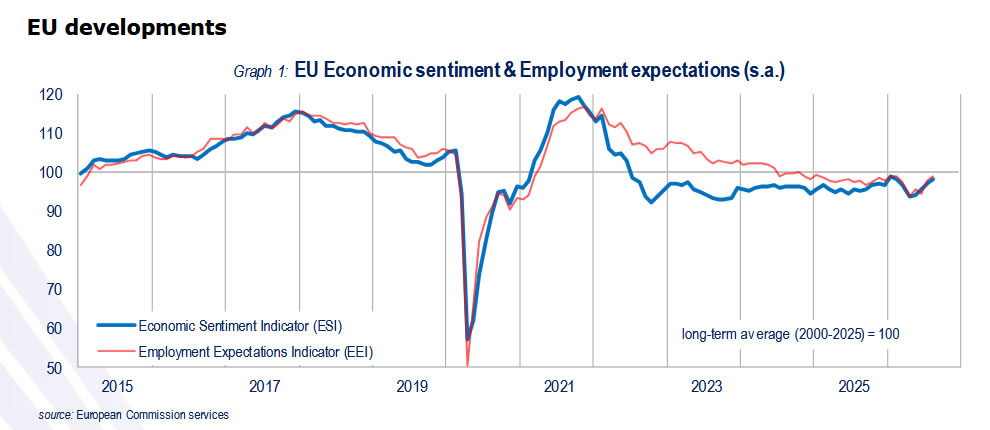
Eurozone Economic Sentiment Indicator rose from a revised 97.1 to 98.4 in August, beating 97.5 consensus and moving closer to its long-term average of 100. Employment Expectations strengthened more sharply from 97.4 to 98.9. Eurozone Services Confidence increased from 5.1 to 5.8, Industry Confidence improved from -6.1 to -5.3, Retail Trade Confidence from -6.8 to -5.7, and Construction Confidence from -5.2 to -5.0. Consumer Confidence edged up from -15.9 to -15.5.
Broader EU picture was similarly constructive, with ESI rising from 97.2 to 98.2 and Employment Expectations from 97.8 to 99.0. Commission said improvement was driven by stronger confidence in industry, services and retail trade, while construction and consumer sentiment were broadly stable. Services recorded broad-based gains across past business conditions, past demand and expected demand, while stronger hiring plans in industry and services lifted employment outlook. Economic uncertainty also fell for a fourth straight month to 17.2, although consumer price expectations rose markedly.
Performance across major economies was uneven but tilted positively. Sentiment improved most in France by 2.3 points, followed by Germany at 1.3 and Italy at 0.8. Netherlands was broadly unchanged at -0.1, while Poland fell 0.5 points and Spain dropped 2.2. Overall, August survey suggests confidence recovery is becoming broader across Eurozone and EU, with services and employment expectations providing clearest support, even as industrial orders, household spending intentions and some country-level readings remain less convincing.
Data Summary
| Indicator | Previous | Latest | Consensus |
|---|---|---|---|
| Eurozone Economic Sentiment Indicator | 97.1 | 98.4 | 97.5 |
| Eurozone Employment Expectations Indicator | 97.4 | 98.9 | — |
| Eurozone Industry Confidence | -6.1 | -5.3 | -5.2 |
| Eurozone Services Confidence | 5.1 | 5.8 | 4.9 |
| Eurozone Consumer Confidence | -15.9 | -15.5 | -15.5 |
| Eurozone Retail Trade Confidence | -6.8 | -5.7 | — |
| Eurozone Construction Confidence | -5.2 | -5.0 | — |
| Eurozone Economic Uncertainty | 18.6 | 18.0 | — |
| EU Economic Sentiment Indicator | 97.2 | 98.2 | — |
| EU Employment Expectations Indicator | 97.8 | 99.0 | — |
| EU Economic Uncertainty | 17.7 | 17.2 | — |
Major-Economy Sentiment Changes
| Economy | Monthly Change |
|---|---|
| France | +2.3 pts |
| Germany | +1.3 pts |
| Italy | +0.8 pts |
| Netherlands | -0.1 pts |
| Poland | -0.5 pts |
| Spain | -2.2 pts |
Key Takeaways
- Eurozone Economic Sentiment rose from a revised 97.1 to 98.4, beating 97.5 consensus and moving closer to long-term average of 100.
- Employment Expectations strengthened from 97.4 to 98.9, showing a notable improvement in hiring outlook.
- Services Confidence increased from 5.1 to 5.8, comfortably beating 4.9 consensus.
- Industry, retail and construction sentiment also improved, while Consumer Confidence edged higher only modestly.
- EU-wide ESI rose from 97.2 to 98.2, with improvement driven by industry, services and retail trade.
- EU service-sector managers became more positive on past business conditions, past demand and expected demand.
- Economic Uncertainty declined again in both Eurozone and EU, adding to evidence that business conditions are becoming less fragile.
- Country performance remained uneven: France, Germany and Italy improved, while Spain posted a notable 2.2-point decline.
- Overall, August survey points to a broader recovery in business confidence and employment expectations, while household sentiment and parts of industrial demand remain less convincing.
Swiss KOF Barometer Jumps to 106.7 as Manufacturing and Foreign Demand Strengthen
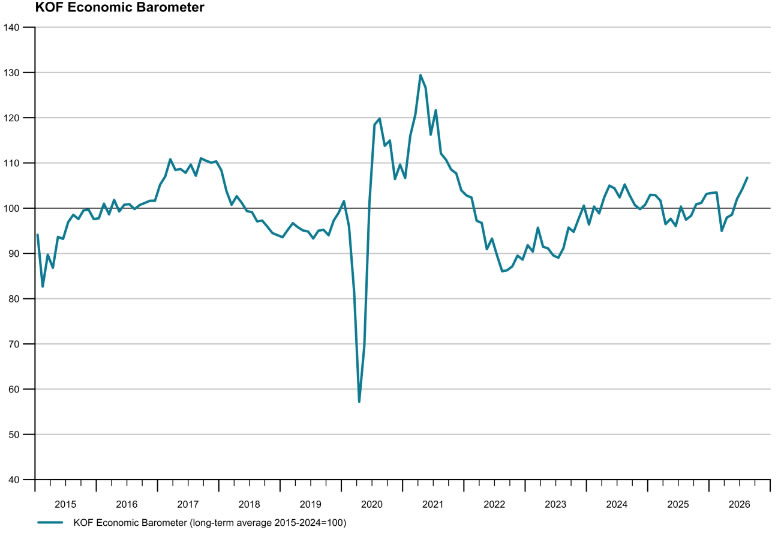
Switzerland’s KOF Economic Barometer rose from a revised 104.2 to 106.7 in August, comfortably above 103.0 consensus and extending its run of monthly gains. The index now stands clearly above its medium-term average of 100, with KOF saying the outlook for the Swiss economy remains positive.
Improvement was led by manufacturing, other services and foreign demand, while private consumption remained the main weak spot and was described as “slightly under pressure.” Within manufacturing and construction, most indicator bundles improved, particularly those for intermediate-goods inventories, employment prospects, production activity and order backlogs. Metal and textile industries also strengthened, while paper and printing weakened.
The broader trend is increasingly constructive, with KOF Barometer recovering from 95.0 in March to 106.7 in August. That suggests Swiss activity momentum has improved materially over recent months, supported by both domestic production indicators and external demand, even as household consumption continues to lag behind the wider recovery.
Data Summary
| Indicator | Latest | Consensus | Previous |
|---|---|---|---|
| KOF Economic Barometer | 106.7 | 103.0 | 104.2 |
Main Drivers
| Area | August Signal |
|---|---|
| Manufacturing | Stronger |
| Other Services | Stronger |
| Foreign Demand | Stronger |
| Private Consumption | Slightly weaker |
| Employment Prospects | Improved |
| Production Activity | Improved |
| Order Backlogs | Improved |
| Intermediate-Goods Inventories | Improved |
| Metal Industry | Improved |
| Textile Industry | Improved |
| Paper & Printing | Weaker |
Key Takeaways
- Swiss KOF Economic Barometer rose from a revised 104.2 to 106.7, beating 103.0 consensus.
- Index moved further above its long-term average of 100, pointing to stronger-than-normal economic momentum.
- Improvement was led by manufacturing, other services and foreign demand.
- Producing industries showed broader strength in employment prospects, production activity, order backlogs and intermediate-goods inventories.
- Metal and textile industries improved, while paper and printing weakened.
- Private consumption remained main soft spot, with KOF saying that indicator bundle was slightly under pressure.
- Barometer has rebounded sharply from 95.0 in March to 106.7 in August, reinforcing picture of a broader economic recovery.