The Swiss National Bank is leaving the SNB policy rate unchanged at 0%. Banks’ sight deposits held at the SNB will be remunerated at the SNB policy rate up to a certain threshold. The discount for sight deposits above this threshold is unchanged at 0.25 percentage points. If necessary, the SNB has an increased willingness to intervene in the foreign exchange market. The SNB thereby counters a rapid and excessive appreciation of the Swiss franc, which would jeopardise price stability in Switzerland.
Inflation has risen in recent months as a result of higher energy prices. Medium-term inflationary pressure, however, is virtually unchanged compared with the last monetary policy assessment. The SNB’s monetary policy is appropriate to keep inflation within the range consistent with price stability and it supports economic development. The SNB will continue to monitor the situation and adjust its monetary policy if necessary, in order to ensure price stability.
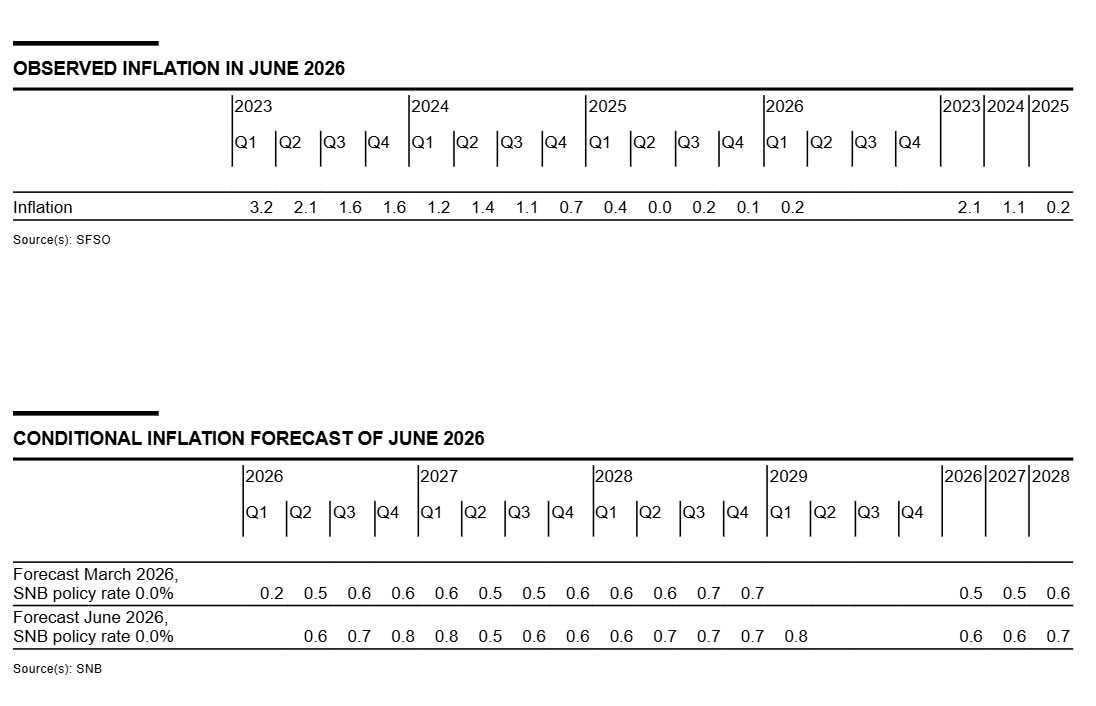
As expected, inflation has risen since the last monetary policy assessment, from 0.1% in February to 0.6% in May. This increase was mainly attributable to higher prices for oil products. The other goods and services made little contribution to the rise in inflation.
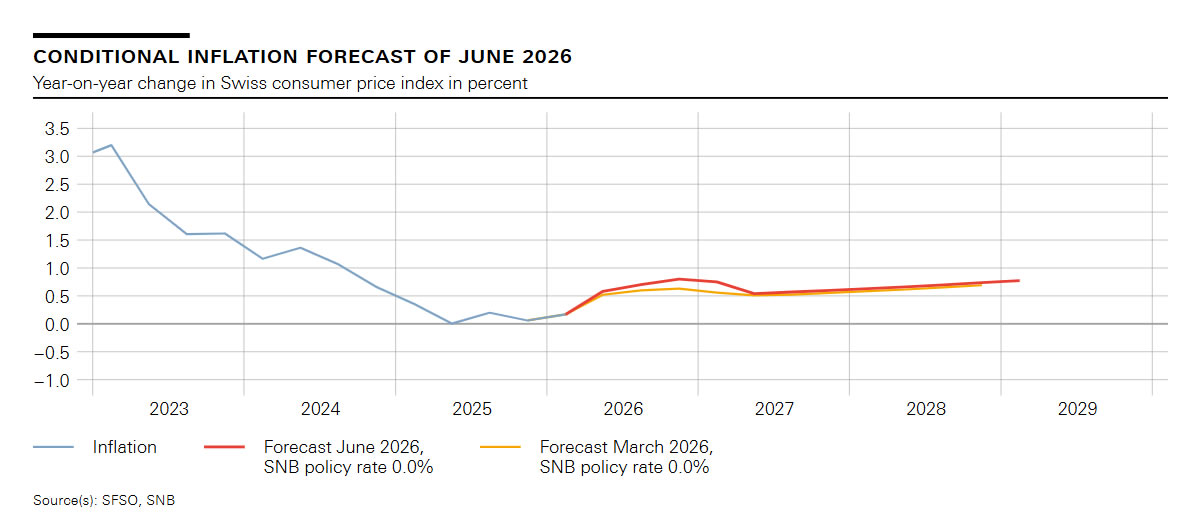
According to the conditional inflation forecast, inflation will initially continue to increase slightly in the coming quarters, before declining again somewhat in the first half of 2027. This decrease is due to the impact of higher energy prices being likely to ease over time. Energy prices will be largely influenced by the further development of the situation in the Middle East.
The forecast in the shorter term is slightly higher compared with the last monetary policy assessment. This is due to the rise in raw material prices and higher inflation abroad. In the medium term, the inflation forecast is practically unchanged. The forecast is within the range of price stability over the entire forecast horizon (cf. chart). It puts average annual inflation at 0.6% for 2026, 0.6% for 2027 and 0.7% for 2028 (cf. table). The forecast is based on the assumption that the SNB policy rate is 0% over the entire forecast horizon.
Global economic growth was solid overall in the first quarter. However, due to the escalation in the Middle East and the increase in energy prices, economic momentum slowed somewhat. Inflation has risen significantly in many countries as a result of higher energy prices. Key interest rates have been raised in the euro area, while they have remained unchanged in the US.
In its baseline scenario, the SNB anticipates that inflation worldwide will remain elevated over the coming quarters due to the higher raw material prices. In addition, global economic growth is likely to be more moderate in the short term than in the previous quarters. However, growth is likely to pick up again in the medium term.
The baseline scenario remains subject to high uncertainty, above all because the situation in the Middle East is still fragile. For example, raw material prices could turn out to be significantly higher than expected. This would increase inflation further and significantly curb economic growth. In addition to the situation in the Middle East, the trade policy environment also remains uncertain.
Economic activity in Switzerland has proved to be resilient given the conflict in the Middle East. GDP growth was solid in the first quarter. Unemployment has risen somewhat since the last monetary policy assessment.
In the coming quarters, the more moderate development of the global economy is likely to dampen growth in Switzerland, while the SNB’s monetary policy will have a supportive effect. In the medium term, the expected improvement in the global economy will provide growth impetus. For 2026 as a whole, the SNB currently expects growth of around 1%. For 2027, the SNB anticipates around 1.5%.
The main risk to the economic outlook for Switzerland is developments in the global economy. In particular, the situation in the Middle East could worsen again and curb global economic activity more strongly. The upward pressure on the Swiss franc could also increase again. Furthermore, US trade policy continues to be a source of uncertainty.
More detailed information on the monetary policy decision can be found in the introductory remarks by the Governing Board (available on the SNB website from 10 am on 18 June 2026).