


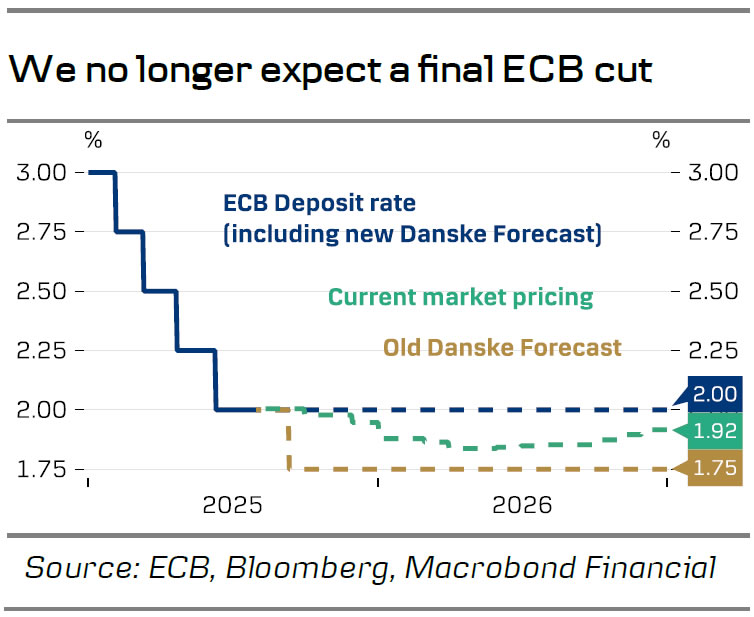
- We remove our previous call for a final September cut by the ECB and expect no further easing in 2025 and 2026, leaving a terminal deposit rate of 2.0%.
- The euro area economy has shown surprising resilience over the summer, with the outlook bolstered by the EU-US deal and accelerated German spending plans.
- Risks are still tilted towards a final cut later this year or in early 2026. Further softening of wage indicators could open the door for a final ‘insurance cut’
We revise our ECB call following the recent string of events, which have reduced the chances of a September cut substantially. We now expect the ECB to keep its policy rates unchanged throughout the entire 2025-26 forecast period. Markets discount roughly 12.5bp worth of ECB cuts by year-end. Previously, our main arguments for a final 25bp cut in September were 1) the elevated trade policy uncertainty, 2) the slowdown in domestic growth, and 3) the ongoing softening of wage growth. As we will elaborate below, trade policy and domestic growth arguments have lost considerable weight. Monetary policy is in a ‘good place’, and recent events have made it less likely ECB will conclude otherwise.
The European economy has proved surprisingly resilient to the elevated trade policy uncertainty that characterized the spring and early summer. Business confidence indicators have improved, and a declining euro area unemployment rate suggests that slack is still being depleted in the region. The US-EU trade deal has provided much-needed clarity, and the US tariff hike on European goods (roughly 10pp) fits well with the ECB baseline scenario from June. Even though we will eventually see some reversal effects of the heavy front-loading of goods in H1, the ECB will most likely interpret this as a temporary distortion without meaningful monetary policy implications.
Apart from trade policy, we have also revised our expected timeframe for the German fiscal policy boost. Earlier this week, the German cabinet agreed on a draft budget that will fast-track new public investments and a set of ‘growth booster’ initiatives, such as electricity tax cuts and accelerated depreciation rules for investments. Parliament will vote on the budget in September. If approved, the measures are set to drive up deficits as early as 2025. Even though the fiscal effect will likely not be felt before 2026, this is still a faster impact than previously assumed. Hence, the German fiscal boost risk coinciding with the lagged effects of the past year’s monetary policy easing, which will continue to strengthen.
Softening of inflationary forces leaves risks for policy rates tilted to the downside. Even though we are now calling for ECB policy rates to remain unchanged through 2025- 26, we still perceive the risk as being tilted to the downside. Euro area wage growth continues to moderate, and the most recent ECB tracker suggests that wage growth (including one-offs) is set to reach 1.7% y/y by Q1/2026. The July inflation report showed core services inflation declining to 3.1% y/y and the most recent momentum fell to the lowest since January, at 3.0% in the 3m/3m SAAR measure. Depending on the development in domestic inflation at the end of this year and the fiscal outlook by then, these factors could give room for taking rates slightly below neutral. However, based on Lagarde’s comments in the July meeting, more easing will require the ECB to reassess its baseline for the underlying inflationary outlook.


