


GBP/USD is consolidating at 1.3232 on Tuesday. The pound remains near its lowest levels globally since late November, with growing pressure stemming from uncertainty over the Iran conflict and rising oil prices.
At the same time, the US dollar continues to draw support from strong US labour market data, which has reduced expectations of Federal Reserve easing.
US President Donald Trump has warned Iran of severe consequences if it refuses to reopen the Strait of Hormuz. However, according to US intelligence estimates, the likelihood of Tehran meeting these demands remains low.
Meanwhile, the possibility of a 45-day truce involving the US, Iran, and regional mediators is being discussed, which could partially reduce tensions.
Amid high oil prices, investors have effectively ruled out a Fed rate cut this year. In the UK, by contrast, the market is now pricing in two Bank of England rate hikes for 2026. However, BoE Governor Andrew Bailey has cautioned that such expectations may be excessive.
Technical Analysis
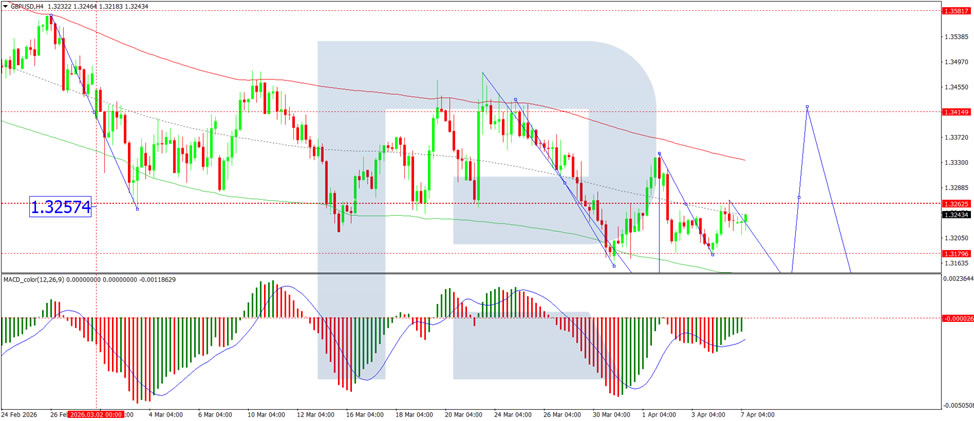
On the H4 GBP/USD chart, the market is forming a broad consolidation range around the 1.3262 level, currently extending down to 1.3180. A move towards 1.3262 is expected in the near term. Following the completion of this correction, a new consolidation range is likely to form. An upside breakout would open the way for a continuation move to 1.3411, while a downside breakout would suggest further movement to 1.3120. Technically, this scenario is confirmed by the MACD indicator, whose signal line is below zero and pointing downwards.
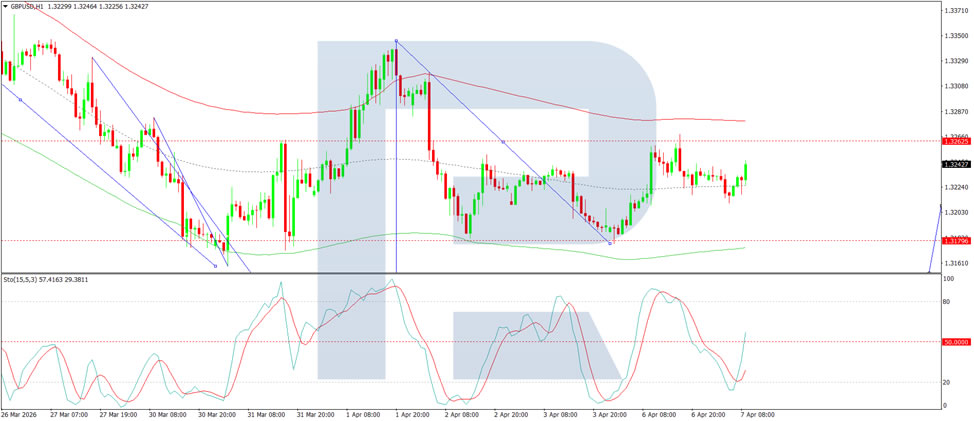
On the H1 chart, the market has formed a compact consolidation range around the 1.3222 level. A downside breakout has initiated a wave structure extending to 1.3120. Should this level be breached, further downside potential towards 1.3050 would emerge. Conversely, an upside breakout from the range could trigger a rebound to 1.3286. Technically, this scenario is confirmed by the Stochastic oscillator, with its signal line below 50 and pointing downwards towards 20.
Conclusion
GBP/USD remains pinned near six-month lows as a perfect storm of geopolitical uncertainty, rising oil prices, and diverging central bank expectations weighs heavily on sterling. While strong US labour data has bolstered the dollar by pushing Fed rate cut expectations further out, the UK market’s pricing of two BoE rate hikes for 2026 appears increasingly optimistic, especially given Governor Bailey’s own caution. The possibility of a 45-day truce offers a glimmer of hope for de-escalation, but US intelligence suggests Iranian compliance remains unlikely. Technical indicators point firmly lower, and unless geopolitical tensions ease substantially, the pound faces continued headwinds.





