The euro remains under pressure against the dollar and is heading into its fifth consecutive weekly decline, though the sell-off is beginning to slow. The pair is trading around 1.1149.
After the Fed kept rates unchanged, the dollar initially weakened but quickly stabilised: the market received no clear signal that the tightening cycle has ended, and the future path of interest rates remains uncertain.
While the Fed held rates steady as expected, the decision was not unanimous. Lisa Cook and Beth Hammack advocated a 25-basis-point rate hike. The Fed reiterated that inflation remains elevated, while the economy continues to expand at a robust pace, domestic demand remains resilient, and investment and productivity growth remain strong. This backdrop prevents the market from completely ruling out further policy tightening.
The Fed has also changed its 2027 meeting schedule: there will be eight meetings in total, one of which will be devoted entirely to strategy, with no rate decision being taken.
Jerome Warsh noted after the meeting that, in his view, the economy does not appear overheated, but the Fed still faces considerable uncertainty. Elevated Treasury yields and strong economic activity data remain additional factors supporting the dollar: the Atlanta Fed model estimates US GDP growth in the third quarter at around 3.4%.
As a result, the fundamental backdrop for EUR/USD remains rather bearish. The lack of an immediate rate hike temporarily limits demand for the dollar, but the Fed’s hawkish stance, high inflation and a resilient US economy are limiting the potential for a euro recovery. For a marked reversal in EUR/USD, the market will need a more explicit signal that the US tightening cycle is over.
Technical Analysis
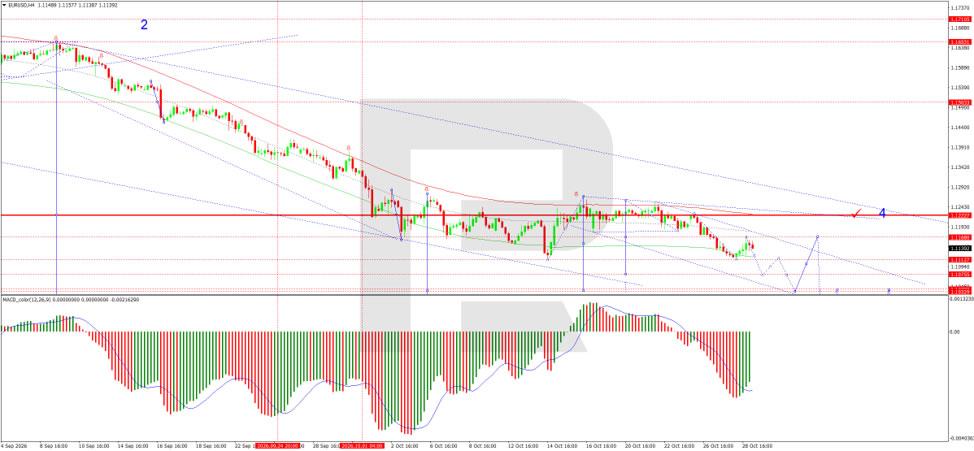
On the H4 chart, EUR/USD continues its downtrend after completing the corrective structure around resistance at 1.1223. The market formed another downward impulse towards 1.1113, then rebounded to 1.1168. The price is currently around 1.1139, consolidating below the nearest resistance. Today, the decline is expected to continue towards 1.1113, with scope for a downward wave to develop towards 1.1075. A break below this support would open the way towards the main target at 1.1033. The MACD indicator confirms this scenario, with its signal line in negative territory. At the same time, the shrinking negative histogram indicates the likelihood of a short-term correction before the downward move resumes.
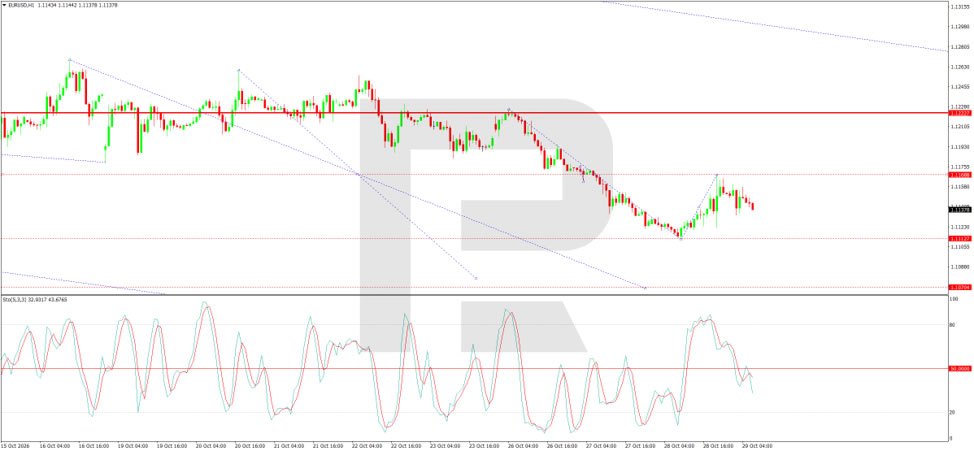
On the H1 chart, the market completed a local upward correction around 1.1168 and formed a reversal structure, then declined towards 1.1138. In the short term, a consolidation range is expected to form below 1.1168, followed by a continuation of the downward wave towards 1.1113. A break below this level would increase selling pressure and create the conditions for a move towards 1.1070 and then 1.1033. The Stochastic oscillator supports the downside scenario: its signal line is below 50 and pointing down, suggesting further downside is possible. Invalidating the main scenario would require the price to close above 1.1168, followed by a correction towards resistance at 1.1223. Until then, the priority remains selling on local upward pullbacks.
Conclusion
EUR/USD remains under pressure, on track for a fifth consecutive weekly decline, as the dollar benefits from the Fed’s hawkish stance despite holding rates steady, elevated Treasury yields and resilient US economic data. The split vote and reaffirmation that inflation remains elevated have kept further tightening on the table, preventing a meaningful euro recovery. While the absence of an immediate rate hike has temporarily limited dollar demand, the overall fundamental backdrop remains bearish for the pair. Technically, the downtrend persists, with the next targets at 1.1113, 1.1075 and 1.1033. A short-term corrective bounce is possible given the shrinking negative MACD histogram, but the broader structure remains negative unless the price closes above 1.1168 and subsequently challenges 1.1223.