Gold remained under strong pressure on Thursday, trading around 3,735 USD per ounce – its lowest level since September 2025. The main negative factor for the market remains expectations of further rate hikes in the US following a series of hawkish signals from the Fed.
Minutes from the October meeting showed that a majority of FOMC members saw additional tightening as necessary to bring inflation back under control. At the meeting itself, the rate was kept in the 3.75–4.00% range by a 10–2 majority, following a 25-basis-point increase in September.
Several Fed officials have also maintained a hawkish tone. Christopher Waller again acknowledged the possibility of a 50-basis-point rate hike in December. John Williams and Alberto Musalem also made clear that the tightening cycle is probably not over yet. Markets now estimate the probability of a 25-basis-point move in December at 90%, with the chance of a 50-basis-point increase at around 10%.
At the same time, macroeconomic data are sending mixed signals but do not yet indicate a sharp economic slowdown. Retail sales rose 0.2% month-on-month in October, but industrial production unexpectedly fell 0.4%, and the NAHB housing market index dropped to 25 points, its lowest level since 2012.
Against this backdrop, the combination of factors remains unfavourable for gold: high inflation, resilient demand in the US economy and expectations of further rate hikes. Even a slight softening in the Fed’s rhetoric does not change the overall picture: high borrowing costs and a strong dollar continue to limit demand for the metal, which does not generate coupon income.
Technical Analysis
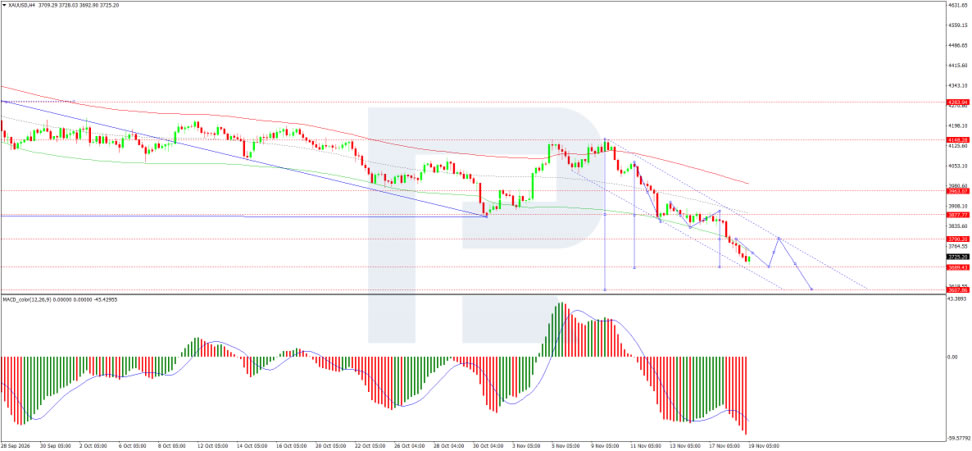
On Thursday, 19 November 2026, gold is trading around 3,724 USD on the hourly chart. On the H4 XAU/USD chart, the downtrend continues, with successively lower highs and lows. After consolidating around 3,878 USD, the price broke below the range and breached the 3,790 USD mark. The MACD signal line is below zero and pointing downwards. The expansion of the negative histogram bars indicates strengthening downward momentum. The nearest support is around 3,689 USD.
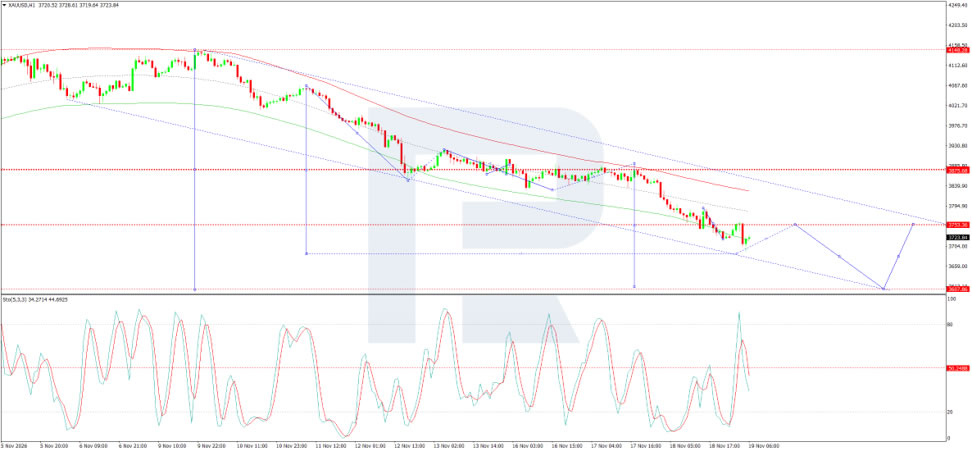
On the H1 XAU/USD chart, the price broke below the 3,753 USD level and, after a local rebound, fell below it once again. This level now acts as the nearest resistance, which the price may retest during an intraday correction. The main line of the Stochastic oscillator has dropped below the signal line, with both lines below 50 and pointing downwards. This configuration is consistent with continued pressure on the price as long as it remains below 3,753 USD.
The baseline scenario for the current session assumes a decline towards the nearest support around 3,689 USD. An hourly close below this level would open the way towards 3,608 USD, the next downside target outlined on both charts. If buyers hold support, a rebound towards 3,753 USD followed by consolidation is possible. A move above 3,753 USD would weaken the downside scenario for the day and open the way for a recovery towards 3,790 USD. The price reaction to this level will show whether the intraday correction can develop into a longer recovery following the break below the previous consolidation range on H4.
Conclusion
Gold remains under strong pressure, trading at its lowest level since September 2025, as hawkish Fed signals and expectations of further rate hikes continue to dominate the market. The October FOMC minutes confirmed that most members see additional tightening as necessary, with December rate hike probabilities at 90% for a 25-basis-point move and 10% for a 50-basis-point increase. Mixed economic data – resilient retail sales but weak industrial production and a sharp decline in housing market activity – have not yet signalled a sharp economic slowdown. For gold, the combination of high inflation, resilient demand and high borrowing costs remains unfavourable. Technically, the downtrend is intact, with support at 3,689 USD; a break below this level could open the way to 3,608 USD. A rebound towards 3,753 USD is possible if support holds, but the broader outlook remains bearish unless resistance is decisively broken.