US initial jobless claims fell from an upwardly revised 195K to 189K in the week ending October 31, below market expectations of 197K, according to the Labor Department. The previous week’s reading was revised up from 194K. The four-week moving average declined from 197.00K to 194.75K, reinforcing the picture of subdued layoff activity. Initial claims were also 39K below the 228K recorded in the comparable week last year, suggesting that new applications for unemployment benefits remain relatively limited.
Continuing claims, however, edged higher, rising from a downwardly revised 1.695M to 1.718M in the week ending October 24. The previous week’s figure was revised down from 1.701M. The four-week moving average increased marginally from 1.7085M to 1.7095M, while the insured unemployment rate held steady at 1.1%. Despite the latest weekly increase, continuing claims remained well below the 1.962M recorded a year earlier. The modest rise therefore warrants monitoring but does not establish a sustained deterioration in the number of workers receiving unemployment benefits.
Overall, the claims figures continue to point to limited layoff pressure rather than a broader weakening in labor market conditions. The decline in initial claims and their four-week average suggests employers are not accelerating job cuts, while the small increase in continuing claims provides a more mixed signal about the stock of workers receiving benefits. However, low claims do not necessarily imply strong hiring or rapid employment growth. Ahead of Friday’s US employment report, the latest figures offer reassurance that layoffs remain subdued, but provide limited evidence about the pace of new job creation.
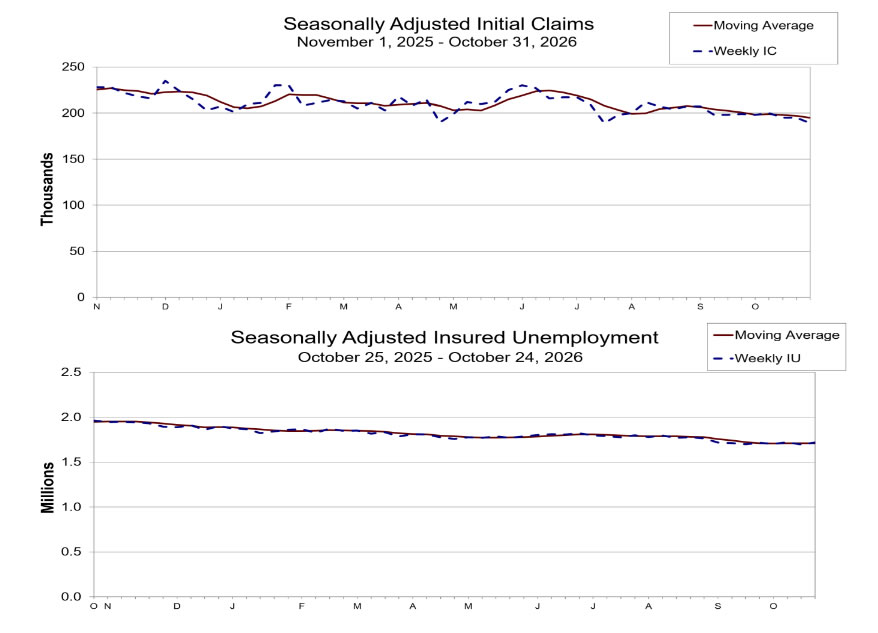
Data Summary
US Weekly Jobless Claims — November 5, 2026
| Indicator | Previous | Current |
|---|---|---|
| Initial jobless claims | 195K | 189K |
| Initial claims 4-week average | 197.00K | 194.75K |
| Continuing claims | 1.695M | 1.718M |
| Continuing claims 4-week average | 1.7085M | 1.7095M |
| Insured unemployment rate | 1.1% | 1.1% |
Initial claims cover the week ending October 31, while continuing claims and the insured unemployment rate cover the week ending October 24. Initial claims were below the 197K consensus. Previous figures incorporate revisions.
Additional Details
| Indicator | Previous | Current |
|---|---|---|
| Unadjusted initial claims | 179,649 | 176,698 |
| Unadjusted continuing claims | 1,484,623 | 1,494,812 |
| Initial claims, year-earlier comparison | 228K | 189K |
| Continuing claims, year-earlier comparison | 1.962M | 1.718M |
Year-earlier comparisons refer to the corresponding reporting weeks in 2025 and 2026, rather than successive weekly observations.
Key Takeaways
- Initial jobless claims fell below 190K: New applications for unemployment benefits declined from an upwardly revised 195K to 189K, undershooting the 197K consensus by 8K.
- The underlying claims trend improved: The four-week moving average fell from 197.00K to 194.75K, supporting the interpretation that layoff activity remains subdued.
- Initial claims were substantially lower than a year earlier: The latest reading of 189K compared with 228K in the corresponding week of 2025, a decline of 39K.
- Continuing claims increased modestly: The number of workers receiving ongoing unemployment benefits rose from a downwardly revised 1.695M to 1.718M, an increase of 23K.
- The continuing claims trend remained broadly stable: The four-week average edged up just 1K to 1.7095M, while the insured unemployment rate held at 1.1%.
- Continuing claims remained below their year-earlier level: The latest 1.718M reading was 244K below the 1.962M recorded in the comparable week last year.
- Unadjusted figures reinforced the low-layoff picture: Actual initial claims declined by 2,951 to 176,698, despite seasonal factors anticipating an increase of 2,539.
- Low layoffs do not necessarily mean strong hiring: Claims data indicate that employers are not accelerating job cuts, but provide limited direct evidence about recruitment or the pace of new employment creation.
- The upcoming employment report remains important: Friday’s US jobs figures should provide a broader assessment of labor demand, complementing the relatively reassuring claims data.