US nonfarm payroll employment accelerated sharply from an upwardly revised 60K to 165K in October, substantially exceeding market expectations of 56K, according to the Bureau of Labor Statistics. Unemployment rate edged down from 4.2% to 4.1%, beating expectations for an unchanged reading. Average hourly earnings growth also strengthened from a revised 0.3% to 0.4% mom, above the 0.3% consensus, while annual wage growth stood at 3.1%. Together, the stronger hiring, lower unemployment and firmer wages delivered a broad upside surprise, suggesting that labor-market conditions were more resilient than anticipated.
Upward revisions further strengthened the employment picture, with August payroll growth revised from 133K to 186K and September from 29K to 60K, adding a combined 84K jobs to previously reported figures. Including October’s gain, payrolls increased by 411K over the latest three months, averaging 137K per month, well above the 48K average monthly increase over the preceding 12 months. The revisions are particularly significant because they indicate that hiring momentum had already been stronger than initially reported, rather than October representing an isolated improvement.
Job gains were led by professional and business services, which added 70K positions, including 33K in professional, scientific and technical services and 28K in administrative and support activities. Temporary help services also rebounded by 18.6K after declining 5.6K in September, offering an encouraging signal for business labor demand. Health care added 42K jobs, transportation and warehousing increased 25K, and manufacturing gained 19K. However, hiring was not uniformly strong, with construction employment slipping 3K and leisure and hospitality losing 13K positions. The industry breakdown nevertheless points to a broader improvement in employment growth beyond the health care sector.
Household survey details reinforced the stronger headline, although some underlying weakness persisted. Labor force participation edged up from 61.8% to 61.9%, while the employment-population ratio increased from 59.2% to 59.3%, alongside the decline in unemployment. Household employment rose by 463K, but the number of people working part time for economic reasons increased by 339K to 4.84M, indicating continued pressure on working hours for some employees. Overall, the report points to a meaningful improvement in US hiring momentum, supported by substantial upward revisions and firmer wage growth. However, the rise in involuntary part-time employment suggests that labor-market conditions remain uneven despite the strong headline figures.
Get key releases like this on the ActionForex Telegram channel.
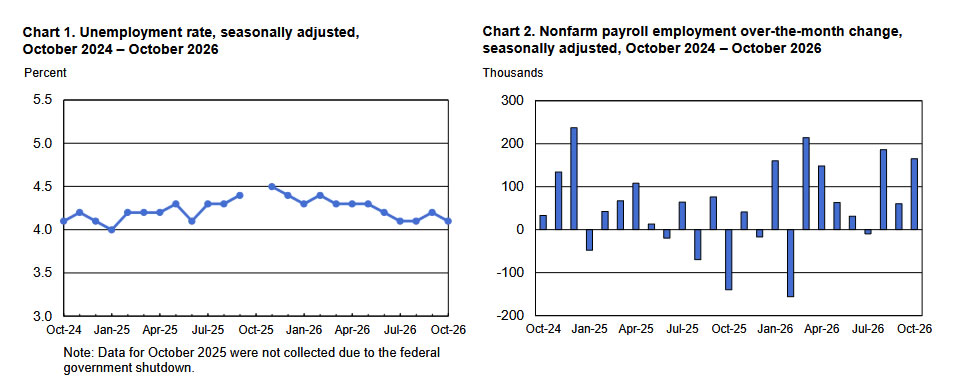
Data Summary
US Employment Situation — October 2026
| Indicator | Sept | Oct | Consensus |
|---|---|---|---|
| Nonfarm payrolls | +60K | +165K | +56K |
| Unemployment rate | 4.2% | 4.1% | 4.2% |
| Average hourly earnings, mom | +0.3% | +0.4% | +0.3% |
| Average hourly earnings, yoy | — | +3.1% | — |
| Labor force participation rate | 61.8% | 61.9% | — |
| Employment-population ratio | 59.2% | 59.3% | — |
| Average weekly hours | 34.4 | 34.4 | — |
| Part-time for economic reasons | 4.501M | 4.840M | — |
Payroll Revisions
| Month | Previously reported | Revised | Revision |
|---|---|---|---|
| August | +133K | +186K | +53K |
| September | +29K | +60K | +31K |
| Combined | +84K |
The three-month average payroll gain increased to 137K, compared with an average of 48K per month over the preceding 12 months.
Employment by Industry
| Industry | Sep | Oct |
|---|---|---|
| Professional and business services | +8K | +70K |
| Health care | +20K | +42K |
| Transportation and warehousing | +7K | +25K |
| Manufacturing | +13K | +19K |
| Temporary help services | -5.6K | +18.6K |
| Construction | +16K | -3K |
| Leisure and hospitality | +13K | -13K |
Source: US Bureau of Labor Statistics, November 6, 2026. Consensus from ActionForex economic calendar. Previous-month figures reflect the latest revisions.
Key Takeaways
- Payroll growth significantly exceeded expectations: Nonfarm payrolls accelerated from an upwardly revised 60K to 165K, beating the 56K consensus by 109K.
- Unemployment unexpectedly declined: Unemployment rate fell from 4.2% to 4.1%, compared with expectations for an unchanged reading, reinforcing the stronger employment picture.
- Wage growth also surprised positively: Average hourly earnings accelerated from 0.3% to 0.4% mom, above the 0.3% forecast. Annual earnings growth stood at 3.1%.
- Previous payroll estimates were revised substantially higher: August was revised upward by 53K and September by 31K, adding a combined 84K jobs to previously reported employment gains.
- The three-month hiring trend strengthened: Payroll gains averaged 137K per month over August–October, compared with 48K over the preceding 12 months, indicating stronger recent hiring momentum than initially reported.
- Professional and business services led employment growth: The sector added 70K jobs, including 33K in professional, scientific and technical services and 28K in administrative and support activities.
- Temporary help employment rebounded: Temporary help services shifted from a 5.6K decline to an 18.6K increase, offering an encouraging indication of business labor demand, although further confirmation is needed.
- Hiring improved across several other industries: Health care added 42K, transportation and warehousing gained 25K, and manufacturing increased 19K. However, construction and leisure and hospitality recorded job losses.
- Labor force participation improved: Participation rate edged up from 61.8% to 61.9%, while the employment-population ratio increased from 59.2% to 59.3%, alongside lower unemployment.
- Involuntary part-time employment remained a concern: The number of workers employed part time for economic reasons rose by 339K to 4.84M, suggesting continued pressure on working hours despite stronger hiring.
- Overall employment momentum improved meaningfully: The combination of a large payroll beat, upward revisions, lower unemployment and firmer wages supports a more resilient labor-market assessment, although underlying conditions remain uneven.