


Japan’s household spending contracted sharply in September, highlighting persistent weakness in private consumption despite improving household income. Real spending fell from -3.1% yoy in August to -6.8%, significantly worse than market expectations of -3.0% and marking the tenth consecutive month of contraction. The decline was the steepest since September 2020, while seasonally adjusted spending dropped 2.8% mom, against expectations of a 0.3% increase. The three-month average annual decline also deepened from -3.3% to -4.5%, suggesting that the deterioration extended beyond a single month’s volatility.
The weakness was widespread across expenditure categories. Transport and communications spending fell 9.1% yoy in real terms, education declined 23.5%, recreation and culture dropped 8.7%, and food spending contracted 2.5%. Spending excluding housing, vehicle purchases, gifts and remittances also fell 7.5%, reinforcing the breadth of the downturn. Government officials attributed part of the weakness to exceptionally poor weather, which discouraged people from going out during September. However, the broad-based declines suggest that weather disruptions alone cannot fully explain the weakness in household consumption, particularly as spending contracted across both discretionary and essential categories.
More significantly, the spending slump contrasted with improving household purchasing power. Among working households, real income rose 0.9% yoy and real disposable income increased 1.7%, yet real consumption expenditure plunged 10.0%. The average propensity to consume fell from 82.1% a year earlier to 72.7%, indicating that higher household income was not translating into stronger spending. While temporary weather disruptions and the timing of major purchases may have amplified September’s decline, the persistent weakness raises questions about households’ willingness to increase consumption despite improving earnings. The figures suggest that Japan’s domestic demand recovery remains fragile, with stronger income growth yet to generate a sustained improvement in consumer spending.
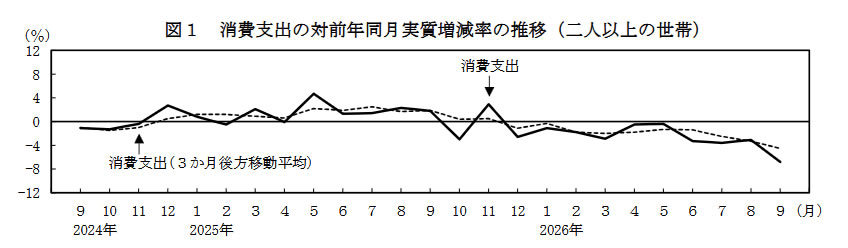
Data Summary — Japan September Household Spending
| Indicator | Sep | Exp. | Aug |
|---|---|---|---|
| Household Spending (yoy, real) | -6.8% | -3.0% | -3.1% |
| Household Spending (mom, real, seasonally adjusted) | -2.8% | +0.3% | +0.1% |
| Three-Month Average (yoy, real) | -4.5% | — | -3.3% |
Spending Breakdown
| Category | Sep (yoy, real) |
|---|---|
| Transport and Communications | -9.1% |
| Education | -23.5% |
| Recreation and Culture | -8.7% |
| Food | -2.5% |
| Utilities and Water | -10.5% |
| Healthcare | -7.6% |
| Furniture and Household Goods | -6.4% |
| Spending Excluding Housing and Other Specified Items | -7.5% |
Working Households — Income and Consumption
| Indicator | Sep (yoy, real) |
|---|---|
| Household Income | +0.9% |
| Disposable Income | +1.7% |
| Consumption Expenditure | -10.0% |
| Average Propensity to Consume | 72.7% (82.1% year earlier) |
Key Takeaways
- Japan’s real household spending plunged 6.8% yoy, its steepest decline since September 2020, with widespread contractions across major categories despite unusually poor weather contributing to the weakness.
- Real income and disposable income among working households increased 0.9% and 1.7% respectively, yet real consumption expenditure fell 10.0%, revealing a significant disconnect between improving purchasing power and actual spending.
- The tenth consecutive annual contraction and deterioration in the three-month trend suggest that domestic demand remains fragile, with stronger household earnings yet to translate into a sustained consumption recovery.