


US initial jobless claims fell from a downwardly revised 202K to 189K in the week ending November 21, well below market expectations of 200K. The four-week moving average also declined from 197.5K to 196K, indicating that layoffs remain relatively contained. Meanwhile, continuing claims dropped sharply from 1.792M to 1.697M in the week ending November 14, while the insured unemployment rate fell from 1.2% to 1.1%.
The figures point to continued resilience in employment retention, although they provide less evidence of accelerating labor demand. The sharp decline in continuing claims largely reversed the previous week’s increase, leaving its four-week moving average virtually unchanged at 1.725M. This suggests that the underlying trend in insured unemployment remains relatively stable. While low initial claims indicate that employers are generally reluctant to shed workers, the data do not directly measure new hiring. The release therefore supports the view that layoffs remain limited without necessarily signaling a renewed acceleration in employment growth.
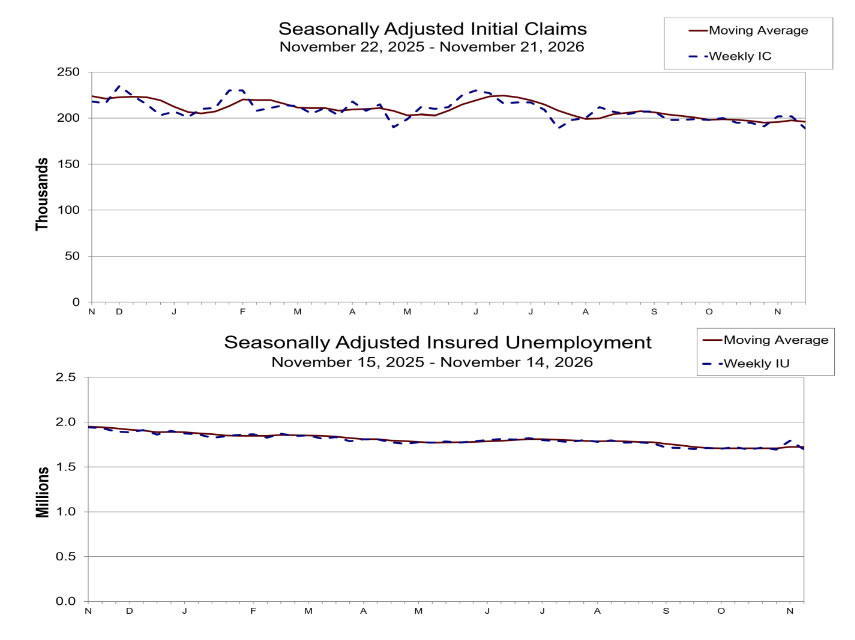
Data Summary — US Jobless Claims, November 25, 2026
| Indicator | Latest | Previous | Change |
|---|---|---|---|
| Initial Jobless Claims | 189K | 202K | -13K |
| Initial Claims, 4-Week Average | 196K | 197.5K | -1.5K |
| Continuing Claims | 1,697K | 1,792K | -95K |
| Continuing Claims, 4-Week Average | 1,724.8K | 1,724.3K | +0.5K |
| Insured Unemployment Rate | 1.1% | 1.2% | -0.1ppt |
Source: US Department of Labor, November 25, 2026. Initial claims cover the week ending November 21; continuing claims cover the week ending November 14. Seasonally adjusted.
Key Takeaways
- US initial jobless claims fell from 202K to 189K, beating expectations of 200K, while the four-week average declined to 196K, indicating that layoffs remain contained.
- Continuing claims dropped sharply to 1.697M, largely reversing the previous week’s increase, although their four-week average remained virtually unchanged.
- Low unemployment filings point to resilient employment retention rather than stronger hiring, suggesting that labor-market conditions remain relatively stable without clear evidence of accelerating demand for workers.