


EURUSD is moving smoothly downward and has touched 1.1840. Investors are preparing for the release of key US statistics that could affect expectations for the Fed’s future policy.
The focus is on the minutes of the last Fed meeting, a preliminary estimate of GDP, and the PCE core inflation index. The latter is a key policy gauge for the regulator.
The dollar came under pressure last week following softer inflation data, which increased expectations of rate easing in the second half of the year. However, a strong labour market report – showing the highest employment growth in more than a year and an unexpected decline in unemployment – pointed to the resilience of the economy.
The market is now pricing in the first rate cut in June. Overall, around 62 basis points of easing are expected for 2026, corresponding to two 25 bp reductions and roughly a 50% probability of a third step.
Technical Analysis
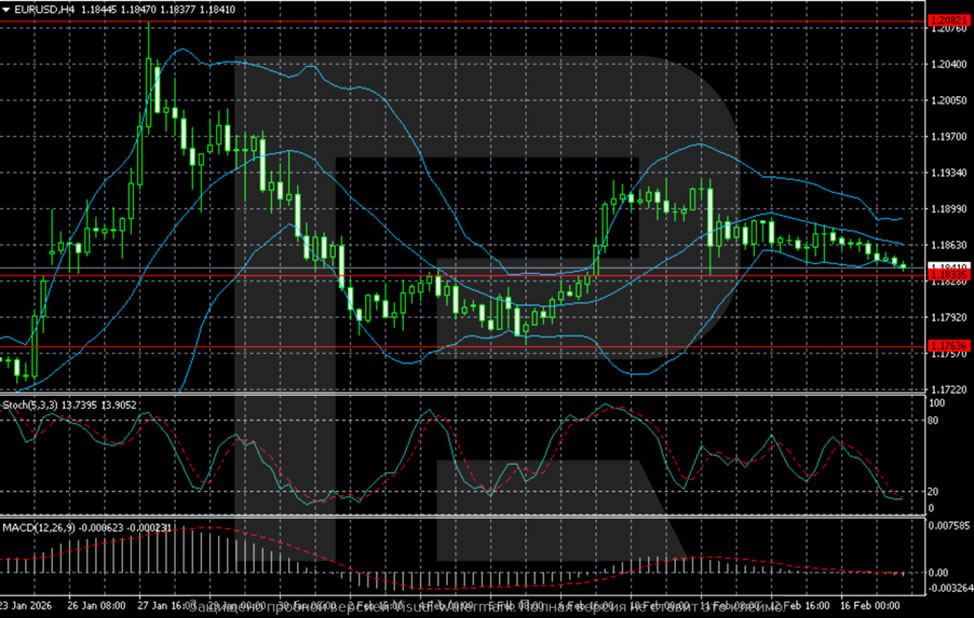
On the H4 time frame, EURUSD is consolidating after pulling back from January highs. The range has expanded, but the price is gradually moving towards its lower limit.
The key level stands at 1.1835, an intermediate support within the wider range of 1.1765–1.2000. If it holds, sideways movement with attempts to correct upward is likely to persist.
A break below 1.1835 would open the way to 1.1765. A return above 1.1890–1.1900 would ease bearish pressure and return the pair to the middle of the range.
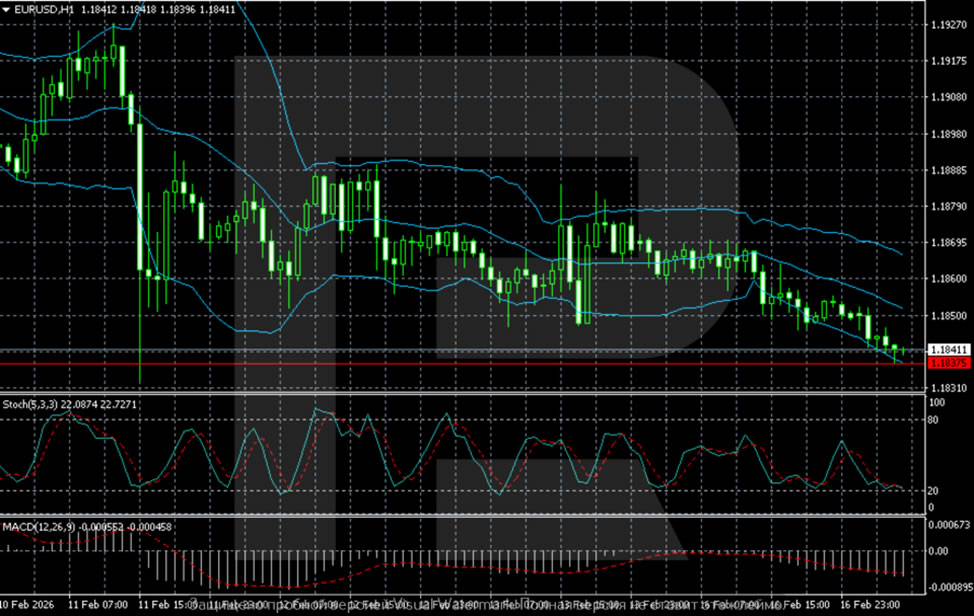
Short-term downward pressure remains on the H1 chart for EURUSD. The price consistently forms lower highs and lows, trading near the bottom of the Bollinger Bands. The middle line acts as dynamic resistance.
The Stochastic oscillator is in the oversold zone, which allows for local rebounds, but the MACD remains in negative territory – momentum is still on the side of sellers. The nearest support is at 1.1835. Securing below it would intensify the decline towards 1.1810–1.1800. Resistance stands at 1.1860–1.1870.
Conclusion
In summary, EURUSD remains under steady selling pressure as markets await pivotal US data that will shape Fed expectations. The pair is testing critical support at 1.1835, with technical indicators confirming bearish momentum despite oversold conditions. The fundamental picture is mixed: softer inflation points to eventual Fed easing, but robust employment data complicates the timeline. The near-term direction hinges entirely on today’s releases. A break below 1.1835 would likely accelerate losses towards 1.1765, while a rebound above 1.1890–1.1900 could signal a temporary respite. Until then, the path of least resistance remains lower.





