


The U.S. Supreme Court ruling against broad tariffs imposed by the U.S. administration under the International Emergency Economic Powers Act (IEEPA) removes government authority to collect them going forward. Still, other legislative authorities are open for the administration to re-instate tariffs.
IEEPA measures accounted for about 60% of tariff revenue reported by U.S. Customs and Border Control in fiscal 2025 and 2026 to-date. The remaining 40% of revenue were collected via other statues including Section 301 and 232 that are not impacted by the ruling.
There are significant questions that also remain—including if or when tariff revenues collected under IEEPA will be repaid.
The ruling will have less impact on Canadian trade than most other countries. Most Canadian exports are already exempt from IEEPA tariffs via an exemption for CUSMA compliant trade.
Other product specific (section 232) tariff measures have been a larger issue for the Canadian economy and those were not impacted by the court ruling.
We continue to view maintaining free trade under CUSMA—including through negotiations to extend the agreement later this year—as more important for the Canadian external demand outlook than court rulings.
Our 2026 forecast rests on the key assumption that CUSMA exemptions will be preserved to maintain lower-friction bilateral trade with the U.S.
IEEPA ruling likely won’t meaningfully change Canada’s tariff backdrop
The U.S. administration has vowed to re-instate tariffs if IEEPA measures are struck down. Statutorily, there are various other channels that allow them to do so.
In the meantime, non-IEEPA measures that account for about half of U.S. tariffs in place prior to the ruling remain unaffected by the court decision.
Other measures, including Section 232 tariffs imposed on a key range of Canadian products like metals, autos, and lumber, accounted for the bulk of duties collected from Canadian exports so far. Importantly, these measures were not under review by the U.S. Supreme Court.
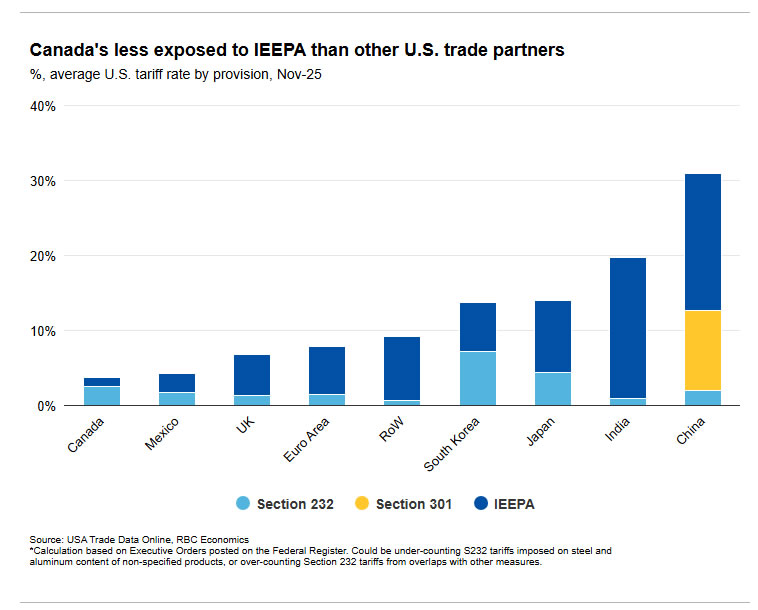
Source: USA Trade Data Online, RBC Economics
*Calculation based on Executive Orders posted on the Federal Register. Could be under-counting S232 tariffs imposed on steel and aluminum content of non-specified products, or over-counting Section 232 tariffs from overlaps with other measures.
Canada has limited exposure to IEEPA tariffs
By our count, 89% of Canadian exports to the U.S. in December were not charged with tariffs because they’re compliant with rules of origin requirements in CUSMA.
That leaves IEEPA measures only effective on less than 5% of exports to the U.S. In December (with the remainder accounted for by Section 232 tariffs), Canada faced an average effective U.S. tariff of 3.1%—the lowest of all major U.S. trade partners.
Moving forward, there are reasons to be optimistic that exemptions will remain in place, largely because they benefit businesses on both sides of the border.
We counted in the past that they effectively lower the U.S. average tariff by 6%, particularly benefitting importers in the 22 U.S. states where Canada is the largest source of imports as of 2025. Still, potential for changes remains a key risk to our baseline forecast.
Canada may lose advantage globally but could see increased U.S. demand
For other major U.S. trade partners (outside of Mexico, which also benefits from lower tariffs thanks to CUSMA/USMCA exemptions), IEEPA tariffs tend to account for the majority of U.S. tariffs, making the Supreme Court ruling more consequential.
If IEEPA tariffs are not replaced, other countries could see significant tariff reductions, and Canada could lose status as the lowest tariffed U.S. trade partner. On the flip side, U.S. tariffs will be halved, leading to increases in U.S. industrial activity and foreign demand.
We continue to view Canada’s international trade risks as a function of one: Canada’s competitive position in the U.S. import market; and two: broader, overall resilience in U.S. import demand tied to the severity of tariffs—the removal of IEEPA tariffs (if not replaced) is actually a negative for the former, but would be a positive for the latter, balancing the impact of the IEEPA ruling on Canada’s economy.





 removes government authority to collect them going forward. Still, other legislative authorities are open for the administration to re-instate tariffs.)