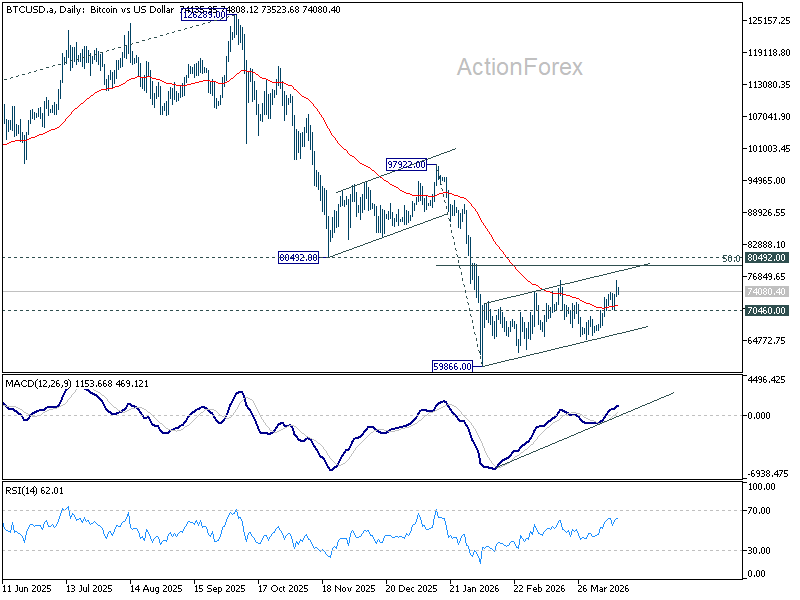
Bitcoin is rising—but without conviction. Despite a broader improvement in risk sentiment this week on hopes of de-escalation in the Middle East, the rally in crypto remains notably subdued. While equities, particularly tech, are pushing back toward record highs, Bitcoin is still struggling well below the $80K psychological level, highlighting a clear lack of committed buying.
The divergence with equities is telling. With the NASDAQ on the verge of retesting its highs, Bitcoin’s inability to follow through suggests that the current move is not a full risk-on endorsement. Instead, it points to a market that is participating, but not leading—held back by a major unresolved factor: regulation.
At the center of that uncertainty is the Clarity Act, the key US crypto market structure bill. While it passed the House last July, progress has stalled in the Senate Banking Committee. The lack of a scheduled markup and the continued silence from leadership suggest that momentum behind the bill has faded.
The next two weeks represent a critical “do-or-die” window. With the Senate returning from recess, failure to advance the bill before May could push meaningful progress out to 2030. Once the US enters the campaign cycle ahead of the 2026 midterms, appetite for controversial legislation is expected to collapse.
Further dampening expectations is the shift in priorities within the Senate. Banking Committee Chair Tim Scott has indicated that his immediate focus is the confirmation of Kevin Warsh to replace Jerome Powell as Fed Chair in May. That effectively sidelines crypto legislation in the near term, reinforcing the perception that regulatory clarity is not imminent.
This policy bottleneck is now acting as a ceiling for Bitcoin. The rally is intact, but the breakout is missing. Without progress on the Clarity Act, institutional participation is likely to remain cautious, limiting upside momentum.
Technically, Bitcoin’s structure reinforces this view. The price action from the 59,866 low appears to be a consolidation phase within the broader downtrend from 126,289. As long as 70,460 support holds, further upside toward 50% retracement of 97,922 to 59,866 at 78,894 is possible.
However, strong resistance is expected near 80,492—support turned resistance—which is likely to cap gains. This level now represents more than just a technical barrier; it is effectively a policy ceiling.
Unless regulatory clarity improves, rejection around 80K would likely complete the consolidation and set the stage for a renewed downtrend, with a retest of the 59,866 low.