


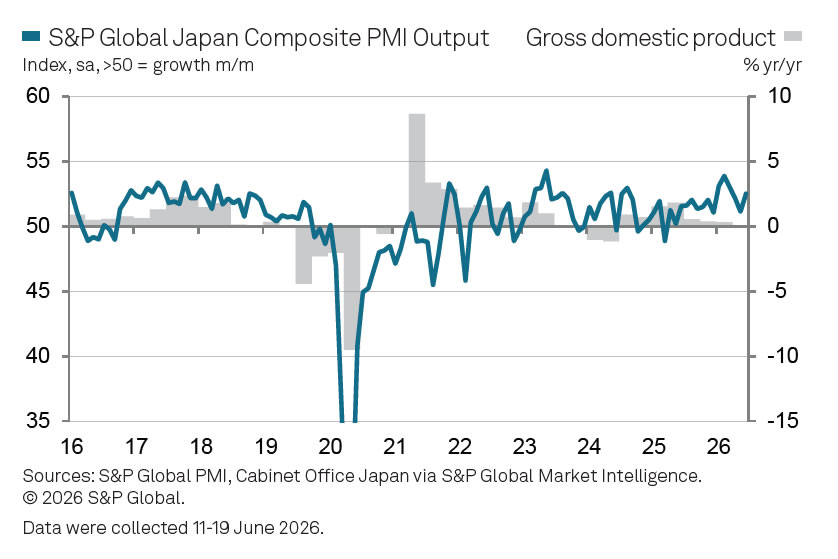
Japan’s private sector gained momentum in June, with the Flash Composite PMI Output Index rising from 51.1 to 52.5, the strongest reading since the outbreak of conflict in the Middle East. Growth was broad-based, with the Services PMI Business Activity Index improving from 50.0 to 51.8. Manufacturing remained firmly in expansion territory as the Manufacturing PMI rose from 54.5 to 54.9. Manufacturing output also strengthened from 54.0 to 54.3, underscoring the sector’s continued resilience.
According to S&P Global’s Annabel Fiddes, manufacturers continued to drive overall growth, recording one of the strongest increases in output seen in more than a decade. At the same time, services activity returned to growth as demand conditions improved across both sectors. The survey points to a strong overall performance in the second quarter and suggests the Japanese economy has thus far weathered the external shocks caused by the Middle East conflict better than many had anticipated.
However, the strength in activity comes with an important caveat. Fiddes noted that part of the recent growth appears to be linked to stockpiling efforts as businesses seek to protect themselves against supply disruptions and higher costs stemming from the conflict. The survey also showed the sharpest increase in input costs in nearly four years, while firms continued to pass those higher expenses on to customers. These inflation pressures helped prompt the Bank of Japan’s latest rate hike to 1.00%, the highest level since 1995. As a result, developments in the Middle East will remain a key factor shaping Japan’s growth, inflation and policy outlook in the months ahead.
| Indicator | May | June | Change |
|---|---|---|---|
| Composite PMI Output Index | 51.1 | 52.5 | ↑ 1.4 |
| Services PMI Business Activity Index | 50.0 | 51.8 | ↑ 1.8 |
| Manufacturing PMI | 54.5 | 54.9 | ↑ 0.4 |
| Manufacturing PMI Output Index | 54.0 | 54.3 | ↑ 0.3 |





