


TL;DR: The Fed’s July hold looked hawkish on the surface, but September hike odds actually fell to 65% from 76%. At the same time as the US 30-year Treasury yield hit its highest level since 2007, a split that points to a deeper term-premium story than a simple rate-path repricing.
The Puzzle: Two Markets, Two Opposite Signals
The Federal Reserve’s July meeting produced one of the more unusual market reactions of recent years. On the surface, the outcome appeared hawkish. The FOMC voted 9-3 to leave rates unchanged at 3.50–3.75%, with Minneapolis Fed President Neel Kashkari unexpectedly joining Beth Hammack (Cleveland) and Lorie Logan (Dallas) in dissenting for an immediate quarter-point hike.
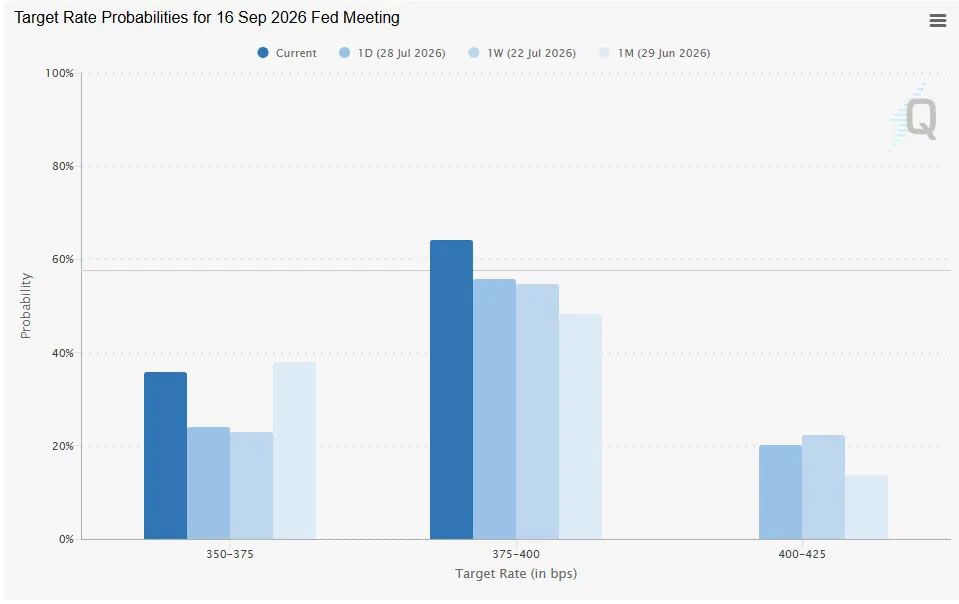
Yet instead of becoming more convinced another hike was imminent, markets moved the other way. CME FedWatch data showed the implied probability of a September rate increase falling to around 65%, down from roughly 76% just one day earlier.
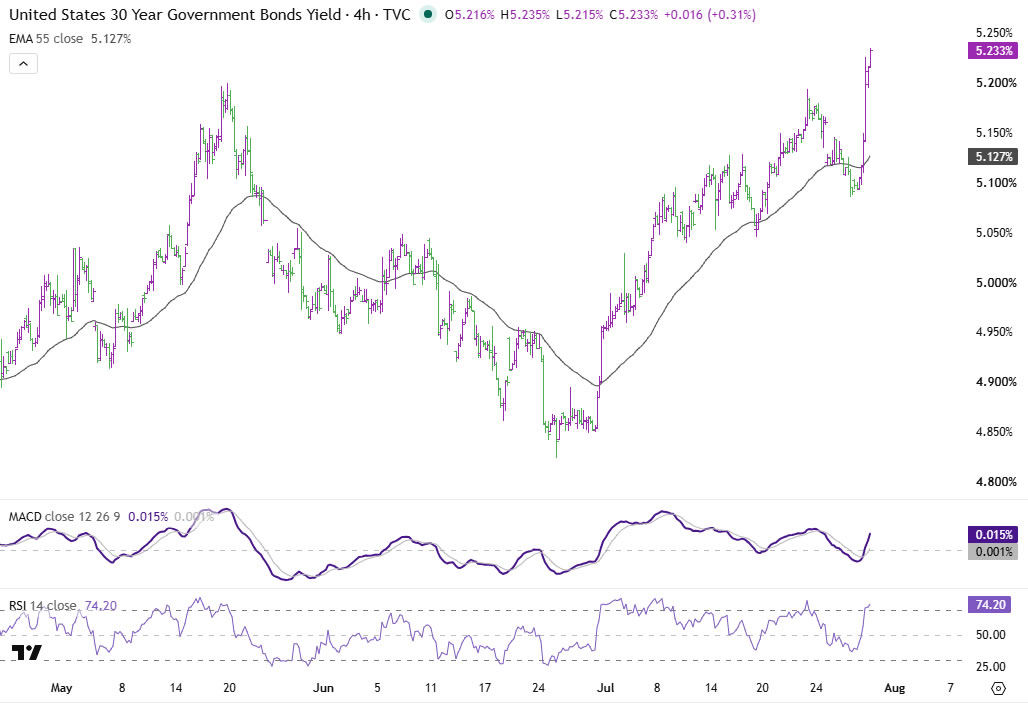
At the same time, another market sent the opposite message. The 30-year Treasury yield climbed to 5.235% — its highest level since 2007 — while the 10-year yield rose to 4.704%. The move was concentrated at the long end of the curve: the 2-year Treasury, the maturity most closely tied to Fed policy expectations, closed at 4.281%, rising only modestly. That combination produced a textbook bear steepening.
If investors were simply concluding another Fed hike had become more likely, short-dated yields should have led the selloff and September odds should have risen, not fallen. Instead, markets became less concerned about the next meeting while demanding higher yields to lend the US government money for decades.
What the CME Repricing Data Actually Shows
The shift becomes clearer when broken down by scenario. For the September FOMC meeting:
- Probability of a hold (3.50–3.75%): roughly 35% currently, versus 24% one day earlier and 38% one month earlier.
- Probability of one hike (3.75–4.00%): roughly 63–64% currently, versus 56% one day earlier and 48% one month earlier.
- Probability of two hikes (4.00–4.25%): roughly 20% currently, versus 26% one day earlier and 14% one month earlier.
The combined hike probability — one hike or more — is what fell from roughly 76% one day before the meeting to 65% after it. In other words, the market didn’t abandon its hike expectations; it consolidated around a single-hike outcome and pared back the tail risk of two.
Why the FOMC Statement Didn’t Explain the Divergence
The FOMC itself offered little explanation for that divergence. The policy statement was almost identical to June’s, reflecting Chair Kevin Warsh’s preference for minimal forward guidance. The Committee again described economic activity as expanding at a solid pace despite Middle East uncertainty, noted inflation remained elevated because of supply shocks including energy, and reiterated its commitment to restoring price stability.
During his press conference, Warsh maintained the Fed is in a period of “watchful thinking, not watchful waiting.” He noted that raising rates could help bring down annual inflation, currently at 3.5% and above the Fed’s 2% target for five consecutive years, but argued there is no “magic wand” capable of quickly returning inflation to target. Markets therefore interpreted the meeting as keeping the door open for further tightening without signaling that September had become materially more likely.
The Real Story: A Term-Premium Repricing, Not a Rate-Path Repricing
That leaves the bond market’s message pointing elsewhere. Rather than repricing the next one or two policy meetings, investors appear to be repricing the long-run inflation outlook and demanding a higher term premium for holding long-duration Treasuries. Several factors likely contributed:
- Warsh’s strategy of stripping forward guidance from FOMC communications has removed one of the market’s traditional policy anchors, leaving investors with greater uncertainty over the future path of rates.
- President Donald Trump’s renewed criticism of unnamed Fed officials — accusing them of having “bad intentions” and arguing “rates should be lowered” and the economy “could be at 8%, 9%, 10%, 12% [annualized growth of] GDP” — while publicly praising Warsh as “fantastic,” has revived debate over the central bank’s independence.
- Geopolitical risk has shifted from a temporary oil shock to a potentially more persistent supply-side problem, after fresh attacks involving Iran, US forces, and Saudi Arabia renewed fears of prolonged disruption to Middle East energy flows.
What the Yield Curve Confirms
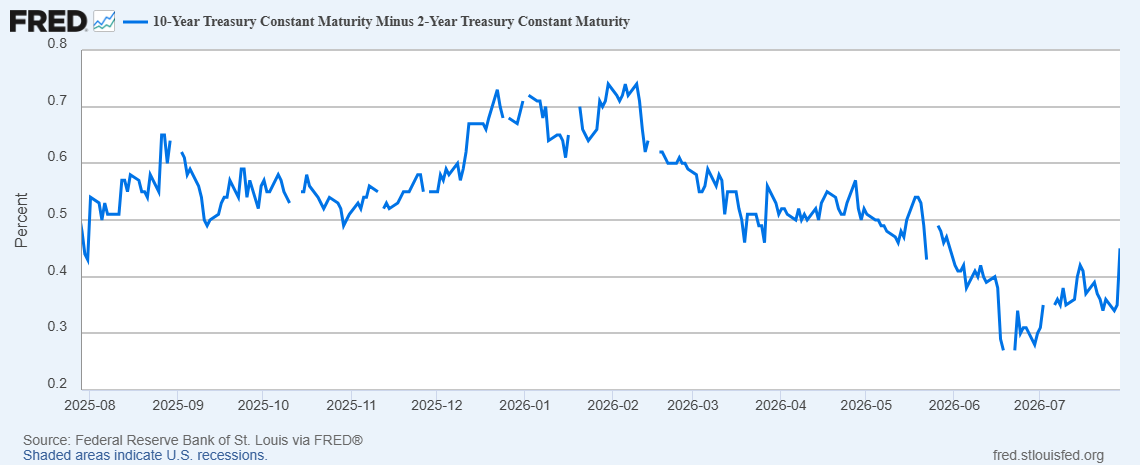
The recent behavior of the yield curve reinforces that interpretation. The 10-year/2-year spread has widened steadily from around 0.25–0.28 percentage points in mid-to-late June to roughly 0.45 now. That June low roughly coincided with Warsh’s first meeting as Chair, a unanimous hold with guidance stripped from the statement.
Importantly, this steepening has unfolded over five to six weeks rather than erupting in a single trading session. Although the curve remains well below the 0.65–0.70 range seen in January–February 2026, the trend suggests investors have been gradually rebuilding inflation and uncertainty premiums — a partial retracement of prior flattening, not a new record steep — rather than merely reacting to one policy meeting.
Why This Distinction Matters
Whether the Fed raises rates in September will be resolved within weeks. Whether investors demand permanently higher compensation to hold long-term Treasury debt because of persistent inflation risks, diminished policy guidance, and greater uncertainty is a much more consequential question — one that isn’t tied to any single decision and tends to persist well beyond it.
Wednesday’s most important market signal may therefore have come not from the FOMC’s three dissents, but from the bond market’s increasingly uneasy view of the years beyond the next meeting: markets grew more relaxed about the next meeting or two (65% vs. 76%) while growing less relaxed about the multi-year outlook (the 30-year at an 18-year high). That split, not either data point alone, is the actual story.
Key Takeaways
- September hike odds fell to 65% from 76% even as the 30-year Treasury yield hit 5.228%, its highest level since 2007.
- Kashkari’s surprise dissent alongside Hammack and Logan made the FOMC vote 9-3, hawkish on the surface but not the market’s key takeaway.
- The bear-steepening pattern — long yields rising while the 2-year stayed contained — signals a term-premium repricing, not a near-term rate-path repricing.
- The 10s2s spread has widened from 0.25–0.28 in mid-June to 0.45 now, a five-to-six-week trend coinciding with Warsh’s shift to minimal forward guidance.
- Trump’s renewed criticism of Fed independence and persistent Middle East supply risk are compounding the long-end repricing alongside reduced policy guidance.





