


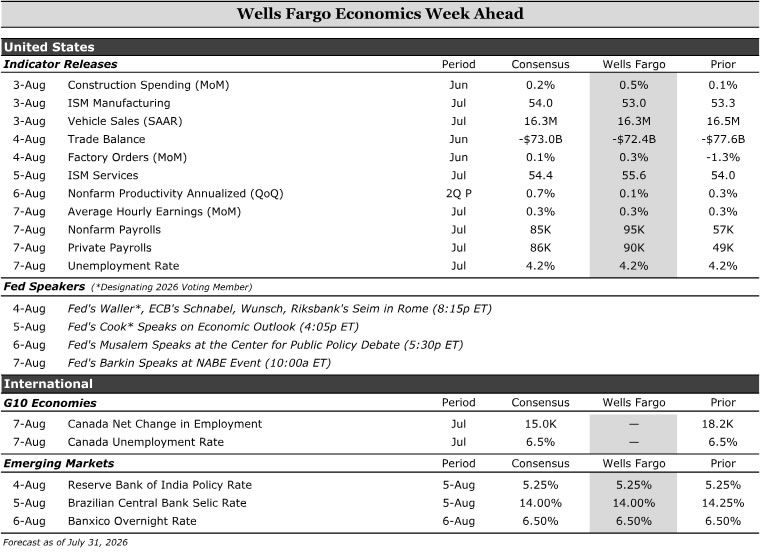
Next week’s U.S. employment report is expected to show the labor market remained broadly stable in July. We look for modest payroll growth, an unchanged unemployment rate and wage growth consistent with limited labor-driven inflation pressure.
Internationally, Canada’s labor market is expected to show further signs of stabilization, supporting a patient BoC stance. Among emerging markets, we expect Brazil’s central bank to cut rates by 25 bps as inflation cools and growth loses momentum. In India, we expect the RBI to remain on hold, though elevated inflation and rupee weakness could prompt a more hawkish tone. In Mexico, Banxico is also expected to stay on hold, with stronger Q2 growth likely to fade in the second half of the year.
- United States: Employment (Friday)
- G10 Economies: Canada Labor Force Survey (Friday)
- Emerging Markets: Brazilian Central Bank (Wednesday), Reserve Bank of India (Friday), Banxico (Friday)
Source: Bloomberg Finance L.P. and Wells Fargo Economics
U.S. Week Ahead
Employment • Friday
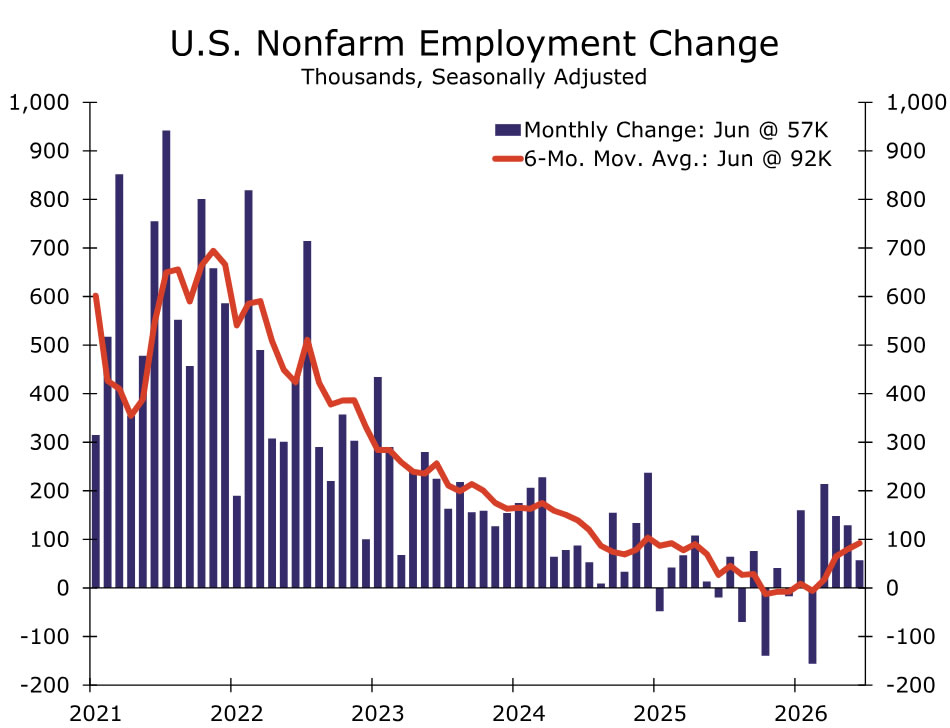
Labor market conditions appear to have been little changed in July. Nonfarm payroll growth averaged 92K over the first half of the year, and we look for a similar 95K increase in July. Small business hiring plans improved in June and initial jobless claims moved lower between survey weeks, suggesting layoffs remain limited. But, not all the July labor data are pointing in a positive direction. Indeed, job postings are hovering below year-ago levels, while ADP’s measure of weekly private-sector payroll growth has slowed since the spring.
Tepid labor demand has been accompanied by slower labor supply growth, helping to keep the labor market in balance. We expect the unemployment rate to hold at 4.2% in July. That said, June’s sharp decline in prime-age labor force participation looks difficult to square with broader economic conditions and may reflect some greater-than-usual monthly volatility in the household survey. The potential for a rebound in the labor force participation rate creates some upside risk for the unemployment rate.
Wage growth should remain consistent with a labor market that is not generating meaningful inflation pressure. We forecast average hourly earnings to rise 0.3% in July, holding the year-over-year rate at 3.5%. Taken together, the report should reinforce the view that labor demand and labor supply have cooled in tandem, leaving the labor market broadly stable.
Source: U.S. Department of Labor and Wells Fargo Economics
G10 Week Ahead
Canada Labor Force Survey • Friday
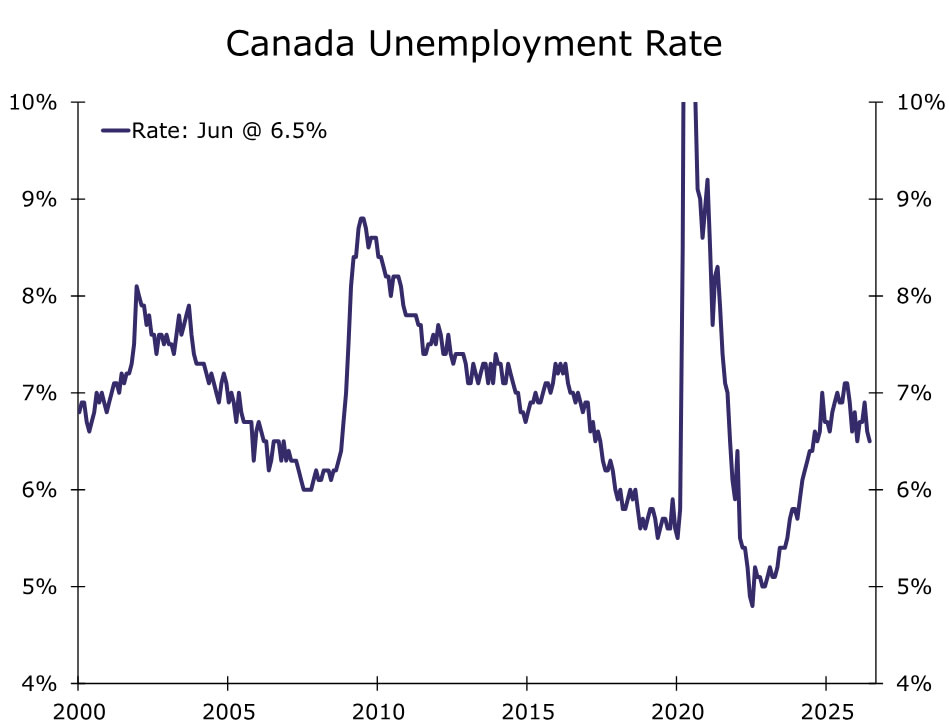
Canada’s labor market has shown tentative signs of stabilization in recent months. Employment gains in May and June reversed some of the weakness seen earlier in the year, though the latest increase of 18K was driven largely by part-time work. As a result, the broader trend remains one of modest hiring, with employment growth running sub-1% year-over-year.
The unemployment rate slid to 6.5% in June, at the lower-end of its recent 12-month range. Cooling labor supply should keep a lid on unemployment even as labor demand remains subdued. Wage growth and other measures of labor demand continue to cool gradually rather than abruptly.
While further hiring gains are likely to be modest, the labor market no longer appears to be deteriorating at the pace seen through much of 2024. For policymakers, that should reinforce the case for patience, with labor market conditions remaining weak enough to contain inflation pressures but not weak enough to necessitate additional near-term easing.
Source: Bloomberg Finance L.P. and Wells Fargo Economics
EM Week Ahead
Brazilian Central Bank • Wednesday
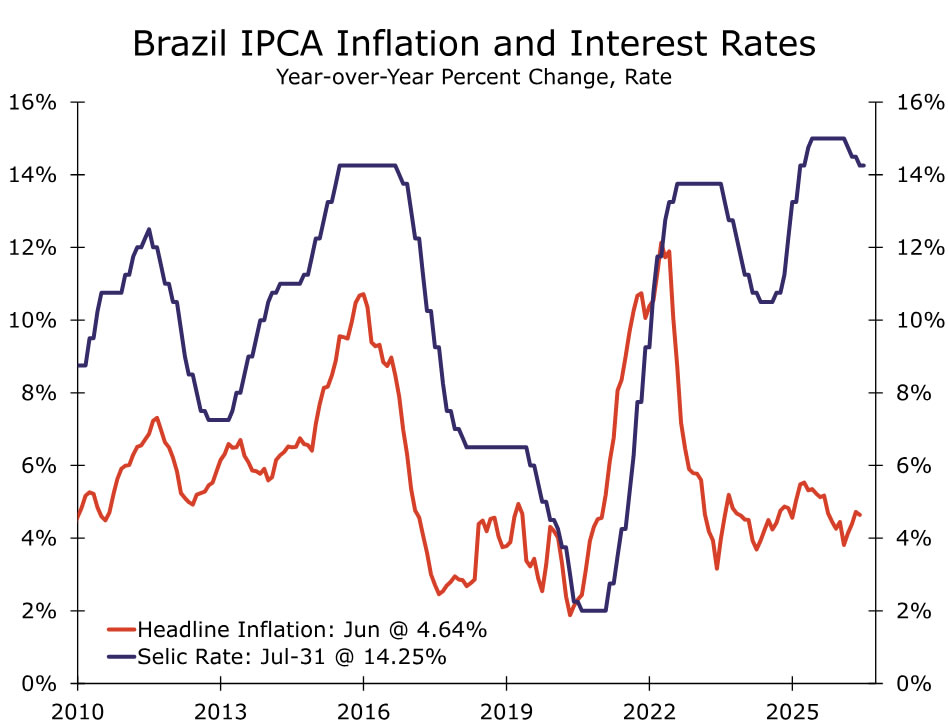
We expect the Brazilian Central Bank (BCB) to continue its easing cycle with a 25 bps rate cut next week, bringing the Selic Rate to 14.00%. Recent indicators support this move, with IPCA-15 inflation slowing to 4.52% year-over-year and 0.06% month-over-month in mid-July. Economic activity also appears to be losing momentum, as Brazil’s economic activity index slowed to 0.8% over the year in May from 1.1%.
That said, policymakers are likely to remain cautious. While the latest inflation data were encouraging, services inflation remains elevated and inflation expectations are still above target. At the same time, uncertainty surrounding energy prices, El Niño-related weather risks and the fiscal outlook suggests the disinflation process may not be fully secured.
Against this backdrop, we expect the BCB to continue easing gradually while retaining the option to pause if inflation risks reaccelerate. We continue to expect the Selic Rate to reach 14.00% by year-end, with another 25 bps cut in Q4.
Source: Bloomberg Finance L.P. and Wells Fargo Economics
Reserve Bank of India • Friday
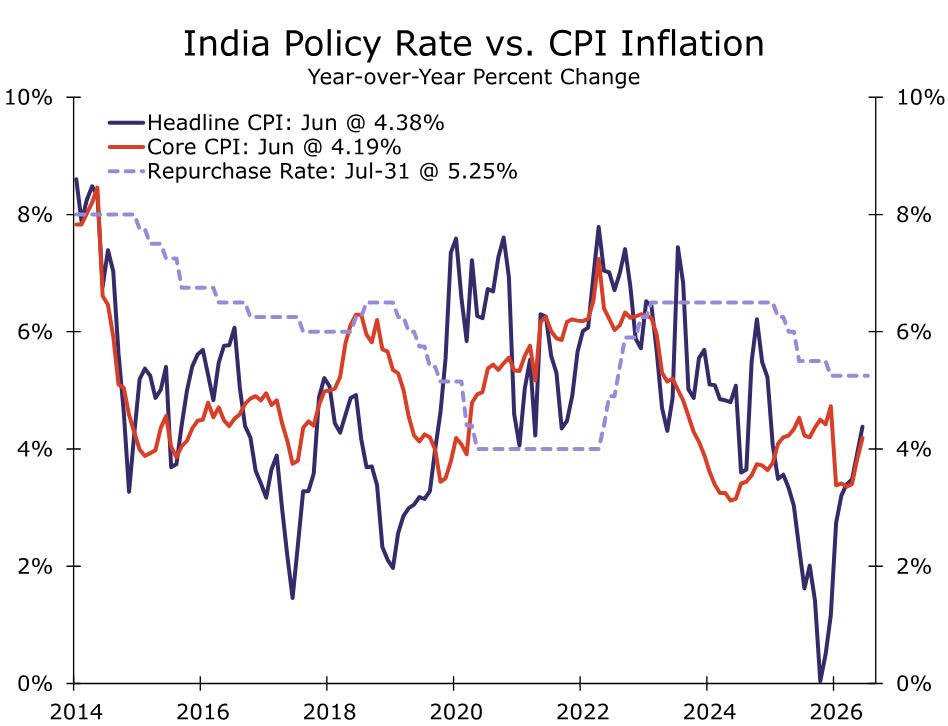
We expect the Reserve Bank of India (RBI) to keep the Repurchase Rate unchanged at 5.25% next week. Headline and core inflation rose to 4.38% and 4.19% year-over-year in June, respectively, which placed both measures above the RBI’s 4% midpoint target. Producer price pressures also remain elevated, with wholesale price inflation at 9.87% year-over-year. El Niño conditions add to food inflation risks.
While inflation risks have increased, the growth outlook remains mixed. Industrial production rose 7.3% year-over-year in June, but July PMI data point to slower momentum and stronger output price pressures. Higher oil prices have also widened the trade deficit and intensified pressure on the rupee despite substantial RBI intervention.
These competing pressures should keep the RBI on hold next week, though elevated inflation and rupee weakness may prompt a more hawkish tilt from its current neutral stance. We continue to expect a 25 bps hike in Q4, which would bring the Repurchase Rate to 5.50% by year-end.
Source: Bloomberg Finance L.P. and Wells Fargo Economics
Banxico • Friday
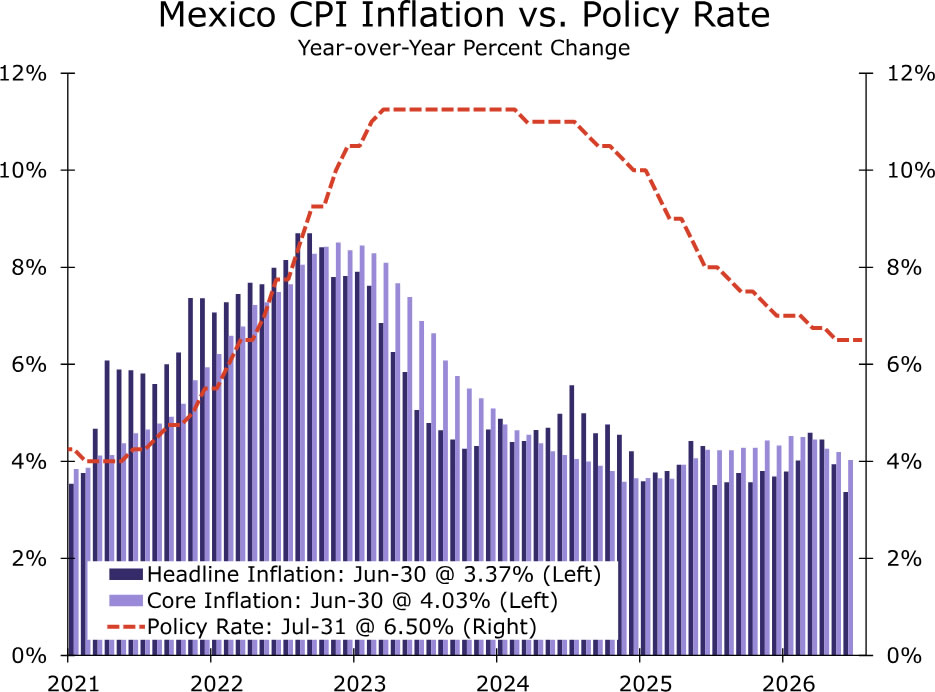
We expect Banxico to keep the Overnight Rate unchanged at 6.50% next week. Mexico’s economy rebounded strongly in Q2 after a weak start to the year, with GDP rising 1.5% quarter-over-quarter after a 0.6% contraction in Q1 and 2.2% year-over-year from 0.2%. Growth was broad-based, but we doubt this pace will be sustained. Q2 likely marked the strongest quarter of the year, with momentum set to fade in the second half as persistent USMCA uncertainty weighs on capex and limits the scope for a stronger recovery.
The latest biweekly inflation data point to continued disinflation, though core inflation remains sticky despite slowing since the start of the year. Inflation expectations also remain elevated over the year-ahead horizon. At the same time, ample slack should limit demand-driven price pressures.
We continue to expect Banxico to keep rates on hold through year-end. The bar for easing remains high, though weaker growth and further progress on inflation could open the door to a cut later this year or in early 2027.
 Source: Bloomberg Finance L.P. and Wells Fargo Economics





