


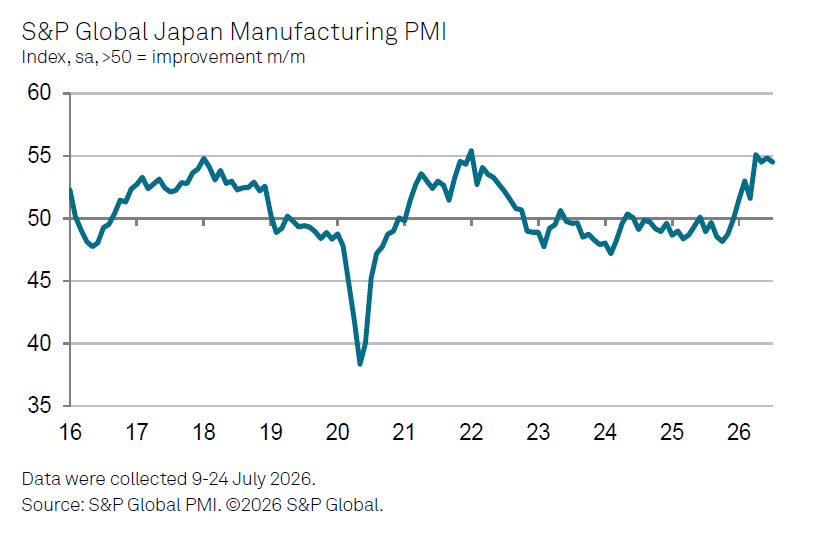
Japan’s manufacturing sector remained firmly in expansion territory in July, with the final S&P Global Manufacturing PMI edging down slightly to 54.5 from 54.8 in June. While the headline index eased marginally, it still pointed to a seventh consecutive month of improving business conditions as the sector entered the second half of the year with robust momentum.
The survey highlighted broad-based strength beneath the headline figure. Manufacturing output posted its strongest increase in nearly 12-and-a-half years as firms responded to the steepest rise in new orders in four-and-a-half years. According to S&P Global, many companies linked the improvement to stronger global demand for semiconductors and expanding AI-related manufacturing activity. Firms also stepped up hiring, but the surge in production and order inflows led to mounting capacity pressures, prompting a sharp increase in purchasing activity and inventory accumulation.
At the same time, geopolitical risks continued to shape business conditions. Companies reported building inventories in response to the conflict in the Middle East, driving the fastest increase in input stocks in more than two years. Although input cost inflation moderated from June, it remained elevated and continued to feed through to higher selling prices. The survey therefore points to a manufacturing sector benefiting from powerful structural demand drivers, while still contending with supply-chain and inflation risks stemming from geopolitical uncertainty.
Economic Data
| Indicator | Actual | Previous |
|---|---|---|
| Manufacturing PMI | 54.5 | 54.8 |
| Production | Strongest growth in nearly 12½ years | Expanded |
| New Orders | Strongest rise in 4½ years | Expanded |
| Employment | Solid increase | Increased |
| Input Costs | Rose at a marked but softer pace | Sharper increase |
| Selling Prices | Rose substantially | Increased |
Market Takeaways
- Manufacturing PMI eased only marginally from 54.8 to 54.5, remaining firmly in expansion territory for a seventh consecutive month.
- Output recorded its strongest increase since early 2014, supported by the steepest rise in new orders in four-and-a-half years, pointing to robust underlying demand.
- Survey respondents highlighted stronger global demand for semiconductors and AI-related manufacturing as key drivers of the rebound.
- Firms continued to hire, but rapid growth in production and orders intensified capacity pressures, prompting the fastest increase in purchasing activity since April 2022 and the quickest inventory build-up in more than two years.
- While input cost inflation moderated from June, cost pressures remained elevated due in part to the Middle East conflict, allowing manufacturers to continue raising selling prices.





