TL;DR: USD/JPY has recovered a third of last week’s intervention-driven losses, but Friday’s payrolls report sets up an asymmetric trade — a strong print faces profit-taking near 160 on intervention risk, while a weak print has a clear, undeterred path back to 155.
A Recovery That Faces Its First Real Test
USD/JPY has recovered roughly one-third of the losses triggered by last week’s rare US-Japan intervention, but Friday’s nonfarm payrolls report will test whether that recovery has much further to run. Under normal circumstances, a major upside or downside payroll surprise would produce broadly symmetrical reactions through Treasury yields and Fed expectations. This time is different. Rapid confirmation of intervention by both Washington and Tokyo, together with unusually forceful messaging, has changed how traders are likely to manage positions. A strong NFP could still send USD/JPY higher, but traders now have powerful reasons to take profits as it approaches 160. A weak report faces no equivalent restraint on the way back toward 155.
Intervention Changed More Than USD/JPY’s Level
The context of last week’s intervention is crucial. Washington and Tokyo didn’t merely step into the market and leave traders guessing — both sides moved quickly to confirm what happened, effectively removing ambiguity over whether the sharp fall from 163.97 was official intervention. That mattered because confirmation transformed a one-off market operation into a warning: authorities were prepared to act against excessive Yen weakness, and speculators shouldn’t assume USD/JPY could simply snap back once intervention flows ended.
Timing reinforced that message. Intervention came immediately before a heavy US data week containing both ISM surveys and, most importantly, today’s employment report. Officials would have known strong data could revive Fed hike expectations and quickly rebuild upward pressure on USD/JPY. By demonstrating their willingness to intervene beforehand, they changed the risk calculation facing anyone considering rebuilding long positions.
That deterrence may prove more important than whether authorities actually intervene again. Traders don’t need to know the precise level or timing of another operation — they only need to believe the probability is sufficiently high that holding an extended USD/JPY long becomes unattractive. In that sense, intervention can continue influencing the pair even without another Dollar being sold.
NFP Has Plenty of Room to Surprise
Today’s employment report arrives after a particularly mixed set of leading indicators. Expectations center on roughly 80K–100K growth in July payrolls after just 57K in June, while unemployment is expected around 4.2% and average hourly earnings around 0.3% mom. But this week’s data provide little conviction over which side of consensus payrolls will land:
- ISM Manufacturing Employment jumped from 49.7 to 52.8, returning to expansion for the first time in 33 months — the strongest employment signal of the week.
- ISM Services Employment moved sharply the opposite direction, falling from 51.2 to 47.4 and returning to contraction.
- ADP added to the softer side of the picture, with private employment growth of only 44K.
- JOLTS offered a more stable message: job openings were little changed at 7.4m, hiring remained subdued at 5.3m, and quits and layoffs were also broadly unchanged — reinforcing a picture of a low-hire, low-fire labor market rather than an abrupt deterioration.
- Weekly initial jobless claims at just 199K confirmed employers are still showing little inclination to shed workers.
Taken together, there’s no clean signal ahead of NFP. That raises the potential for a meaningful surprise — and makes the reaction in USD/JPY particularly interesting.
Strong NFP: USD/JPY Can Rise, But Who Wants to Chase It Above 160?
A strong payroll report should initially produce a straightforward reaction. Treasury yields would likely rise, the Dollar should strengthen, and markets could revive expectations for a September Fed hike — a possibility particularly relevant with Brent having rebounded above $83, reducing some of the disinflationary relief that drove Fed repricing earlier this week.
USD/JPY would naturally participate. The rebound from 155.22 could extend, but the difficulty comes as the pair approaches 160. Technically, the 50% retracement of 163.97 to 155.22 lies at 159.59, almost exactly overlapping the 55 4H EMA, currently around 159.51 — making 159.50–160.00 an obvious resistance zone even without intervention risk.
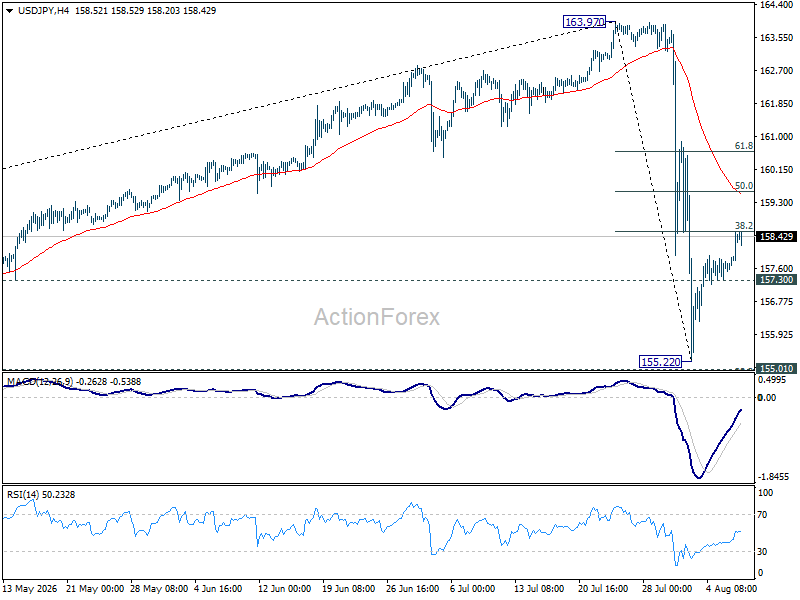
But intervention changes incentives around that resistance dramatically. A trader buying USD/JPY following strong payrolls may have a profitable position by the time the pair approaches 160. Holding onto that trade then means accepting the possibility that Washington and Tokyo intervene again and erase those gains rapidly — last week’s operation demonstrated that this is no longer a theoretical tail risk.
Friday timing adds another consideration. Traders approaching US close would have to decide whether to carry those longs through a weekend of persistent Middle East uncertainty and then into Monday’s thinner Asian liquidity, when intervention risk would be particularly difficult to ignore. Many may decide there’s little reason to do so — creating a natural tendency toward profit-taking around 160. Importantly, authorities wouldn’t need to intervene for this mechanism to work: if speculators voluntarily close longs rather than challenge authorities, deterrence itself becomes part of resistance.
Weak NFP: Downside Has No Intervention Problem
A significant payroll miss produces a much cleaner setup. Weak employment growth, particularly if combined with higher unemployment or softer wage growth, would undermine remaining expectations for a September hike. Treasury yields would likely fall, the Dollar would weaken, and USD/JPY could quickly reverse its recovery from 155.22.
Unlike the upside case, traders would have little reason to fear that authorities might stand in their way. Last week’s intervention was explicitly aimed at strengthening the Yen — a fundamental move in the same direction would therefore be entirely consistent with the policy objective already demonstrated by Washington and Tokyo.
Technically, a break of 157.30 minor support would shift focus back toward the 155.22 intervention low. The size and speed of any decline would depend heavily on the magnitude and composition of the payroll surprise, but there’s little obvious policy deterrent preventing traders from testing that area.
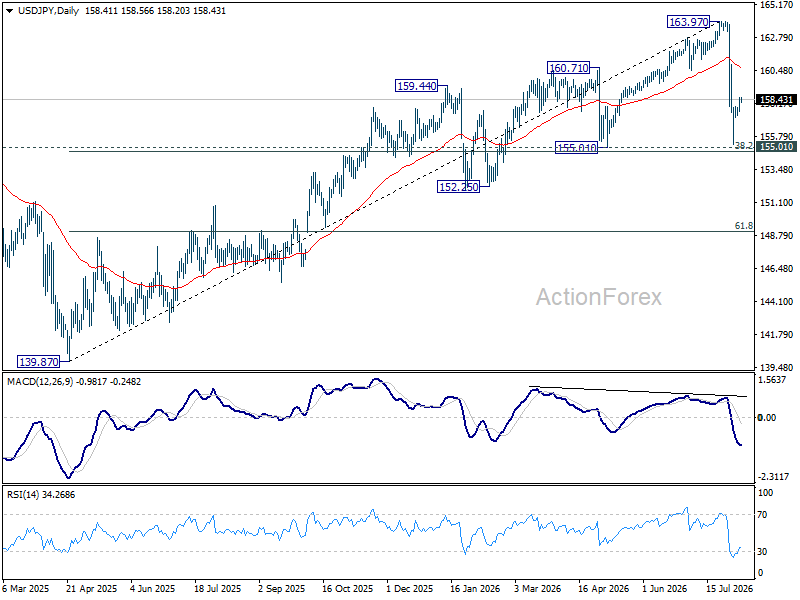
There is, nevertheless, a different reason for shorts to become cautious around 155. The 38.2% retracement of 139.87 to 163.97 lies at 154.76, creating significant medium-term technical support immediately beneath the intervention low. Once USD/JPY approaches that 154.76–155.22 zone, fresh downside would offer progressively less attractive risk-reward. Weekend positioning matters here too — with geopolitical uncertainty still elevated, traders sitting on profitable USD/JPY shorts may see little benefit in pressing them aggressively into major technical support immediately before markets close, which could generate profit-taking around 155 even without any official resistance to Yen strength.
ActionForex’s View: Same Payroll Surprise, Very Different Risk Calculations
The result is an unusually asymmetric NFP setup. A strong report can revive Fed hike expectations and extend USD/JPY’s rebound, but every move toward 159.50–160.00 increases the incentive for traders to bank profits rather than challenge authorities who have already demonstrated willingness to intervene.
A weak report has a clearer path lower. A break of 157.30 could reopen 155.22, with authorities unlikely to discourage a move that reinforces their own intervention objective. Only around 154.76–155.22 does the downside encounter a comparable reason for traders to step back — and there, the constraint comes from technical support and weekend risk rather than fear of official action.
That could leave 155–160 functioning as an effective post-intervention range. More importantly, it demonstrates why the success of last week’s operation shouldn’t be judged solely by whether Washington and Tokyo return to the market. If intervention risk persuades traders to take profits before USD/JPY can rebuild its previous rally, deterrence is already doing much of the work authorities intended.
Key Takeaways
- USD/JPY faces an asymmetric NFP setup: intervention risk caps upside profit-taking near 160, while downside toward 155 faces no equivalent official resistance.
- Leading indicators send conflicting signals into NFP — ISM Manufacturing improved sharply while ISM Services contracted and ADP came in soft, leaving no clean consensus read.
- 159.50–160.00 is key resistance (the 50% retracement at 159.59 overlapping the 55 4H EMA at 159.51), reinforced by traders’ reluctance to hold longs through intervention-risk weekends.
- A break of 157.30 support would reopen the 155.22 intervention low, a move authorities have no incentive to resist since it aligns with their own policy objective.
- 154.76–155.22 marks the next technical floor beneath the intervention low, where profit-taking on shorts is likely driven by technical support and weekend risk rather than intervention fear.