


TL;DR: USD/JPY has tumbled from 160.38 through 158, not because of actual intervention but because fear of a repeat is shaping trader psychology near 160 — a fear reinforced by rapidly repricing BoJ tightening expectations, setting up an asymmetric test for Friday’s NFP.
Not Intervention, but July Changed the Risk Calculus
USD/JPY has fallen sharply from 160.38 yesterday, and the selloff extends through 158 today. But latest move bears little resemblance to confirmed intervention seen at end of July. That operation drove pair almost vertically from 163.97 to 155.22, a drop of roughly 8.75 Yen, or more than 5%, as Japan intervened with US participation. By comparison, latest decline has been much smaller, more orderly and spread over hours rather than minutes.
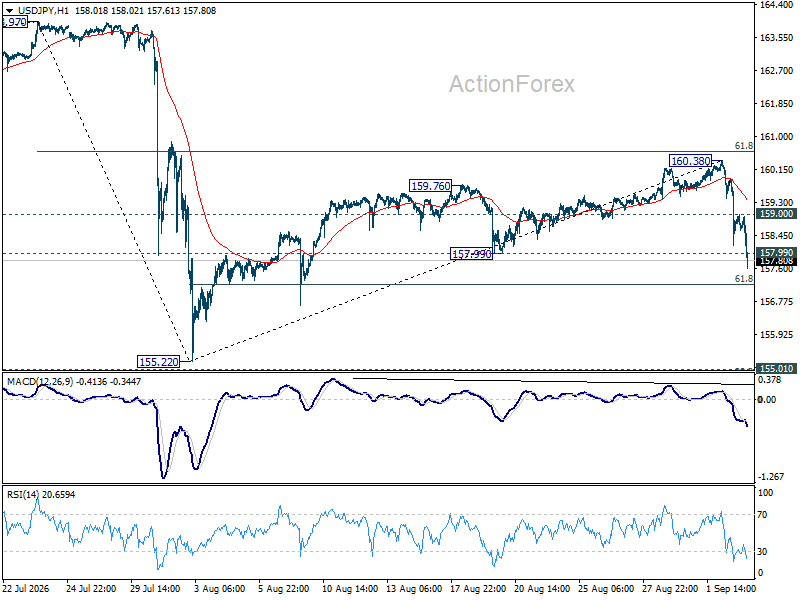
There is therefore little in price action itself to suggest authorities have stepped back into market. But July intervention still matters because it changed how traders behave when USD/JPY approaches 160. With pair again testing familiar territory ahead of another US payroll report, market is facing a pre-NFP repeat in positioning psychology, even without a repeat of official action.
That leaves an important distinction: intervention is not driving USD/JPY lower directly, but fear of intervention is shaping risk-reward around 160. Traders carrying short-Yen positions now have recent evidence that official action can produce a sudden multi-Yen reversal. That makes position reduction more likely before authorities actually intervene.
Intervention Fear Explains Timing; BoJ Repricing Explains Durability
Intervention anxiety alone would make latest move vulnerable to reversal. What gives Yen strength a more durable foundation is rapid repricing of BoJ tightening path.
Markets are no longer simply debating whether BoJ raises rates at September 17–18 meeting. OIS pricing points to roughly 96.5bp of cumulative tightening over the coming 12 months, close to four quarter-point hikes. September itself is priced at around an 84% probability, but more important development is how much additional tightening is being built beyond that meeting.
BoJ board member Hajime Takata reinforced that shift in his Wednesday speech in Sapporo. He described “2026 [as] a regime change” in monetary policy, argued rate hikes should become “nimble and data-dependent,” and said BoJ should not be “bound by particular intervals or ranges anticipated in the markets.”
That directly challenges old assumption of roughly semiannual tightening. If BoJ is moving from two carefully spaced hikes a year toward a genuinely data-dependent cycle, Yen becomes less attractive as a cheap and predictable funding currency.
Washington Is Reinforcing, Not Creating, the BoJ Story
US pressure adds another layer. Treasury Secretary Scott Bessent has repeatedly encouraged Japan to normalize policy, while reports following his G20 meetings with Japanese officials said he argued that Japan’s next step should be higher rates.
That matters because Washington and Tokyo increasingly appear aligned on the direction of adjustment: less Yen weakness and tighter Japanese monetary conditions. It also reduces market confidence that renewed USD/JPY gains well through 160 would be passively tolerated.
Still, BoJ tightening case should not be reduced to US pressure. Takata’s argument is domestic: Japan’s inflation regime has changed, price stability target is close to being achieved, and policy should increasingly guard against an inflation overshoot. Bessent amplifies that backdrop; he does not create it.
The distinction reinforces central thesis. Intervention fear explains why traders are nervous near 160. BoJ repricing explains why buying back Yen can continue even without intervention.
ActionForex’s Technical View on USD/JPY
Technical picture has deteriorated quickly. USD/JPY’s decline from 160.38 has now extended through 157.99 support, confirming that the rebound from 155.22 has completed as a three-wave corrective move. Immediate focus is now on 61.8% retracement of 155.22 to 160.38 at 157.19.
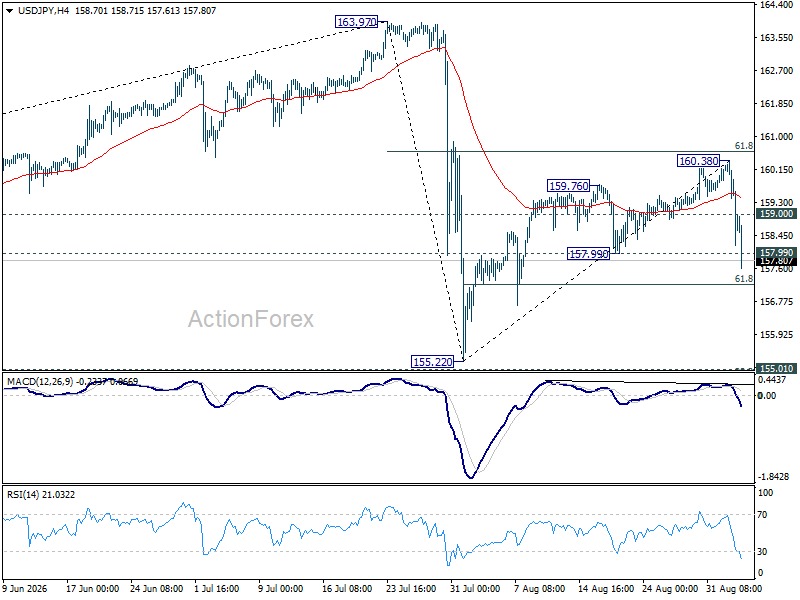
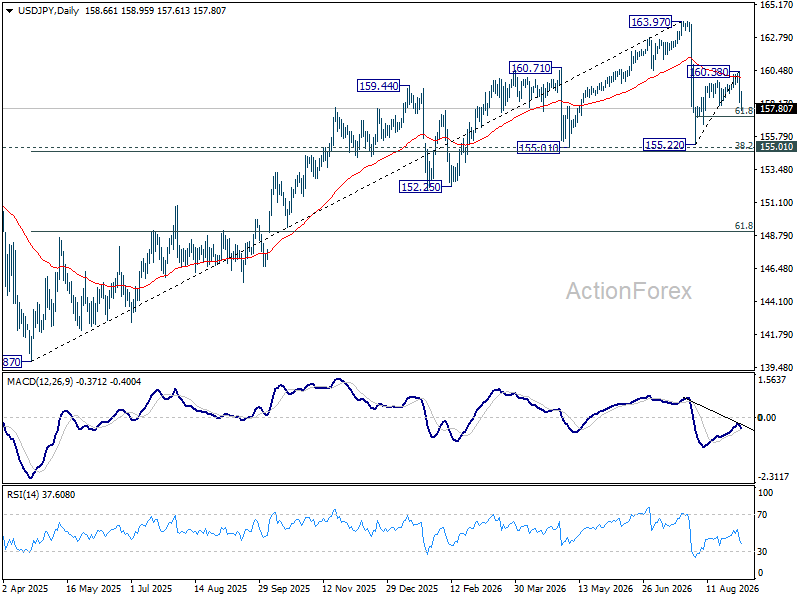
Firm break of 157.19 will pave the way toward the 154.76–155.01 medium-term support zone, which includes the 38.2% retracement of 139.87 to 163.97 at 154.76. The recent 155.22 intervention low sits just above that area.
Momentum is already stretched. 4H RSI has dropped into deeply oversold territory around low-20s, while MACD has turned sharply lower. That creates room for a near-term bounce, but an oversold rebound would not repair technical damage by itself. On upside, 159.00 is first minor resistance. A break there would stabilize near-term picture and reopen 160. But that is where technical recovery runs into a much less measurable obstacle: intervention risk.
NFP Makes the Setup Asymmetric
Friday’s US payroll report is therefore unusually important.
Current Fed pricing still favors another September hike, but softer ADP employment has reminded markets that labor data remain one of clearest ways to challenge hawkish path. A weak NFP would attack USD/JPY through US side of rate differential: Treasury yields could fall, Fed hike expectations could ease and the break of 157.99 could extend toward 157.19.
That creates a relatively clean downside sequence: 157.19 → 154.76–155.22 support zone
There is no equivalent policy barrier preventing Yen from strengthening through those levels.
A strong NFP creates a different setup. It would likely support US yields, and allow USD/JPY to recover through 159.00 toward 160. But a move materially above 160 must overcome two additional hurdles that did not exist in same form earlier this year: fresh intervention memory and a much more aggressive BoJ tightening path.
That does not make 160 an official ceiling. It does mean upside becomes progressively harder to price with conviction.
Strong Payrolls Need to Do More Than Save September
This is where NFP asymmetry becomes clearest.
A merely solid jobs report may be enough to preserve September Fed hike expectations. But that may only produce another test of 160.
For USD/JPY to establish a more durable move higher, NFP probably needs to push markets toward a more aggressive Fed path beyond September, not just validate one hike already substantially priced. In other words, US rates would need to become more hawkish faster than Japanese rates are being repriced.
By contrast, a weak NFP does not face that higher threshold. It would simultaneously reduce US rate support, reinforce Fed-BoJ convergence and encourage more short-Yen covering.
That leaves USD/JPY with an asymmetric pre-NFP setup. Weak jobs have a relatively unobstructed route toward 155 levels. Strong jobs can drive a rebound, but a convincing break above 160 must overcome both intervention risk and a BoJ tightening cycle that markets increasingly expect to accelerate.
Key Takeaways
- USD/JPY’s fall from 160.38 toward 158 is far more orderly than July’s confirmed intervention, suggesting fear of a repeat, not actual official action, is driving the move.
- OIS pricing points to roughly 96.5bp of cumulative BoJ tightening over the next 12 months, with September priced at an 84% probability but more tightening expected beyond it.
- BoJ’s Takata described 2026 as a “regime change” toward nimble, data-dependent hikes, directly challenging the old assumption of roughly semiannual BoJ moves.
- A weak NFP has a relatively clear path toward the 154.76-155.22 support zone, while a strong NFP faces two extra hurdles above 160: intervention memory and accelerating BoJ tightening.
- 157.19 is the key near-term level; a break opens the 154.76-155.01 zone, while 159.00 is the first resistance on any oversold bounce.





