


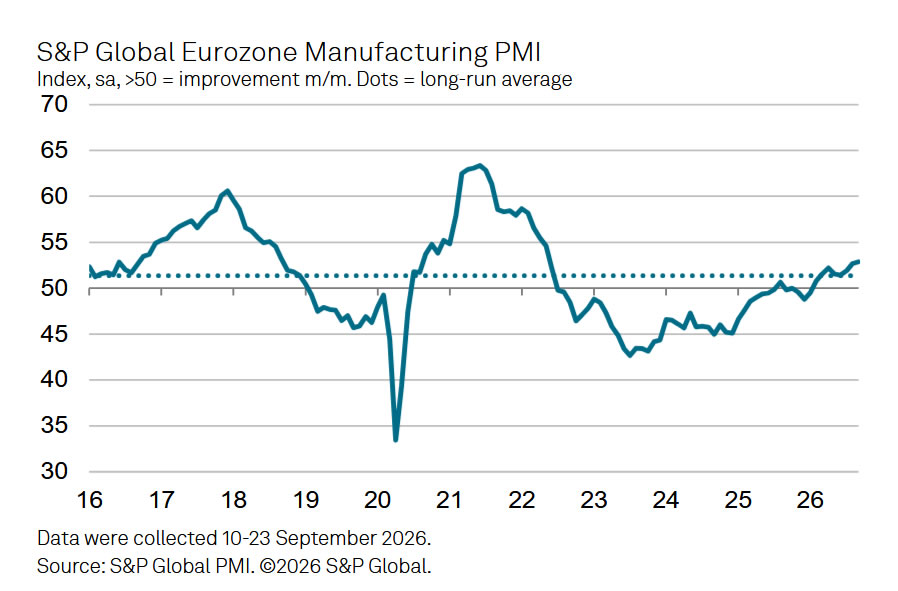
Eurozone PMI Manufacturing rose from 52.7 to 52.9 in September, reaching a 52-month high, while the Output Index increased from 53.3 to 53.6, its strongest level in 55 months. The expansion also broadened geographically, with all eight economies covered by the survey recording readings above 50 for the first time in more than four years. The Netherlands led the improvement, followed by Ireland and Austria, while Germany and Greece also posted solid expansions and Spain, France and Italy grew more moderately.
Demand strengthened further, with new orders rising at the fastest pace since March 2022 and export orders increasing for a second consecutive month, marking the first sustained rise in foreign demand for more than four-and-a-half years. Backlogs increased for the first time since April, while factory employment rose again after three years of persistent declines. Purchasing activity also strengthened, and business confidence climbed to a seven-month high, indicating that the recovery is spreading beyond production into orders, hiring and capacity expansion.
The main counterpoint was renewed inflation pressure. Input costs and output prices both rose at faster rates for the first time since May, although the increases remained below the peaks seen earlier in the year. S&P Global said the upturn was being driven particularly by stronger demand for investment goods, including machinery and equipment linked to AI and defence spending, while consumer-goods demand continued to decline under cost-of-living pressure. The September survey therefore points to a broader and more convincing manufacturing recovery, but one now accompanied by firmer pipeline price pressures.
Data Summary
| Indicator | Current month | Previous month | Trend |
|---|---|---|---|
| PMI Manufacturing | 52.9 | 52.7 | 52-month high |
| PMI Output | 53.6 | 53.3 | 55-month high |
Eurozone PMI Manufacturing rose from 52.7 to 52.9 in September, while output strengthened from 53.3 to 53.6. Both readings reached their highest levels since 2022.
Components
| Component | Trend |
|---|---|
| New Orders | Fastest growth since March 2022 |
| New Export Orders | Rose for a second month; first sustained increase in over 4.5 years |
| Employment | Increased again after three years of persistent declines |
| Backlogs | Rose for the first time since April |
| Purchasing Activity | Second-fastest increase since May 2022 |
| Supplier Delivery Times | Lengthened further, but delays were least severe since February |
| Business Confidence | Rose to a seven-month high |
| Input Prices | Inflation accelerated for the first time since May |
| Output Prices | Inflation accelerated for the first time since May |
The recovery broadened beyond production into orders, exports, employment and purchasing, while price pressures also began to firm again.
Key Takeaways
- PMI Manufacturing rose from 52.7 to 52.9, reaching a 52-month high.
- The Output Index climbed from 53.3 to 53.6, its strongest level in 55 months.
- All eight surveyed Eurozone economies recorded manufacturing expansion for the first time in more than four years.
- New orders grew at the fastest pace since March 2022, strengthening the case that the recovery is increasingly demand-led.
- Export orders rose for a second straight month, marking the first sustained increase in more than four-and-a-half years.
- Stronger order books encouraged factories to add workers again, ending the persistent employment decline seen over the previous three years.
- Investment goods were the main growth engine, with AI and defence-related demand supporting machinery and equipment production.
- Consumer-goods demand remained weak as higher living costs continued to restrain household spending.
- Input-cost and selling-price inflation both accelerated for the first time since May, although they remained below earlier-year peaks.
- Overall, September showed a broader and more convincing manufacturing recovery, but one increasingly accompanied by renewed pipeline inflation pressure.





