Sterling Rallied, Dollar Fell and Aussie Fell Even Harder
Today’s themes:
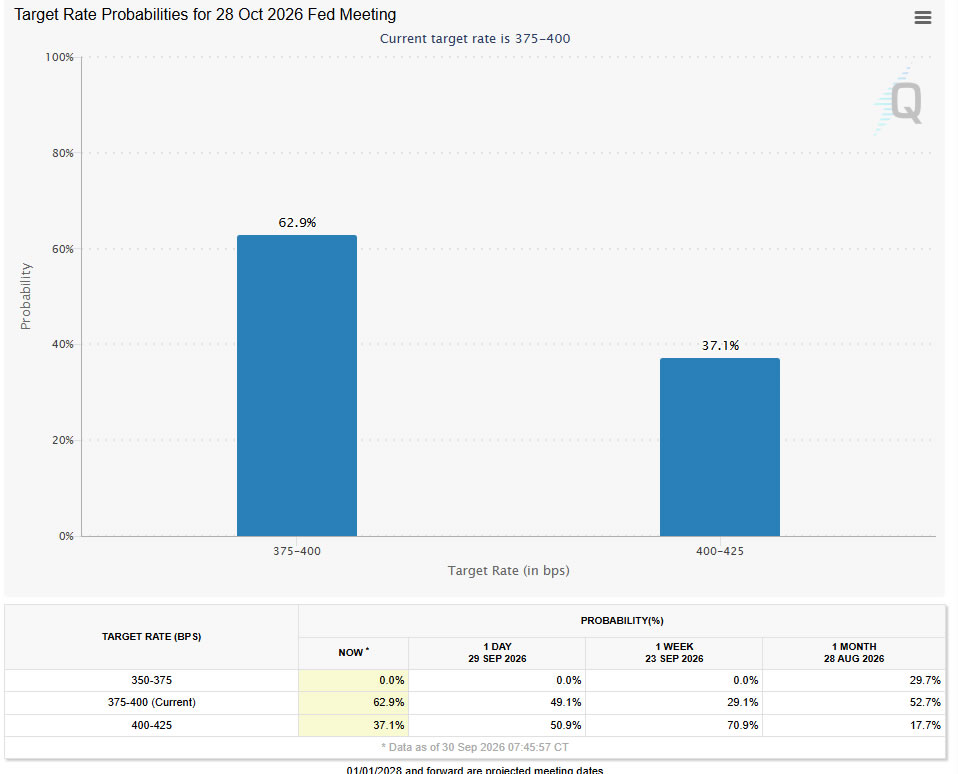
- Dollar: softer headline and core PCE reinforced New York Fed President John Williams’ case that there is “no need for urgency” on another hike, pulling October Fed odds from around 51% to 37.1%.
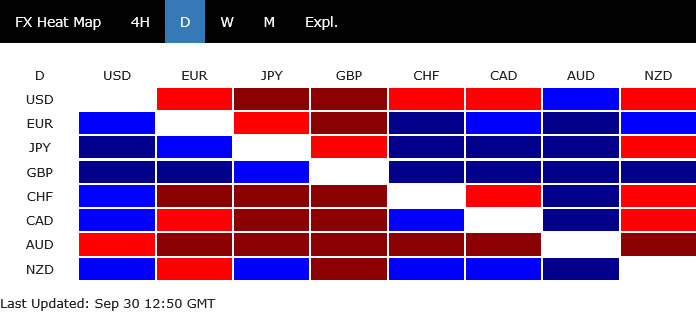
- Aussie: headline CPI jumped to 4.0% y/y, but a soft trimmed mean failed to rebuild rate-hike expectations after Governor Michele Bullock’s cautious post-hike guidance, leaving AUD the weakest major currency even against a broadly weaker Dollar.
- Sterling: upwardly revised GDP landed on top of an already-building BoE tightening repricing from Governor Andrew Bailey and Deputy Governor Dave Ramsden, pushing November hike odds to around 89%.
Sterling rallied, Dollar fell and Aussie fell even harder. The difference was not the data alone, but where each central bank already stood before the numbers arrived.
US PCE inflation undershot expectations and reinforced Williams’ argument that there is “no need for urgency” on another rate hike. Australian headline CPI accelerated to 4.0% y/y, but a softer-than-expected trimmed mean failed to rebuild expectations for rapid RBA follow-through after Bullock’s cautious guidance earlier this week. In the UK, meanwhile, stronger GDP landed on top of an already-developing BoE tightening repricing triggered by Bailey and Ramsden.
The result was a clear divergence across FX. The Dollar weakened broadly, although it remained firmer against AUD. Aussie underperformed every other major currency, extending its post-RBA decline despite what was, underneath the headline, a relatively benign inflation report. Sterling, meanwhile, broadened its gains as markets pushed the expected BoE policy path higher.
Softer PCE Validates Williams’ Case for Patience
The US inflation report delivered the clearest challenge to the recently aggressive October Fed-hike trade.
Headline PCE inflation rose 0.3% m/m, below the 0.4% consensus, while core PCE increased 0.2% m/m, also undershooting the 0.3% forecast. On an annual basis, headline inflation came in at 3.4% y/y versus 3.7% expected, while core inflation was 3.0% versus 3.4% expected.
The annual misses look particularly large, although they need to be treated carefully because the BEA’s annual benchmark revisions lowered the historical comparison path. The cleaner fresh signal came from the monthly readings: both headline and core inflation undershot consensus.
Markets responded accordingly. The probability of an October Fed hike fell from around 51% before the release to 37.1%, leaving a hold at 62.9% as the clearer market base case.
That repricing fits directly with Williams’ Tuesday message. He argued that September’s hike left the Fed with “no need for urgency”, while still allowing for another increase later this year. PCE did not eliminate the possibility of further tightening, but it weakened the argument that the next adjustment needs to come immediately.
US PCE at a Glance
- Headline PCE: 0.3% m/m (vs. 0.4% forecast); 3.4% y/y (vs. 3.7% expected).
- Core PCE: 0.2% m/m (vs. 0.3% forecast); 3.0% y/y (vs. 3.4% expected).
- October Fed hike odds: fell from around 51% to 37.1%; hold at 62.9% now the base case.
- Context: annual misses partly reflect BEA benchmark revisions to the historical comparison path.
Strong Spending Keeps PCE From Being a Clean Dovish Signal
The report was not uniformly soft.
Personal spending surged 0.9% m/m, above the 0.8% forecast, while real PCE increased a strong 0.6%. Personal income, by contrast, rose only 0.2%, and real disposable income was unchanged.
Consumers therefore continued spending considerably faster than their incomes were growing.
That matters because it keeps the economic message mixed. The inflation data weakened the case for urgency, but the spending data did not show an economy suddenly rolling over.
Energy also remained visible inside the report. Gasoline prices rose strongly, while broader energy goods and services remained an important source of price pressure. Yet even with that contribution, the PCE indices still failed to reach the inflation rates markets had expected.
The Dollar reaction therefore reflects less conviction in immediate Fed tightening, rather than a wholesale shift toward a weak US growth narrative.
- Personal spending: +0.9% m/m (vs. 0.8% forecast); real PCE +0.6%.
- Personal income: +0.2% m/m; real disposable income unchanged.
- Energy: gasoline prices rose strongly, remaining a source of price pressure despite the overall undershoot.
Aussie Falls Despite a Benign Underlying CPI Signal
Australia produced almost the opposite market puzzle.
Headline CPI accelerated from 3.5% to 4.0% y/y, exactly matching expectations, while monthly inflation slowed from 1.0% to 0.4%, also in line with consensus.
But the underlying numbers were softer.
Trimmed mean CPI slowed from 0.5% to 0.2% m/m, below the 0.3% forecast, while the annual rate held at 3.6% for a third consecutive month.
The gap between headline and underlying inflation was heavily influenced by energy. Automotive fuel prices surged 14.8% m/m after rising 7.5% in July, reflecting higher world oil prices as well as the remaining unwind of federal fuel-excise relief. Electricity also contributed materially to the headline increase, while both categories were excluded from the trimmed mean calculation.
That makes August a hot headline but relatively benign underlying inflation report.
Yet AUD was still the weakest major currency of the session.
Australia CPI at a Glance
- Headline CPI: 3.5% to 4.0% y/y (as expected); monthly rate slowed from 1.0% to 0.4%.
- Trimmed mean CPI: 0.5% to 0.2% m/m (below 0.3% forecast); annual rate held at 3.6% for a third month.
- Automotive fuel: +14.8% m/m after +7.5% in July, driven by oil prices and the fuel-excise relief unwind.
- Electricity also contributed to the headline, but both fuel and electricity were excluded from the trimmed mean.
CPI Failed to Reverse the Post-RBA Repricing
That underperformance says more about Tuesday’s RBA meeting than about Wednesday’s CPI report.
The RBA raised the cash rate unanimously to 4.60% and retained an explicit willingness to tighten again if necessary. But Bullock’s press conference introduced considerably more uncertainty about whether another move would actually be required.
Her emphasis was that the latest degree of restriction might prove sufficient, rather than that another hike should already be treated as the baseline.
The softer monthly trimmed mean did little to challenge that interpretation. If anything, it was consistent with the possibility that this week’s increase may prove enough, rather than providing markets with a reason to rebuild expectations for immediate follow-through.
That helps explain the otherwise unusual price action.
A softer US PCE report and broad Dollar weakness would normally provide at least some support to a currency such as AUD. Instead, Aussie continued falling even against Dollar.
The post-RBA repricing was strong enough to overwhelm the external Dollar tailwind.
Sterling Extends a BoE Repricing That Started Before GDP
Sterling sat at the other end of the spectrum.
UK Q2 GDP growth was revised from 0.4% to 0.5% q/q, while annual growth was revised from 1.2% to 1.4% y/y. The stronger numbers reinforced the view that the economy entered the second half with more resilience than previously estimated.
But GDP did not start the Sterling move.
The sequence began with BoE Governor Andrew Bailey, who highlighted the difficulty of maintaining current policy if persistently high energy prices continue to lift inflation. Deputy Governor Dave Ramsden then went further on Monday, explicitly leaving open the possibility of another hike if upside inflation pressures continue building.
GDP provided the third leg.
Markets now assign close to an 89% probability of a November hike, while the broader OIS curve prices multiple additional increases through 2027.
The crucial distinction is therefore straightforward:
GDP confirmed the Sterling trade. It did not create it.
UK GDP at a Glance
- Q2 GDP: revised from 0.4% to 0.5% q/q; annual rate revised from 1.2% to 1.4% y/y.
- November BoE hike odds: around 89%, with the OIS curve pricing multiple further increases through 2027.
- Sequence: Bailey’s energy-inflation warning, then Ramsden’s explicit hike openness Monday, then GDP as the third confirming leg.
UK Growth Is Resilient, but Domestic Demand Is Less Impressive
The GDP composition also warrants some restraint.
Output growth was relatively broad, with services and construction expanding. But on the expenditure side, net trade did much of the heavy lifting. Export volumes rose 2.8%, with goods exports particularly strong, while household consumption increased only 0.3%.
Government consumption fell 0.5%, although that number was partly distorted by June’s heatwave and associated school closures.
Meanwhile, general government net borrowing rose from 4.2% to 5.2% of GDP, increasing attention on the October 28 Budget and the possibility that tighter fiscal policy will eventually weigh on activity.
That leaves Sterling with a strong near-term policy story but a less straightforward medium-term growth story.
For now, markets are focused on the former.
- Export volumes: +2.8%, with goods exports particularly strong.
- Household consumption: +0.3% only.
- Government consumption: -0.5% (partly distorted by June’s heatwave and school closures).
- General government net borrowing: rose from 4.2% to 5.2% of GDP, ahead of the October 28 Budget.
One Energy Shock, Three Different FX Outcomes
Energy prices run through all three stories, but they are producing very different market outcomes.
In the US, energy continued to lift some PCE components, yet broader inflation still undershot expectations and pushed markets away from an October Fed hike.
In Australia, fuel and electricity drove headline CPI sharply higher, but trimmed mean inflation remained comparatively contained and failed to rebuild expectations for another near-term RBA move.
In Britain, persistent energy inflation is one of the reasons BoE officials have become more willing to discuss further tightening, while resilient GDP has reduced immediate concern about the economy’s ability to tolerate it.
The same underlying shock is therefore generating three different FX reactions because each central bank entered the day from a different policy position.
- The Dollar is weaker because urgency is being priced out.
- Aussie is weaker because the market still doubts how much tightening remains after this week’s hike.
- Sterling is stronger because markets increasingly believe the BoE tightening cycle has further to run.
Three Currencies, Three Central Bank Positions
| Currency | Data Surprise | Pre-Existing Central Bank Stance | FX Outcome |
|---|---|---|---|
| USD | Headline PCE 0.3% (vs. 0.4%); core 0.2% (vs. 0.3%) | Williams: “no need for urgency” on another hike | Dollar weakened broadly; Oct hike odds fell from ~51% to 37.1% |
| AUD | Headline CPI 4.0% y/y (as expected); trimmed mean 0.2% m/m (below 0.3% forecast) | Bullock: this week’s hike “might prove sufficient” | AUD weakest major, extending its post-RBA decline |
| GBP | Q2 GDP revised up to 0.5% q/q / 1.4% y/y | Bailey and Ramsden already flagging further tightening | Sterling broadened gains; Nov hike odds near 89% |
Related Coverage
Sterling & UK
Sterling Broadens Gains as BoE Repricing Builds and UK GDP Confirms Resilience; EUR/GBP Presses Breakdown, GBP/CHF Tests Breakout — a deeper look at the technical levels now in play across Sterling crosses.
US Data & Fed Voices
US PCE Inflation Misses Forecasts Even as Consumer Spending Accelerates — the full detail behind today’s inflation undershoot.
US ADP Employment Beats at 90K, but Job Gains Remain Concentrated — an early labor-market cross-check alongside today’s inflation data.
Fed Hawks Keep Inflation Pressure in Focus, but Williams Signals Patience — the split among Fed officials behind today’s “no need for urgency” message.
Asia-Pacific Data
Australia CPI Jumps to 4.0%, but Trimmed Mean Undershoots Expectations — the full breakdown of today’s headline-versus-underlying inflation gap.
ANZ NZ Business Confidence Softens as Oil Surge Hits Activity, Not Inflation — a neighboring economy facing the same energy shock with a different transmission.
China NBS PMIs Return to Expansion, but Demand Still Trails Production — the regional demand backdrop AUD trades against.
Japan August Data Soften as Industrial Production Falls and Retail Sales Momentum Fades — a softer print from the region’s other major economy.
Yen Crosses
Why Are EUR/JPY and AUD/JPY Breaking When USD/JPY Is Barely Moving? — how intervention risk is redirecting broad Dollar moves into the Yen crosses.
FAQ
Why did the Dollar fall on a stronger consumer spending report?
Because PCE inflation still undershot forecasts even though spending was strong. Markets read the softer core and headline PCE as reinforcing Williams’ case for patience, pulling October Fed hike odds down from around 51% to 37.1%.
Why did AUD fall despite a hot headline inflation print?
Because the trimmed mean, the RBA’s preferred underlying measure, undershot expectations at 0.2% m/m, and Governor Bullock’s post-hike message already suggested this week’s increase might be sufficient. That left little room for markets to rebuild near-term tightening bets.
Why didn’t GDP start Sterling’s rally?
Because the BoE repricing was already underway from Bailey’s and Ramsden’s hawkish comments earlier in the week. GDP simply confirmed the economy’s resilience on top of a move that had already begun.
Key Takeaways
- US headline and core PCE undershot forecasts, pulling October Fed hike odds from around 51% to 37.1%; strong spending (+0.9% m/m) kept it from being a clean dovish signal.
- AUD was the weakest major currency of the session despite headline CPI jumping to 4.0% y/y, because trimmed mean inflation slowed to just 0.2% m/m, below forecast.
- AUD underperformed even against a broadly weaker Dollar, showing the post-RBA repricing outweighed the external Dollar tailwind.
- UK Q2 GDP was revised up to 0.5% q/q and 1.4% y/y, reinforcing a BoE tightening repricing that began with Bailey and Ramsden; markets now price around 89% odds of a November hike.
- The same energy price shock ran through all three inflation reports but produced opposite FX reactions because each central bank entered the day from a different policy stance.
What to Watch Next
Whether Friday’s nonfarm payrolls confirm or complicate today’s ADP-driven labor cross-check. Any further Fed commentary testing whether Williams’ “no need for urgency” view holds across the rest of the committee. Australia’s next data points for signs of whether the RBA’s post-hike pause narrative continues to hold. And the UK’s October 28 Budget, given rising government borrowing, for whether fiscal tightening starts to weigh on the growth story now supporting Sterling.