Australia’s private-sector expansion lost momentum in September, with S&P Global’s PMI Services falling from 53.2 to 51.9 and PMI Composite easing from 52.7 to 51.3. Both indices remained above the 50 no-change threshold for a fourth consecutive month, but each signalled the slowest growth in three months. Services new-business growth also moderated to the weakest pace in the current three-month expansion sequence, although export orders increased for the first time in five months.
The underlying picture was softer. Services employment fell for the first time since May, with firms citing slower new-order growth and cost considerations, while overall private-sector employment also returned to contraction. Business confidence slipped to a three-month low. Growth remained concentrated in services as manufacturing output contraction deepened, while overall export business declined because weaker manufacturing exports outweighed the modest improvement in services.
The more uncomfortable signal came from inflation pressures, which strengthened despite slower activity. Services input-cost and output-price inflation both accelerated from August and stood above their respective historical averages, with higher fuel, labour and other input expenses feeding through to customers. S&P Global Economics Associate Director Jingyi Pan said the acceleration in private-sector output-price inflation suggests CPI could stay elevated in coming months and could keep the RBA on a hawkish bias. The September PMI therefore points to a less favourable mix of slowing growth but persistent price pressure, rather than a straightforward easing in economic conditions.
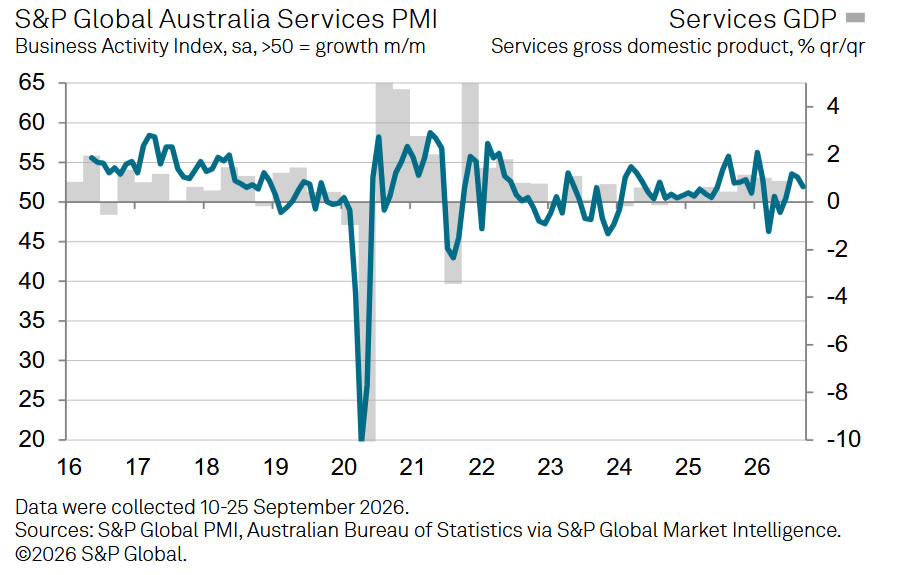
Data Summary
| Indicator | Sep | Aug |
|---|---|---|
| PMI Services | 51.9 | 53.2 |
| PMI Composite | 51.3 | 52.7 |
Remarks
- Growth: Both PMI Services and PMI Composite remained above 50 for a fourth month, but expansion slowed to the weakest pace in three months.
- New business: Services growth softened to the weakest pace in the current three-month expansion sequence.
- Exports: Services export business rose for the first time in five months, though only marginally.
- Employment: Services staffing fell for the first time since May, while overall private-sector employment also returned to contraction.
- Confidence: Business confidence fell to a three-month low.
- Prices: Services input-cost and output-price inflation both accelerated from August and remained above their respective historical averages.
- Manufacturing: Output contraction deepened, leaving private-sector growth concentrated in services.
Key Takeaways
- Growth lost momentum: PMI Services fell from 53.2 to 51.9 and PMI Composite from 52.7 to 51.3, although both remained above 50 for a fourth month.
- Demand softened: Services new-business growth slowed for a second month and was the weakest in the current three-month expansion sequence.
- Labour conditions weakened: Services employment declined for the first time since May, while employment across the private sector also returned to contraction.
- Manufacturing remained the weak spot: overall growth continued to come from services as manufacturing output contraction deepened.
- Inflation moved in the opposite direction: services input-cost and output-price inflation both accelerated despite the slower pace of activity.
- S&P Global said faster private-sector output-price inflation could keep CPI elevated in coming months and maintain a hawkish RBA bias.
Full Australia PMI Services final release here.