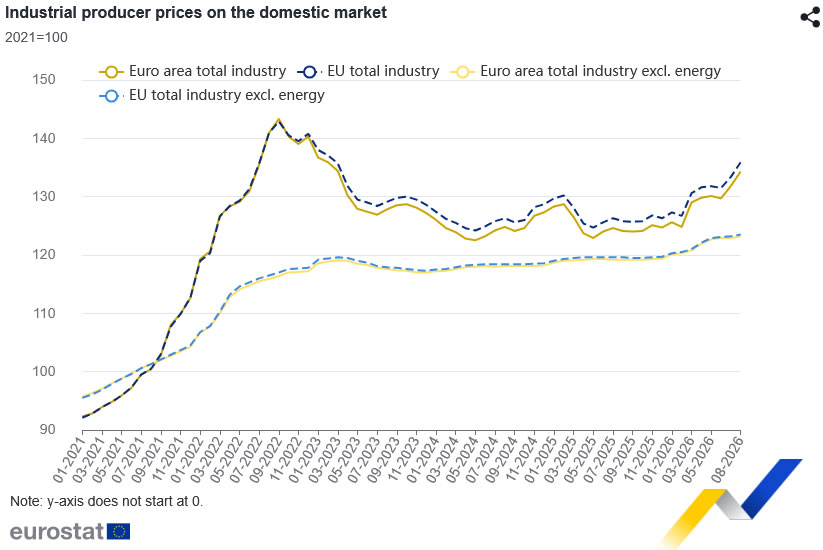
Eurozone producer-price inflation accelerated sharply in August, with industrial producer prices rising from 1.6% to 1.9% m/m and from 5.8% to 8.2% y/y. July’s readings were unrevised. Energy remained the dominant driver, with energy producer prices increasing 5.6% m/m and 21.0% y/y, accounting for much of the renewed headline pressure.
Underlying price pressures also firmed. Producer prices excluding energy rose 0.2% m/m and accelerated from 3.1% to 3.4% y/y. Intermediate-goods inflation strengthened to 6.8% y/y, while durable consumer goods rose 3.4% y/y and capital goods 2.6% y/y. Non-durable consumer goods remained the main exception, with prices still down 0.8% y/y. Producer prices increased month-on-month across all member states.
The release therefore points to a renewed pipeline inflation impulse, led by energy but no longer confined to it. The rise in ex-energy prices suggests broader cost pressure is also building through the production chain, reinforcing the firmer inflation signal seen elsewhere in recent Eurozone business surveys. The key distinction is that August’s surge was overwhelmingly energy-driven at the headline level, while the underlying measures moved higher more gradually rather than showing the same degree of acceleration.
Data Summary
| Indicator | Aug | Jul |
|---|---|---|
| PPI m/m | 1.9% | 1.6% |
| PPI y/y | 8.2% | 5.8% |
| PPI ex-energy m/m | 0.2% | 0.0% |
| PPI ex-energy y/y | 3.4% | 3.1% |
Key Takeaways
- Headline producer inflation accelerated sharply: PPI rose from 1.6% to 1.9% m/m and from 5.8% to 8.2% y/y.
- Energy was the dominant driver: energy producer prices increased 5.6% m/m and 21.0% y/y.
- Underlying pressures also firmed: ex-energy producer inflation rose from 3.1% to 3.4% y/y, while prices increased 0.2% m/m after being unchanged in July.
- Intermediate goods remained strong: prices rose 0.4% m/m and 6.8% y/y.
- Durable goods inflation also strengthened: durable consumer goods rose 3.4% y/y, while capital goods increased 2.6%.
- Non-durable goods remained softer: prices were still down 0.8% y/y.
- Price increases were broad geographically: every member state recorded a monthly increase in industrial producer prices.
- The overall message is energy-led inflation with some broadening underneath, rather than a purely isolated energy spike.