


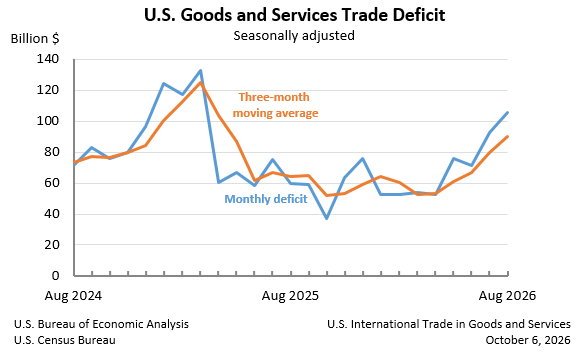
The US goods and services trade deficit widened sharply from a revised $92.8bn to $105.6bn in August, substantially larger than expected. The deterioration came despite continued export growth: exports rose 1.4% to $315.2bn, while imports jumped 4.3% to $420.8bn. The $12.7bn increase in the overall deficit was concentrated in goods, where the shortfall widened by $12.8bn to $136.6bn, while the services surplus edged higher to $31.0bn.
The composition therefore points more to stronger import demand than weakening foreign demand for US goods and services. Goods imports accounted for almost all of the monthly increase in total imports, with gains concentrated in industrial supplies and materials as well as capital goods. Exports also increased, led by goods shipments, while services exports were broadly steady. In real terms, goods imports rose much faster than goods exports, reinforcing the conclusion that the wider deficit was driven primarily from the import side.
The August deterioration also needs to be set against a much stronger year-to-date comparison. Through August, the cumulative goods and services deficit was still $138.2bn, or 19.9%, smaller than in the same period of 2025, as exports had risen 11.8% versus a 4.4% increase in imports. The latest month therefore represents a sharp widening in the trade gap, but not an export collapse. Instead, imports accelerated strongly enough to overwhelm continued export growth, making the underlying signal one of firmer inbound demand rather than broad weakness in external demand.
Data Summary
| Indicator | Aug | Jul | m/m |
|---|---|---|---|
| Trade deficit | $105.6bn | $92.8bn | 13.7% |
| Exports | $315.2bn | $310.7bn | 1.4% |
| Imports | $420.8bn | $403.6bn | 4.3% |
The August deficit was substantially wider than the roughly $89.8bn consensus.
Key Takeaways
- The trade deficit widened sharply from a revised $92.8bn to $105.6bn in August.
- Imports were the main driver, surging 4.3% to $420.8bn, while exports still increased 1.4% to $315.2bn.
- The deterioration was therefore not an export-collapse story. Foreign demand for US goods and services remained positive, but inbound demand strengthened much faster.
- Goods accounted for the widening, with the goods deficit rising to $136.6bn, while the services surplus edged up to $31.0bn.
- Import strength was concentrated particularly in industrial supplies and materials and capital goods, pointing to stronger demand for inputs and investment-related products.
- Export growth was also supported by goods shipments, while services exports were broadly steady.
- The broader 2026 picture remains stronger: the year-to-date trade deficit was still 19.9% smaller than in the same period of 2025, as exports had risen 11.8% versus 4.4% growth in imports.
- Overall, August represents a sharp monthly deterioration in the balance, but one driven by import strength rather than weakening external demand.





