


French Risk Has Brought the Euro to the Line; 1.1185 Decides Whether the Downtrend Accelerates
What’s happening: EUR/USD fell to around 1.1160, its lowest since May 2025, before recovering to 1.12. French fiscal and political risk is the dominant Euro-specific pressure, while Spain’s snap election on November 29 has added a headline without comparable market stress. The pair pierced the 1.1185 Fibonacci projection but has not yet confirmed a break, even though Fed hike expectations have eased and French bond yields have stabilized somewhat.
Why it matters: Neither interest-rate differentials nor a generalized Eurozone panic explain the move; it is French-specific risk with broader Euro implications. A decisive loss of 1.1185 would strengthen the case that the decline from 1.2081 is developing into an impulsive medium-term downtrend, with the current leg from 1.1710 potentially entering its strongest phase. The next move around 1.1185 will determine whether the bearish trend is solidified and begins to accelerate.
EUR/USD has reached a point where today’s political headlines matter less for the size of the immediate move than for what could come next. The pair fell to around 1.1160, its lowest since May 2025, before recovering to 1.12. French fiscal and political risk remains the dominant Euro-specific pressure, while Spain’s snap election adds another headline without yet producing comparable market stress. France is identified as the main drag as EUR/USD hit a 17-month low, while Spanish equities largely shrugged off Prime Minister Pedro Sánchez’s call for a November 29 election.
The more important development is technical. EUR/USD has pierced 1.1185, the 100% projection of 1.1848 to 1.1323 from 1.1710, but has not yet confirmed a break. A decisive loss of that level would strengthen the case that the decline from 1.2081 is developing into an impulsive medium-term downtrend, with the current leg from 1.1710 potentially entering its strongest phase. In that sense, French political risk has brought the Euro to the line; the next move around 1.1185 will determine whether the broader bearish trend is solidified and begins to accelerate.
France Is the Core Risk, Spain Is Secondary
Europe has two political stories today, but markets are not treating them equally.
France Fiscal Snapshot
- OAT-Bund spread: pushed above 100bp during September
- OAT-Bund spread: briefly above 150bp on Friday, before retreating
- France’s debt: around 119% of GDP
- France’s deficit: roughly 5.4%, which the government is trying to reduce through its 2027 budget
In France, the repricing has been building for weeks. The OAT-Bund spread pushed above 100bp during September and surged to levels last seen during the Eurozone sovereign debt crisis period. The spread was briefly above 150bp on Friday, before retreating, as investors focused on France’s fiscal position and the difficulty of repairing it through a fragmented parliament ahead of the 2027 presidential election.
The fiscal backdrop explains why the political uncertainty carries market weight. Prime Minister Sébastien Lecornu’s government has proposed a combination of tax increases and spending restraint, but the legislation still faces a difficult parliamentary process.
The key point is that this is no longer simply a generic global bond-market selloff. France has developed its own risk premium. The widening relative to Germany—and the fact that French sovereign stress has at times exceeded Italy’s—shows investors differentiating between Eurozone credits rather than selling the bloc indiscriminately.
Spain is different.
Prime Minister Pedro Sánchez called an early election for November 29 after parliament rejected key housing measures, adding another layer of political uncertainty to Europe. But the market reaction has so far been restrained. Spanish equities remained positive on the day, while investors saw limited reason to worry about Spain’s finances given comparatively solid growth.
France vs Spain: How Markets Are Treating Each
| France | Spain | |
|---|---|---|
| Political trigger | Fragmented parliament and a difficult 2027 budget process | Snap election on November 29 after parliament rejected key housing measures |
| Fiscal backdrop | Debt around 119% of GDP; deficit roughly 5.4% | Limited reason to worry about finances given comparatively solid growth |
| Market reaction | OAT-Bund spread briefly above 150bp on Friday; CAC 40 underperforming | Spanish equities positive on the day |
The distinction is simple:
France is being priced. Spain is being watched.
Bonds Stabilize, but Euro Keeps Falling
That distinction also helps explain today’s cross-asset pattern.
French bonds opened under renewed pressure, but yields subsequently eased from their early levels and remained below last week’s peak. The OAT-Bund spread also pulled back from Friday’s extreme rather than extending immediately higher. That is important because today is not another acceleration of the bond shock.
Cross-Asset Moves
- EUR/USD: fresh 17-month low
- CAC 40: fell, underperforming the major European equity indices
- STOXX 600: advanced
- Spanish equities: gained
- DAX, FTSE and Ibex: firmer
Instead, the incremental pressure is showing more clearly elsewhere. EUR/USD made a fresh 17-month low, while the CAC 40 underperformed the major European equity indices. Paris shares fell while the broader STOXX 600 advanced and Spanish equities gained.
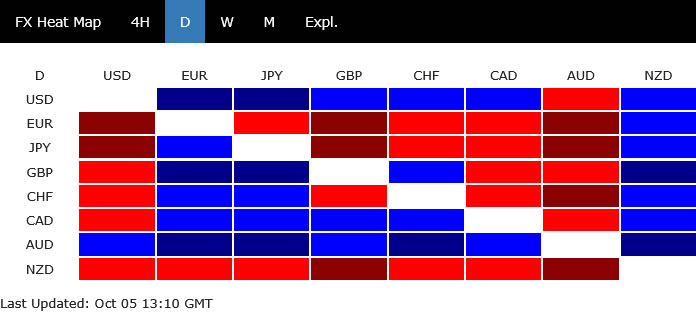
The FX heat map adds another useful clue. The Euro is broadly weak against the Dollar, Sterling, Canadian Dollar and Australian Dollar, but there is no comparable cross-market surge into every traditional haven. That argues against treating today as a generalized systemic risk event.
French sovereign stress remains serious, but the immediate move looks more like a Euro-specific risk premium being expressed through the currency and French equities while the bond market pauses after last week’s repricing.
The Rate Story Alone Does Not Explain EUR/USD
The usual interest-rate explanation is also incomplete.
Fed expectations have become less aggressive at the very front end after softer US labor data, with October hike probability sharply reduced. Normally, that should remove at least some Dollar support. Yet EUR/USD is still making new lows.
That suggests the Euro side of the equation matters increasingly. French fiscal uncertainty, fragmented sovereign pricing inside the monetary union, weak confidence around the durability of the regional recovery and elevated energy costs are creating a risk premium that ordinary rate-differential analysis does not fully capture.
This is particularly important because today’s Euro weakness is occurring even as French yields themselves stabilize somewhat. The market is no longer simply demanding a larger premium to hold OATs; the political and fiscal uncertainty is also being reflected in the currency.
That does not mean the bond problem has disappeared. It means today’s incremental repricing is being expressed more visibly elsewhere.
Why This Is Not Yet a Eurozone Panic
There are several reasons not to overstate the move.
Four Reasons Not to Overstate It
- French yields are below last week’s extreme rather than accelerating through it.
- Spanish bonds and equities are not showing the same degree of stress. If France’s problems were rapidly becoming a broader Eurozone sovereign event, Spain and Italy would be expected to begin moving much more aggressively alongside it.
- Broader European equities are not collapsing. The CAC is the outlier, while DAX, FTSE and Ibex have been firmer.
- The currency heat map does not show the sort of uniform rush into defensive currencies associated with acute systemic stress.
The right description is therefore French-specific risk with broader Euro implications, not contagion.
That distinction could change if the OAT-Bund spread drives decisively back through last week’s extremes while Bunds rally and peripheral spreads begin widening together. But that is not the configuration today.
French Bond Spread, Budget and Spain: What Could Change the Picture
The first test remains the French bond spread. Another sustained move above the 140–150bp area, particularly if accompanied by renewed demand for Bunds and widening in Spain and Italy, would indicate that the stress is broadening rather than merely consolidating.
The second is the French budget process. Markets need evidence that the 2027 fiscal package can survive a fragmented parliament and produce a credible path toward stabilizing the debt burden. France’s proposed measures are substantial, but parliamentary amendments are expected and implementation remains central to the credibility question.
Spain’s November 29 election is a secondary political catalyst, but the more immediate question is whether Spanish assets continue to distinguish themselves from France.
For EUR/USD, however, the most important signal may arrive before any of those political events. It is already sitting on the level that can decide whether the existing decline becomes something materially larger.
EUR/USD Technical Outlook: 1.1185 Is the Decision Point
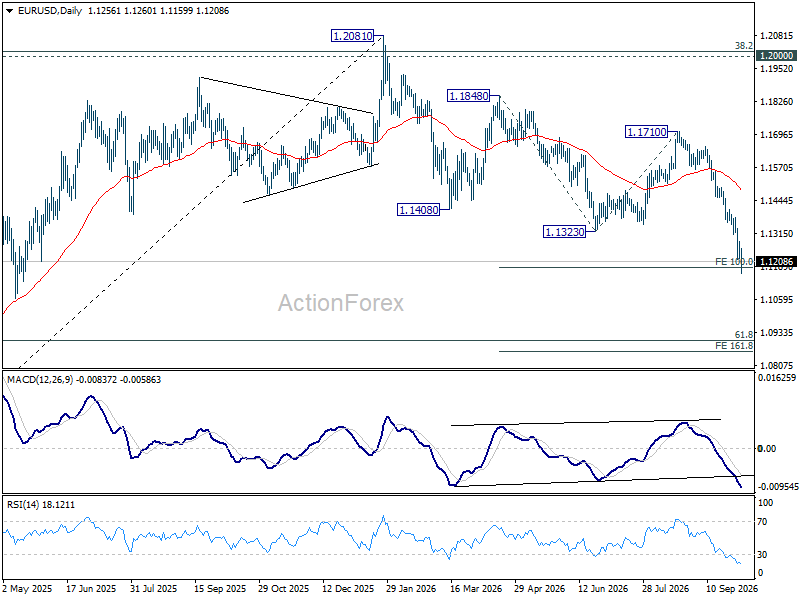
EUR/USD is testing 1.1185, the 100% projection of the decline from 1.1848 to 1.1323, projected from 1.1710.
Today’s 1.1160 low pierced that level intraday, but EUR/USD recovered back above it. That makes the current setup a warning rather than a confirmed breakdown.
A decisive daily close below 1.1185 would materially change the technical picture. The decline from 1.2081 could then increasingly be interpreted as an impulsive sequence:
1.2081 to 1.1408, rebound to 1.1848, fall to 1.1323, rebound to 1.1710, followed by the current decline. That is, a 1-2-i-ii.
Under that count, the fall from 1.1710 would represent the potentially powerful wave iii of the developing bearish sequence.
Key EUR/USD Levels
| Level | Significance |
|---|---|
| 1.1710 | A break above invalidates the impulsive count |
| 1.1323 | First critical resistance on any recovery; a sustained recovery above it would weaken the immediate impulsive count |
| 1.1185 | 100% projection of 1.1848 to 1.1323 from 1.1710; the decision point |
| 1.0904 | Larger 61.8% retracement |
| 1.0861 | 161.8% projection, the next major downside projection, close to the 61.8% retracement |
| 1.0759 | Next projection below the 1.0861–1.0904 zone |
The next major projection would be 1.0861, the 161.8% projection. That sits close to the larger 61.8% retracement around 1.0904, creating a significant downside target zone. Below there, the next projection lies around 1.0759.
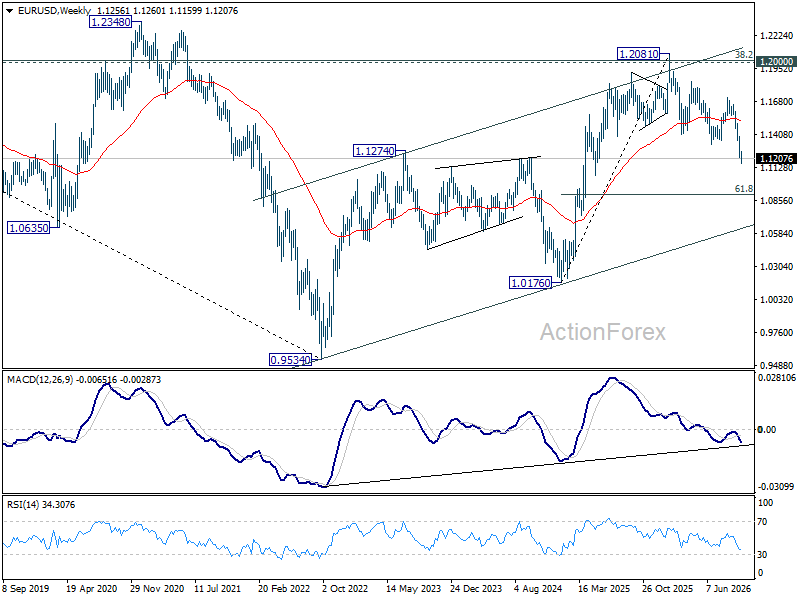
The larger implication is more important still. A confirmed impulsive fall from 1.2081 would strengthen the case that EUR/USD has begun reversing the entire three-wave corrective rise from the 0.9534 low of 2022. That would represent a meaningful medium-term trend change rather than merely another pullback inside the previous recovery.
For now, however, that conclusion is premature. Daily RSI is already deeply oversold, and EUR/USD has recovered from below 1.1185 intraday. A daily close beneath the level is the first confirmation; a weekly close below 1.1185 would carry considerably more weight.
On any recovery, 1.1323 has become the first critical resistance. As long as that former support holds as resistance, downside risk remains dominant. A sustained recovery above 1.1323 would weaken the immediate impulsive count, while a break above 1.1710 would invalidate it.
French political risk has helped drive EUR/USD to this point. Whether 1.1185 now gives way will determine whether the Euro’s medium-term decline merely continues—or begins to accelerate.
Related Coverage
Europe: Data and Sentiment
- Eurozone Sentix Slips as Expectations Fall, France Replaces Germany as the Main Concern: investor sentiment data pointing to the same geographic shift in worry that is driving the Euro-specific risk premium.
- Eurozone PMI Hits 41-Month High as Growth Broadens and Price Pressures Reheat: September growth at a 41-month high, but with stronger selling prices and backlogs that make the release notably more hawkish.
- Eurozone PPI Re-Accelerates as Energy Shock Spills Into Broader Producer Costs: August producer inflation re-accelerated, with stronger ex-energy prices suggesting pipeline pressure is broadening beyond energy.
- UK Composite PMI Falls to 52.0 as Growth Slows and Costs Rise: services still expanding but with slower new orders, falling employment and higher fuel and payroll costs.
Gold, Yen and Asia-Pacific
- Gold: Fed Hike Delay Isn’t Relief, FOMC Minutes Put the Rate Plateau to the Test: the Gold angle on collapsed October hike odds, with Wednesday’s FOMC minutes testing the extended tightening path priced into 2027.
- Nikkei Eyes Record High, But Four Forces Stand Between USD/JPY and 164: why this equity breakout may not repeat the last run in USD/JPY, with 160 now inside a tougher resistance zone.
- BoJ Uchida: AI’s Demand Shock Has Arrived Before Its Productivity Payoff: the BoJ Deputy Governor on AI’s first macro impact arriving through demand, prices and easier financial conditions.
- Japan PMI Growth Slows, But Hiring and Price Pressures Stay Firm: a weaker services headline, but with faster hiring, rising backlogs and exceptionally strong selling-price inflation underneath.
- Australia PMI Services Falls to 51.9 as Growth Slows and Price Pressures Rise: softer activity and falling employment paired with faster input and output-price growth.
FAQ
Why is EUR/USD making new lows when Fed hike expectations have eased?
Fed expectations have become less aggressive at the front end after softer US labor data, which should normally remove some Dollar support. Yet EUR/USD fell to around 1.1160, its lowest since May 2025. French fiscal uncertainty, fragmented sovereign pricing inside the monetary union, weak confidence in the regional recovery and elevated energy costs are creating a risk premium that rate-differential analysis does not fully capture, and that premium is now also being reflected in the currency.
Is France’s bond stress turning into a Eurozone panic?
Not yet. French yields and the OAT-Bund spread have pulled back from last week’s extremes, Spanish bonds and equities are not showing the same stress, broader European equities are not collapsing and the currency heat map shows no uniform rush into defensive currencies. The better description is French-specific risk with broader Euro implications, not contagion. That could change if the OAT-Bund spread drives decisively back through last week’s extremes while Bunds rally and peripheral spreads begin widening together.
What would a break below 1.1185 mean for EUR/USD?
1.1185 is the 100% projection of 1.1848 to 1.1323 from 1.1710, and EUR/USD pierced it intraday without confirming a break. A decisive daily close below it would support reading the decline from 1.2081 as an impulsive sequence, with the fall from 1.1710 as a potentially powerful wave iii. The next projection is 1.0861, close to the 61.8% retracement around 1.0904, with 1.0759 below that. A weekly close below 1.1185 would carry considerably more weight, while a break above 1.1710 would invalidate the count.
Key Takeaways
- EUR/USD fell to around 1.1160, its lowest since May 2025, before recovering to 1.12, with French fiscal and political risk as the dominant Euro-specific pressure.
- France is being priced and Spain is being watched: the OAT-Bund spread was briefly above 150bp on Friday and French debt is around 119% of GDP, while Spain’s November 29 election drew a restrained market reaction.
- Today is not another acceleration of the bond shock: yields and the spread pulled back, and the pressure is showing more clearly in EUR/USD and the CAC 40.
- Rates do not explain the move: Fed expectations have become less aggressive, yet EUR/USD is still making new lows.
- This is French-specific risk with broader Euro implications, not contagion, though that could change if the spread breaks back through last week’s extremes while peripheral spreads widen with it.
- EUR/USD pierced 1.1185 but has not confirmed a break; a decisive daily close below would strengthen the impulsive count, and a weekly close below would carry considerably more weight.
- Below 1.1185 the next projection is 1.0861, near the 61.8% retracement around 1.0904, then 1.0759; 1.1323 is first resistance and a break above 1.1710 would invalidate the count.
What to Watch Next
For EUR/USD, the decision point is 1.1185: a daily close below is the first confirmation and a weekly close below would carry considerably more weight, while 1.1323 is the first resistance on any recovery. On the political side, watch whether the French bond spread makes another sustained move above the 140–150bp area, how the 2027 budget fares in a fragmented parliament, and whether Spanish assets keep distinguishing themselves from France ahead of the November 29 election.





