Highlights
- Crude exports through the Strait of Hormuz are recovering, but the reliability and cost of moving those barrels remain far from normal. Oil prices are still carrying a premium for the risk that today’s recovery proves fragile.
- Refined products, particularly diesel, are suffering from lean inventories and limited refinery capacity, keeping crack spreads and end-user fuel costs elevated.
- Recent policy measures including the G7’s coordinated 100-million-barrel release should provide some near-term relief to product markets, particularly through a front-loaded diesel draw, but it is not enough to reset the market.
- Higher crude prices remain a net positive for Canada through stronger exports, incomes and government revenues. However, Canada remains exposed to higher diesel and gasoline costs through integrated North American and global fuel markets.
More than half a year into the U.S.-Iran conflict and oil markets are still far from functioning normally. Oil shipments through the Strait of Hormuz appear to be recovering sharply—closing in on pre-war levels—yet WTI remains around $90 per barrel (bbl), roughly 40% above where it traded before the conflict. If more oil is moving again, why are prices still elevated? Further, and more central to this report, why are refined-product markets showing even fewer signs of relief?
On the former, higher oil prices are more likely pricing the reliability of future supply than reflecting what today’s supply looks like. The recovery in Middle Eastern exports is certainly reducing the immediate risk of a severe physical shortage, but restoring barrels is not the same thing as restoring normality. Firstly, the risk of further disruptions remains materially higher than before the war. Second, oil is moving through longer, more complex and less transparent routes, raising freight, insurance and other costs. Third, emergency strategic and commercial inventories have already absorbed a large portion of the shock, leaving a thinner cushion if oil flows pull back again. Finally, the recovery has been uneven across the barrel. Crude can be rerouted relatively quickly, whereas refined products remain more constrained.
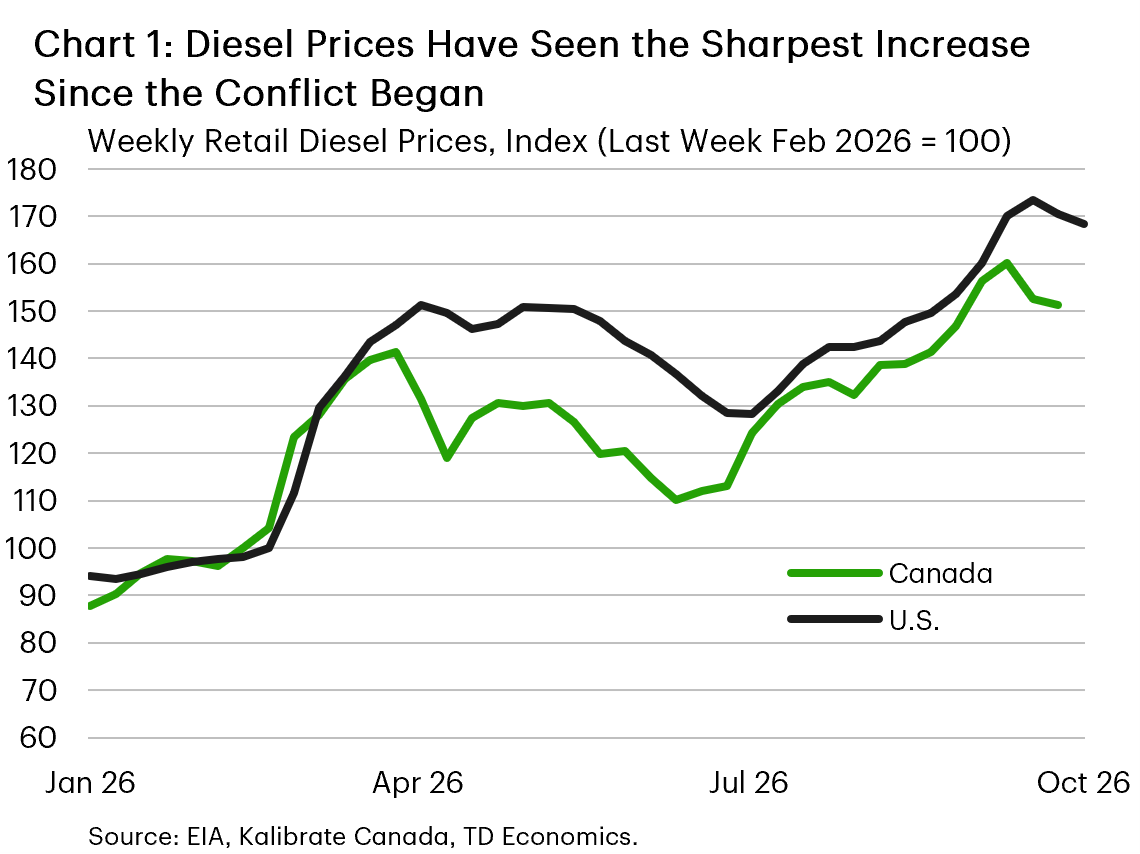
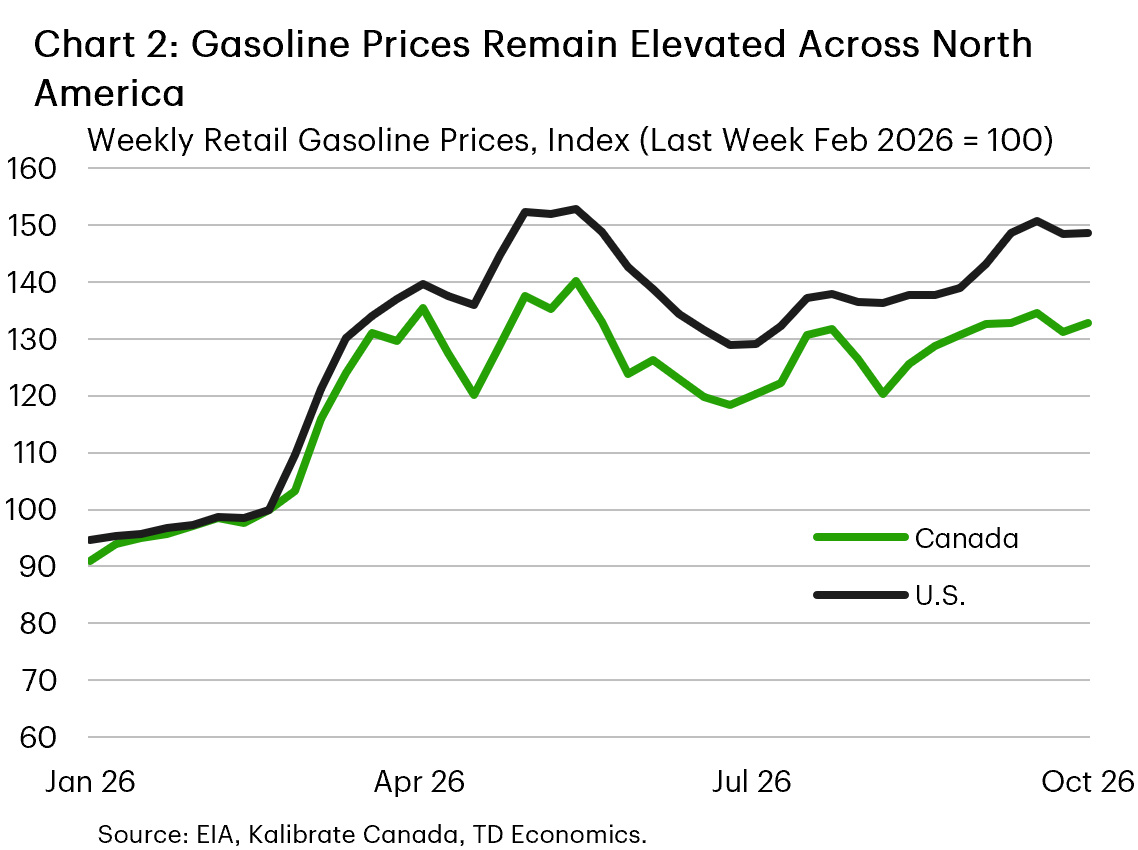
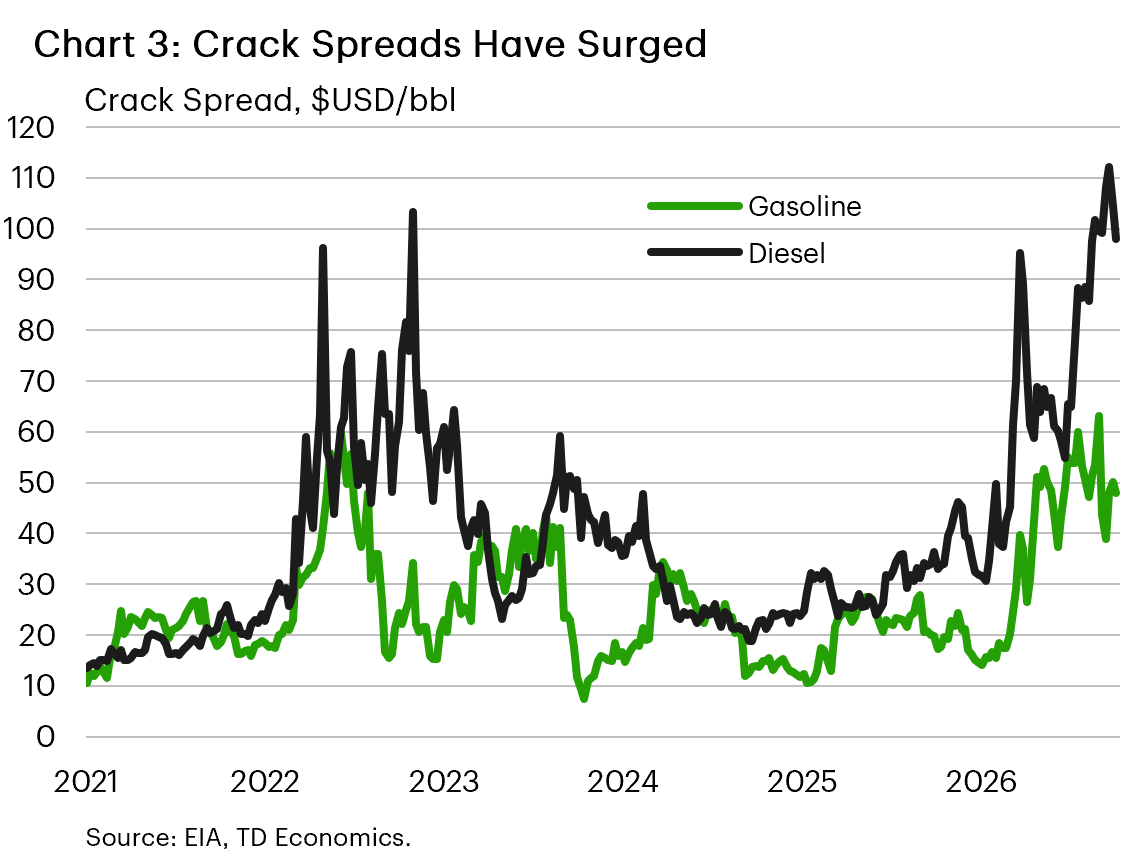
That has resulted in energy market tightness shifting further downstream. While crude markets have benefited from recovering supply, refined-product markets continue to face constraints from limited refinery availability, lean inventories and barriers to moving fuel between regions. The impact is increasingly visible in retail fuel prices, with diesel and gasoline prices in both Canada and the U.S. rising sharply since the start of the conflict (Charts 1 and 2). Two patterns stand out. First, price increases have generally been more pronounced in the U.S. Second, diesel markets are experiencing significantly greater stress than gasoline markets. This is also evident in crack spreads (Chart 3), which measure the value of refined products relative to crude. Diesel crack spreads in the U.S. Gulf Coast remain near record highs even as crude flows have improved, while gasoline cracks, though elevated, are less extreme.
One Barrel, Several Markets
Households and firms do not consume crude oil directly. They buy the gasoline, diesel, jet fuel, heating oil and the goods moved with them. And refineries do not produce these products independently. The latest U.S. refinery slate showed that one barrel of crude yields roughly 44% gasoline, 30% distillate (i.e., diesel) and 12% jet fuel–these shares can be adjusted at the margin, but the scope is limited. This creates an interesting link between the economics of each fuel. Strong margins in one product can support refinery runs and increase the supply of others. The reverse is also true. If margins weaken far enough, refiners may reduce crude throughput, lowering output across the barrel.
Refined product markets also have regional components. For example, in the U.S., more than half of total refining capacity sits on the Gulf Coast, while the East Coast relies more on pipelines and imports. The U.S. is certainly connected by internal transport links but there are still barriers to product transfer such as product specifications and shipping costs, which can keep some regional conditions tight, even if national supply looks adequate. These regional dynamics also matter for Canada. Atlantic Canada is closely linked to Atlantic Basin fuel markets, Ontario and Quebec are integrated with the U.S. East Coast, while Western Canada is more connected to refining and product flows in the U.S. Midwest and Pacific Northwest.
Diesel Remains the Pressure Point
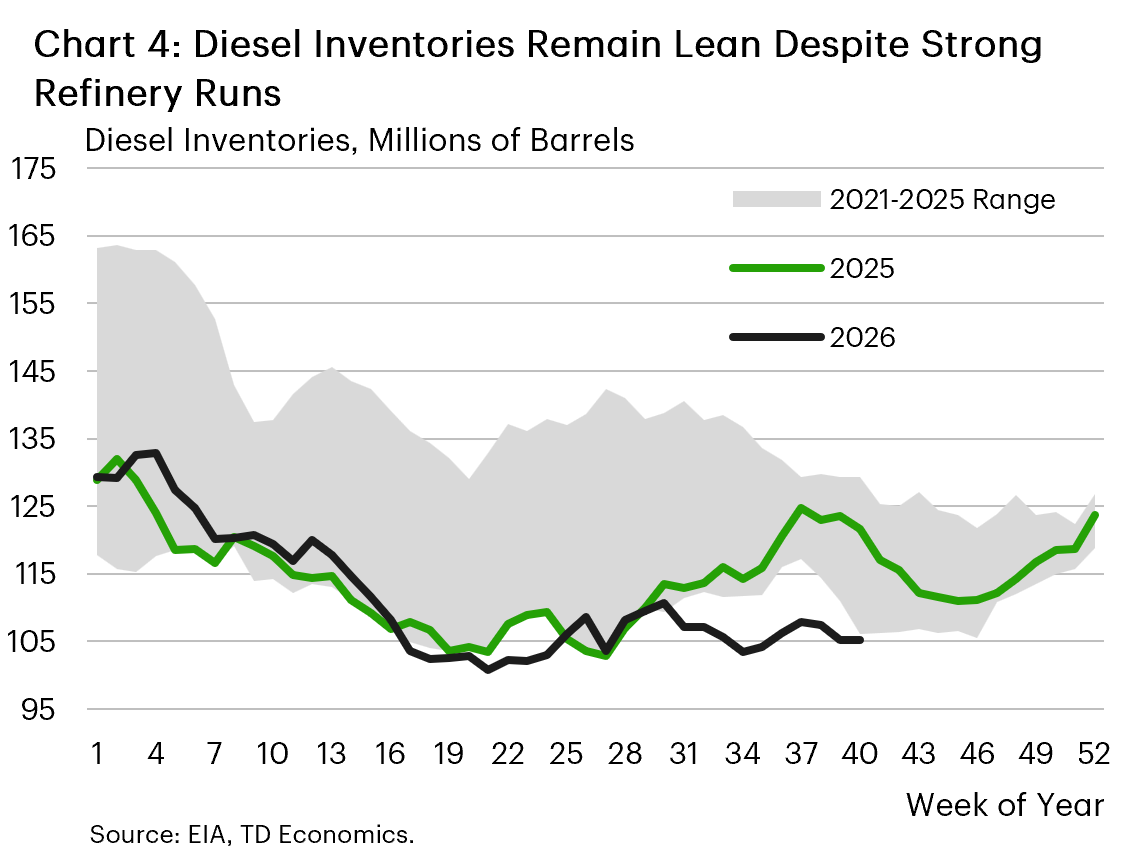
Diesel is currently the tightest part of the barrel. U.S. distillate stocks stood roughly 11% below their five-year seasonal average as of early October, even with refinery utilization near 97% (Chart 4). Under normal conditions, these high run rates would rebuild inventories, but instead, strong overseas demand continues to pull U.S. barrels into the global market.
The U.S. has also become a key global balancing supplier, exporting roughly 1.3-1.4 million/bpd on a net basis, with Latin America and Europe among the largest destinations. Europe still faces a structural diesel deficit after losing much of its former Russian supply, while ongoing conflicts in Russia and the Middle East have further tightened the pool of available barrels to the tune of 1.0-1.6 million/bpd.
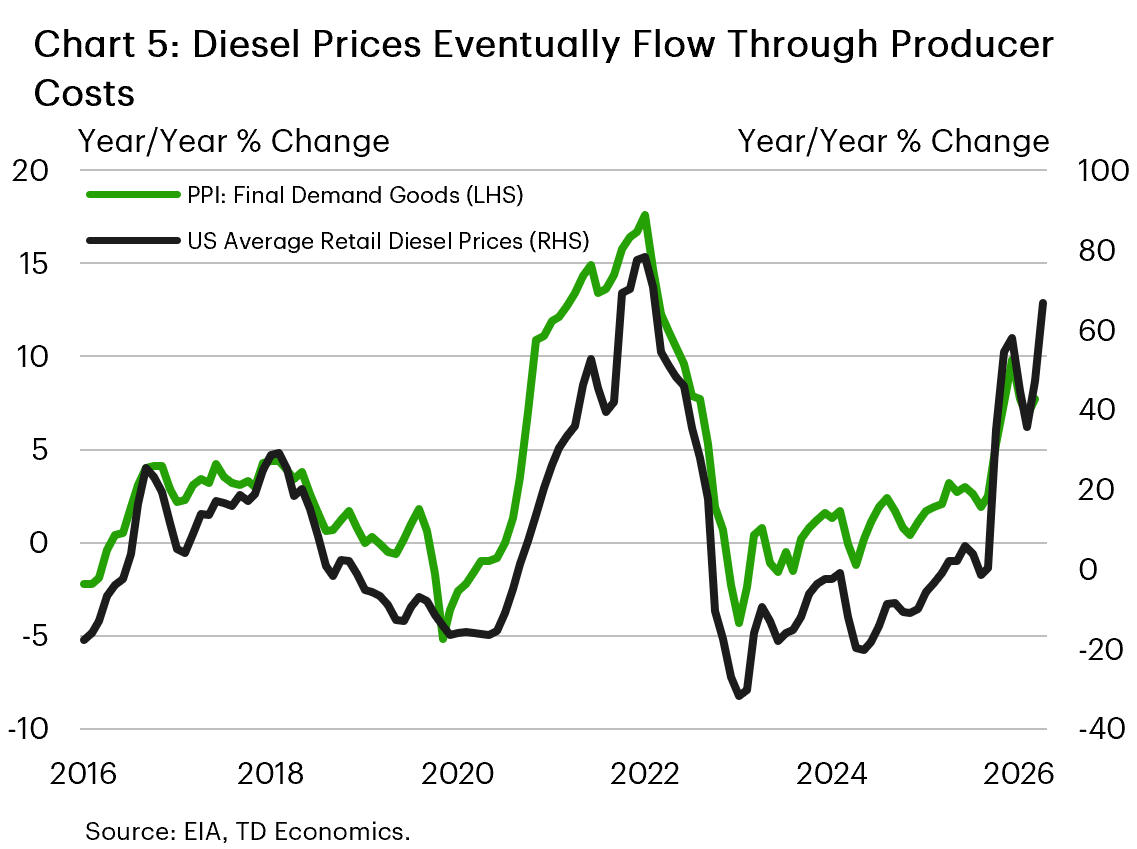
Diesel also matters disproportionately for the economy because it powers trucking, agriculture, construction, mining, rail, marine transport and some industrial activity. North American households have relatively little direct exposure, but they pay indirectly. Higher fuel bills first compress business margins, then pass into things like freight surcharges, food distribution, construction materials and finally into consumer-goods and services prices. The timing and magnitude of pass-through depend on demand conditions and firms’ pricing power, but the persistence of currently elevated prices raises the odds of a broader inflation problem (Chart 5).
Policy Responses Buy Time, Not a Full Reset
Policymakers have increasingly shifted their focus toward easing pressure in refined-product markets. The centerpiece is the recent G7 agreement to coordinate the release of up to 100 million barrels of crude oil and diesel. The draw is scheduled to begin immediately and run over four months, with a substantial diesel release front-loaded within the first 20 days. Members also agreed to coordinate refinery maintenance and temporarily raise utilization where feasible.
This G7 package is likely a more market-friendly policy compared to the now-abandoned plan for the U.S. to outright ban diesel exports. The direct release of diesel bypasses the time needed to move crude through the refinery system and should put downward pressure on diesel prices and crack spreads in the near-term. Additional feedstock from crude releases can also help minimize the need for further deep commercial inventory draws and support refinery throughput.
Spread evenly over four months, 100 million barrels would be equivalent to roughly 800k/bpd (or roughly 0.8% of global demand). We don’t have full details about the release plan, but we do know that supply to market will be uneven because diesel is being front-loaded. The agreement has not yet specified the split between crude and finished products or the contribution from individual countries.
Secondary and more localized measures have been announced in the U.S. with recent changes to dyed-diesel usage rules to provide some flexibility for fuel users in specific sectors. And more recently, the Trump administration has indicated that additional Russian diesel imports could be allowed into the U.S. market. The announced shipments total roughly 13.5 million barrels, equivalent to about 3-4 days of U.S. diesel consumption if delivered in full. The scope of these measures is small relative to global diesel consumption, but underscores the increasing focus on relieving pressure in refined-product markets compared to addressing broader crude supply.
All in all, we view these policy responses as shorter-term stabilizers, similar to the IEA strategic reserve release program announced back in March. They can provide near-term relief, particularly for diesel markets, by helping rebuild inventories, narrow spreads and reduce some of the extreme tightness embedded in product markets. The G7 release will do most of the heavy lifting, while secondary measures are unlikely to materially alter broader market balances on their own. The measures alone do not directly address some of the more structural issues and will not create new refining capacity or fully offset disruptions in broader global trade flows.
Gasoline: Different Channel, Same Barrel
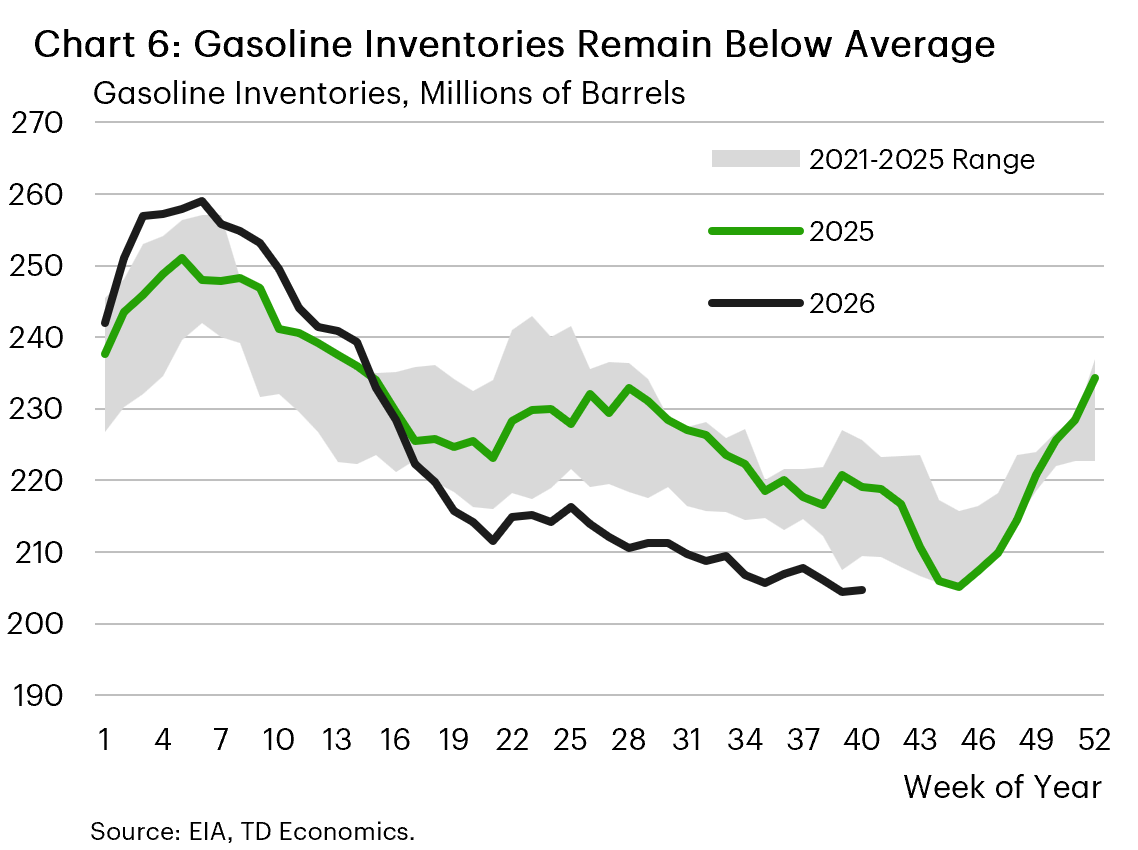
Gasoline is less uniformly tight than diesel, but it is the fastest route from energy markets into household budgets. U.S. gasoline inventories are about 6% below their five-year average as of early October (Chart 6), compared with the over 10% deficit for distillates. Relative to diesel, gasoline is less rigid because of blending flexibility and more seasonal demand, but its economic impacts are more immediate. An emergency release that supports refinery runs should add gasoline supply alongside diesel, while lower crude costs can reduce refinery feedstock expenses. But the benefit at the pump will depend on how quickly wholesale product prices and spreads respond.
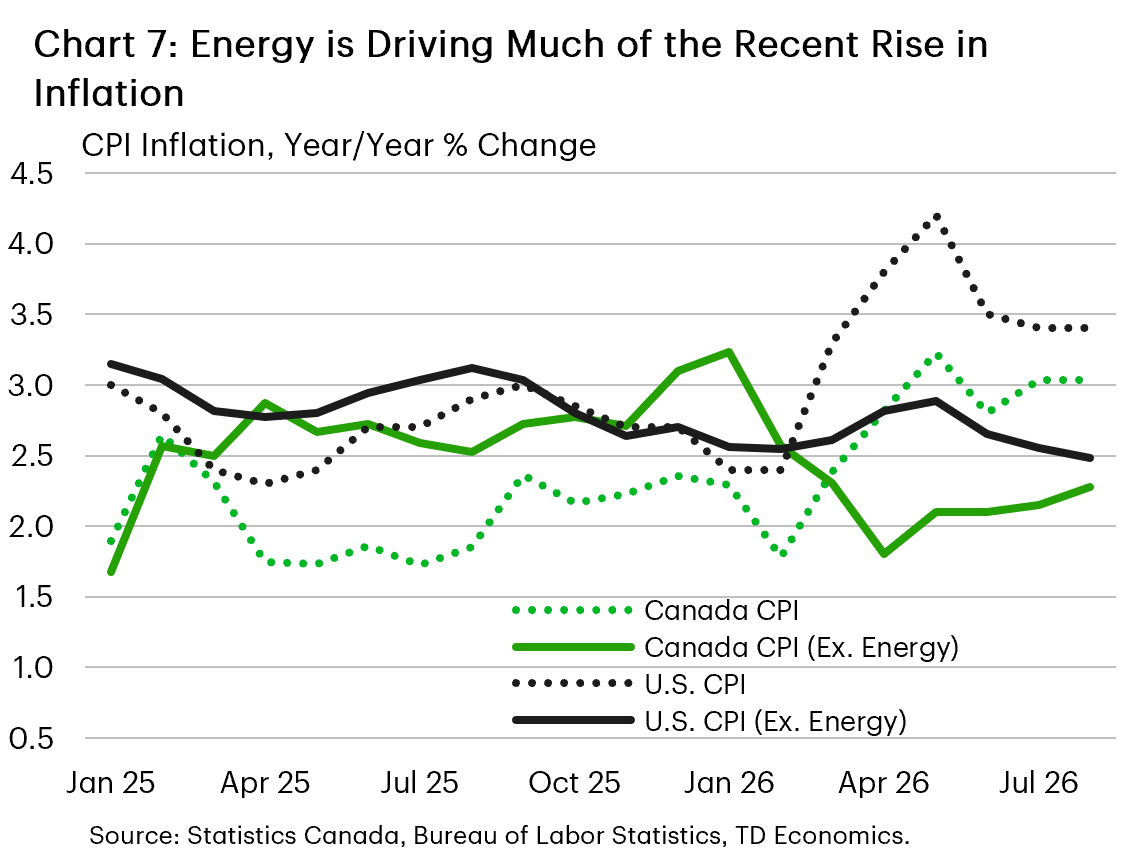
Gasoline carries roughly a 4% weight in Canada’s CPI basket and a 3% weight in the U.S. basket. As a result, higher fuel costs have fed quickly into headline inflation in recent months, with year-over-year CPI inflation now running above 3% in both economies. Excluding energy, price growth in both economies sits at a more pedestrian 2-2.5% (Chart 7). So unlike diesel, the first-round effect is visible directly at the pump and in disposable incomes.
Canada Is an Energy Producer, but a Product-Market Price Taker
In a high price environment, Canada’s crude production has provided an important income and revenue buffer, but it does not make the country immune to tighter fuel markets. While Canada imports roughly 485,000 bpd of refined products (mostly from the U.S.), most of that is in condensates. With roughly 1.9 million bpd of refining capacity, Canada produces most of the gasoline and diesel it consumes. Therefore, Canada doesn’t necessarily face fuel supply constraints, but it is directly exposed to North American and global product prices.
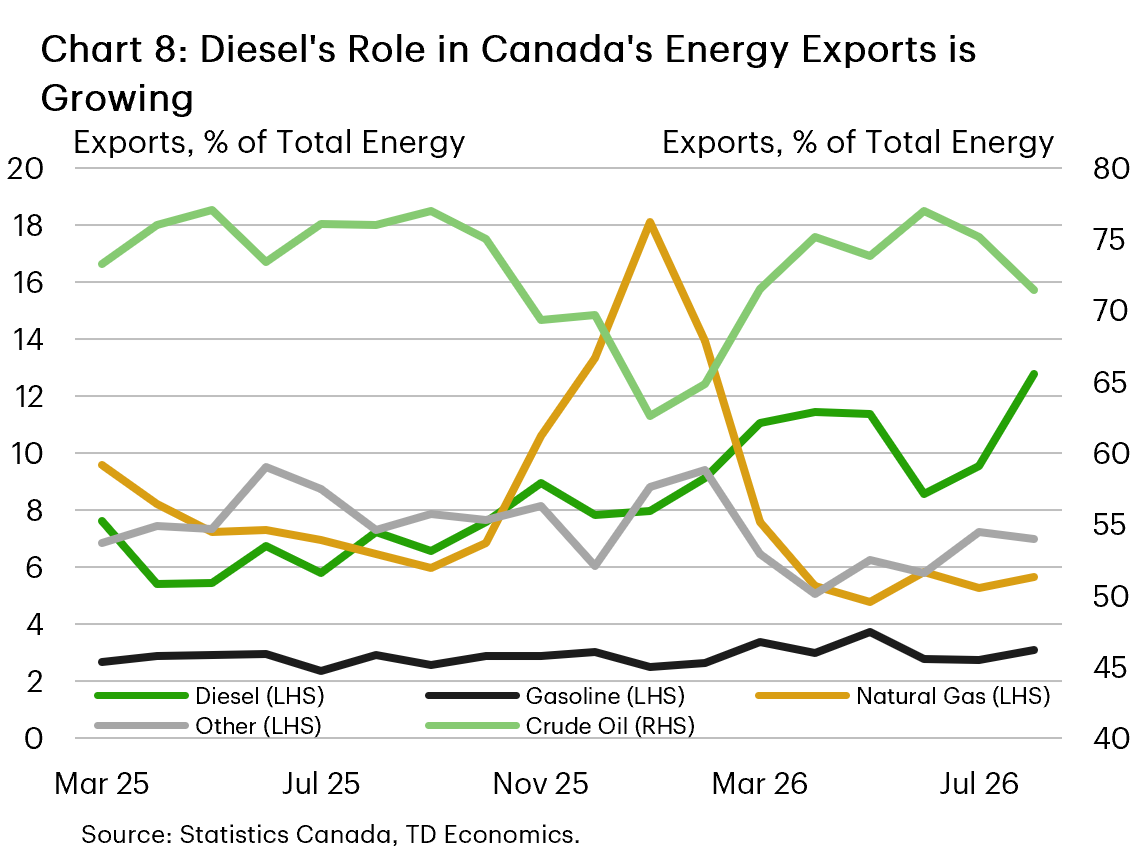
The economic effects of this cut in a few different directions. Over the last 6 months, energy exports have risen by $4.5 billion/month on average, bolstering producer incomes, government revenues and Canada’s terms of trade. Crude oil continues to account for the lion’s share of this lift, but interestingly, diesel is becoming a more important part of the equation. Diesel’s share of total energy exports has more than doubled since the start of the war to 13% and now accounts for over $2 billion/month in intake (Chart 8). What’s more, this suggests that Canada has become a marginal supplier to global markets, specifically parts of the U.S. and Latin America, Europe, and the U.K. The flip side of this is that higher diesel and broader refined fuels costs still reduce household purchasing power while compressing margins in sectors that cannot fully pass on the costs.
The recent G7 agreement is positive for Canada in two respects. First, it lowers the risk of trade-related disruptions to North American diesel and gasoline supplies. Second, a front-loaded diesel release could lower Atlantic Basin and U.S. product benchmarks that influence prices in central and eastern Canada. The magnitude of relief will depend on the location and specification of the barrels released, as well as the response of crack spreads and the Canadian dollar—details we will need to await.
The effects of tighter refined-product markets are also likely being felt unevenly across provinces. For example, Atlantic Canada is closely tied to Atlantic Basin fuel markets. Ontario and Quebec are integrated with U.S. East Coast and global product pricing. British Columbia faces Pacific Basin dynamics. And the Prairies have a stronger supply position, but a greater concentration of diesel-intensive industries such as agriculture, trucking and mining.
What Would Deliver Lasting Relief?
The recent policy packages can take the edge off the shock, but lasting relief requires more than emergency barrels. Our base case remains for crude prices to gradually move lower as Middle Eastern supply recovers and reserve releases reach the market. However, relief in refined-product markets may prove slower to materialize. Lean inventories, limited refining flexibility and ongoing logistical disruptions could keep diesel and gasoline prices elevated even as crude prices retreat. Durable crude-price normalization is therefore the natural starting point, but it is unlikely to be enough on its own; shipping risk must fall and inventories need to rebuild. In addition to this, product markets will need to see a combination of higher refinery availability, fewer unplanned outages and a more reliable return of Russian and Middle Eastern product flows. Falling crack spreads would signal that those bottlenecks are easing and that product markets are coming into better balance. Weaker freight and industrial activity could also help rebalance markets, but that would represent a softer demand backdrop rather than an improvement in supply. Canada would benefit largely through the same channels. Narrower crack spreads and improved Atlantic Basin supply would be particularly important for central and eastern Canada, while a stronger Canadian dollar could lower the local-currency cost of any fuel the country imports.
The Bottom Line
Crude markets appear to be healing faster than refined-product markets, but the energy shock is far from over. Export recovery through the Strait of Hormuz is encouraging, but the path forward remains fragile. Recent policy responses should provide some relief to product markets, especially for diesel, but it does not solve the underlying constraints facing fuel markets. Until inventories rebuild and product markets rebalance, lower crude prices may not translate into the same degree of relief for households and businesses.