The Dollar Weakened Broadly but Modestly as Treasury Yields Extended Their Retreat
What’s happening: The Dollar weakened broadly but modestly on Tuesday, slipping against all seven major counterparts, as US Treasury yields extended their retreat from last week’s highs. The 10-year yield fell below 5.19%, down from last week’s 5.365% peak, helped by softer oil prices and renewed concerns over AI-sector valuations. The selling lacked conviction, with broader equity markets showing mixed reactions to the technology selloff.
Why it matters: The IMF’s latest Global Financial Stability Report warned that elevated government debt, persistent inflation risks and growing borrowing requirements could trigger a “disorderly” increase in sovereign bond yields, so a retreat in yields should not be mistaken for the disappearance of structural risks. Wednesday’s US CPI report is the immediate test of whether the Treasury recovery can extend, and it is keeping investors cautious about extending their positions.
The Dollar weakened broadly but modestly on Tuesday, as US Treasury yields extended their retreat from last week’s highs amid softer oil prices and renewed concerns over AI-sector valuations. The US 10-year yield fell below 5.19%, extending its decline from last week’s 5.365% peak, while the greenback slipped against all seven major counterparts. However, the selling lacked conviction, with broader equity markets showing mixed reactions to the technology selloff. Wednesday’s US CPI report appears to be keeping investors cautious about extending their positions, even as the Treasury market shows clearer signs of a correction.
Treasury Yields Retreat on Several Fronts
Treasury and Equity Moves
- US 10-year Treasury yield: fell below 5.19%, extending its decline from last week’s 5.365% peak
- KOSPI: plunged 5.46%, with heavy losses in major chipmakers
- Nasdaq futures: weakened
- European equities: advanced
- Dow futures: gained
The decline in Treasury yields reflected several overlapping influences. Oil prices retreated during the session as investors assessed the prospect of increased Russian diesel supplies following the reported US-brokered energy ceasefire between Russia and Ukraine. However, implementation of the agreement remains disputed, while crude prices were still close to late-week levels. The intraday oil decline alone therefore cannot fully explain the broader Treasury recovery.
Renewed concerns over AI investment and semiconductor competition also contributed to government bond demand. South Korea’s KOSPI plunged 5.46%, with heavy losses in major chipmakers, while Nasdaq futures weakened. Nevertheless, the selling was concentrated in technology, with European equities advancing and Dow futures gaining. Meanwhile, Treasury yields had already begun retreating following last week’s well-received bond auctions. Tuesday’s move thus appears to extend an existing recovery, supported by several factors rather than a single decisive shift in the macroeconomic outlook.
IMF Warns Bond-Market Vulnerabilities Have Not Disappeared
The IMF’s latest Global Financial Stability Report provided a striking counterpoint to Tuesday’s bond rally. While Treasury yields are falling in the near term, the Fund warned that elevated government debt, persistent inflation risks and growing borrowing requirements could trigger a “disorderly” increase in sovereign bond yields.
The IMF also highlighted vulnerabilities arising from leveraged participation in Treasury markets. Hedge funds’ share of US Treasury holdings increased from approximately 4% in 2022 to 9% in 2025, raising concerns that crowded positions could amplify market disruption during a collective unwind. Meanwhile, AI infrastructure investment is becoming an increasingly important source of corporate bond issuance, potentially adding competition for capital.
The contrast is noteworthy: AI-sector concerns are encouraging Treasury demand in the short term, while AI-related borrowing is among the longer-term pressures facing bond markets. The IMF’s warning does not imply an imminent reversal of Tuesday’s rally, but it underlines why a retreat in yields should not be mistaken for the disappearance of structural risks.
Near-Term Support vs Longer-Term Pressure for Treasuries
| Horizon | Factors |
|---|---|
| Near-term support for Treasuries | Softer oil on prospects of more Russian diesel supply; renewed AI and semiconductor concerns, including the 5.46% KOSPI plunge; last week’s well-received bond auctions |
| Longer-term pressures flagged by the IMF | Elevated government debt; persistent inflation risks; growing borrowing requirements; hedge funds’ Treasury share rising from approximately 4% in 2022 to 9% in 2025; AI infrastructure investment adding to corporate bond issuance |
Dollar Weakness Remains Restrained as CPI Approaches
In currency markets, the Dollar declined against all seven major peers, while the Euro recovered from last week’s pronounced weakness. However, the Euro’s stabilization has not been accompanied by a meaningful improvement in French sovereign-risk concerns. The broader FX reaction also remained relatively subdued, with neither the Yen nor Swiss Franc attracting consistent safe-haven demand despite the semiconductor selloff.
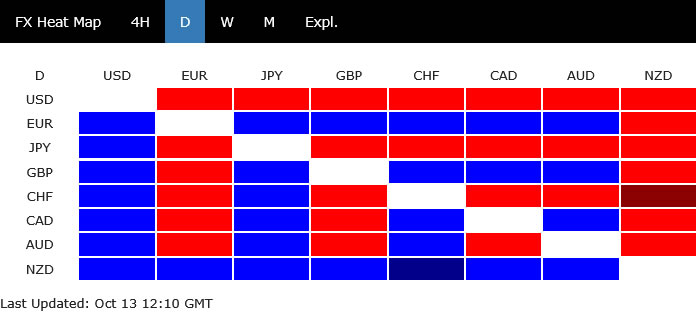
Falling Treasury yields have not consistently translated into Dollar weakness this month. The greenback continued advancing late last week even as yields retreated, suggesting that interest-rate differentials are only one of several influences shaping currency movements. With markets now pricing a high probability of an October Fed pause, investors appear reluctant to make more decisive directional bets before receiving fresh inflation evidence.
Elsewhere in Markets
- Brent crude: traded near $105, caught between expectations of additional Russian diesel supplies and continuing risks to Middle Eastern energy infrastructure
- Gold and Silver: edged higher alongside falling Treasury yields
- Bitcoin: recovered following another episode of leveraged selling
- RBA September meeting minutes: confirmed a strong preference for tightening, but produced little immediate reaction in the Australian Dollar
Elsewhere, Brent crude traded near $105, caught between expectations of additional Russian diesel supplies and continuing risks to Middle Eastern energy infrastructure. Gold and Silver edged higher alongside falling Treasury yields, while Bitcoin recovered following another episode of leveraged selling. In Australia, the RBA’s September meeting minutes confirmed a strong preference for tightening, but produced little immediate reaction in the Australian Dollar.
CPI Could Determine Whether the Treasury Recovery Continues
Wednesday’s US CPI release is the immediate test. Headline inflation is expected to rise 0.6% month-on-month, largely reflecting higher energy costs, while core inflation is forecast at 0.2%. The distinction matters because a softer underlying reading could reinforce the Treasury recovery, potentially creating additional downward pressure on the Dollar.
Conversely, stronger-than-expected core inflation could revive expectations for further Fed tightening and interrupt the decline in yields. Thursday’s PPI, retail sales and other economic releases will provide additional evidence, followed by remarks from Fed Chairman Kevin Warsh.
US CPI: Two Readings
| Core CPI outcome | Likely market effect |
|---|---|
| Softer underlying reading | Could reinforce the Treasury recovery, potentially adding downward pressure on the Dollar |
| Stronger-than-expected core inflation | Could revive expectations for further Fed tightening and interrupt the decline in yields |
For now, Treasury yields are correcting and the Dollar is following lower, but broader markets have yet to show a decisive shift in direction. The IMF’s warning highlights the structural vulnerabilities that could eventually push borrowing costs higher again. Wednesday’s CPI will provide the more immediate indication of whether the current Treasury recovery has room to extend or whether inflation concerns will reassert themselves.
Related Coverage
US Yields, the Dollar and Crypto
- US Treasury Yields Have Turned Lower. Will the Dollar Follow Before CPI?: the Dollar Index view, with DXY still holding above 101.920 support and CPI set to decide whether falling yields trigger a deeper pullback.
- Bitcoin and Ether Bounce From a Second Liquidation Wave. Is the Correction Over?: two liquidation waves in under a week defended near-identical support, but neither coin has cleared the resistance needed to confirm a bottom.
Fed, BoE and IMF
- Fed’s Waller: Treasury Yields Are Doing Some Tightening, But AI Could Keep Inflation Elevated: higher yields doing part of the Fed’s work, though AI investment could sustain inflation pressure for another two to three years.
- Fed’s Hammack Favors Quicker Hikes as Markets Bet on October Pause: Cleveland Fed’s Beth Hammack warning against waiting too long, with markets pricing an October pause and a December hike.
- BoE’s Greene Turns IMF Growth Upgrade Into Argument for Higher Rates: the IMF’s 1.3% UK growth upgrade read as evidence that rates are not restrictive enough.
- IMF Sees Global Growth Holding Up, But Its Shock Absorbers Are Running Low: the IMF’s growth outlook of 3.1% in 2026, set against dwindling energy inventories, weakening fiscal buffers and growing reliance on AI investment.
Asia-Pacific Data
- RBA Minutes Reveal Strong Case for September Hike, With Holding Considered Only Briefly: policymakers gave extensive consideration to a September hike and discussed holding only briefly.
- Australia NAB Business Confidence Sinks to -13, But Capacity Pressures Persist: among the weakest readings on record, with employment conditions at a five-year low but capacity utilisation still above average.
- Japan PPI Slows More Than Expected to 6.8%, But Industrial Price Pressures Persist: the slowdown was driven largely by falling agricultural and petroleum prices, while chemicals, plastics and other industrial costs tell a different story.
FAQ
Why did the Dollar weaken on Tuesday?
The Dollar slipped against all seven major counterparts as US Treasury yields extended their retreat from last week’s highs, with the 10-year yield falling below 5.19% from a 5.365% peak. Softer oil prices, renewed concerns over AI-sector valuations and well-received bond auctions last week all contributed. The move was modest and lacked conviction, though, and falling yields have not consistently translated into Dollar weakness this month.
What did the IMF warn about Treasury yields?
The IMF’s Global Financial Stability Report warned that elevated government debt, persistent inflation risks and growing borrowing requirements could trigger a “disorderly” increase in sovereign bond yields. It also highlighted leveraged participation in Treasury markets, with hedge funds’ share of US Treasury holdings rising from approximately 4% in 2022 to 9% in 2025, and AI infrastructure investment adding to corporate bond issuance. The warning does not imply an imminent reversal of Tuesday’s rally, but it shows why lower yields should not be mistaken for the end of structural risks.
What would Wednesday’s US CPI report change?
Headline inflation is expected to rise 0.6% month-on-month on higher energy costs, with core inflation forecast at 0.2%. A softer underlying reading could reinforce the Treasury recovery and add downward pressure on the Dollar. Stronger-than-expected core inflation could revive expectations for further Fed tightening and interrupt the decline in yields, which are currently pricing a high probability of an October Fed pause.
Key Takeaways
- The Dollar weakened broadly but modestly on Tuesday, slipping against all seven major counterparts, but the selling lacked conviction.
- The US 10-year yield fell below 5.19%, extending its decline from last week’s 5.365% peak, helped by softer oil, AI-sector concerns and last week’s well-received auctions.
- The intraday oil decline alone cannot fully explain the Treasury recovery, which looks like an extension of an existing recovery with several supports.
- The IMF warned that elevated debt, persistent inflation risks and growing borrowing requirements could trigger a “disorderly” increase in sovereign bond yields.
- Hedge funds’ share of US Treasury holdings rose from approximately 4% in 2022 to 9% in 2025, raising concerns that crowded positions could amplify disruption in a collective unwind.
- Falling Treasury yields have not consistently translated into Dollar weakness this month, and a high probability of an October Fed pause is priced.
- Wednesday’s US CPI, with headline expected at 0.6% m/m and core at 0.2%, is the immediate test of whether the Treasury recovery can extend.
What to Watch Next
Wednesday’s US CPI report is the immediate test: a softer core reading could extend the Treasury recovery and weigh on the Dollar, while stronger core inflation could revive Fed tightening expectations and interrupt the decline in yields. Thursday’s PPI and retail sales follow, then remarks from Fed Chairman Kevin Warsh.
Beyond the data, watch whether Treasury yields keep correcting or whether the structural vulnerabilities the IMF highlighted, including debt supply, inflation risks and leveraged Treasury positioning, begin to push borrowing costs higher again.