Eurozone manufacturing expansion moderated slightly in October, with S&P Global PMI Manufacturing easing from 52.9 to 52.7, extending its run above the 50 threshold to nine consecutive months. The index remained consistent with solid growth, although the pace of improvement slipped to a two-month low. PMI Manufacturing Output also declined from 53.6 to 52.8, a four-month low, as total new orders increased more slowly despite export orders recording their strongest growth in over four-and-a-half years. Employment expanded for a third consecutive month, while backlogs continued rising at a relatively strong pace.
Growth remained uneven across member states, with Germany’s PMI Manufacturing rising from 53.9 to 54.2, its second-highest reading in almost four-and-a-half years. In contrast, France slipped back into contraction as its index fell from 50.6 to 49.5, driven by declines in output and new orders. French manufacturers reported their sharpest reduction in new business since July 2025, including weaker demand from overseas clients. Italy also returned to contraction, leaving six of the eight surveyed Eurozone economies reporting improvements in manufacturing conditions.
Meanwhile, supply-chain pressures and input inflation intensified despite moderating demand growth. Purchasing activity increased at its fastest pace since May 2022, while manufacturers accumulated input inventories for the first time since December 2022, partly reflecting precautionary stockbuilding. Supplier delivery times lengthened at their sharpest pace since June, contributing to input cost inflation reaching a five-month high. Selling prices continued rising sharply, while business confidence stayed below its historical average. The survey therefore points to a resilient but uneven manufacturing expansion, with stronger activity in several economies contrasting with renewed weakness in France and Italy and mounting cost pressures across the region.
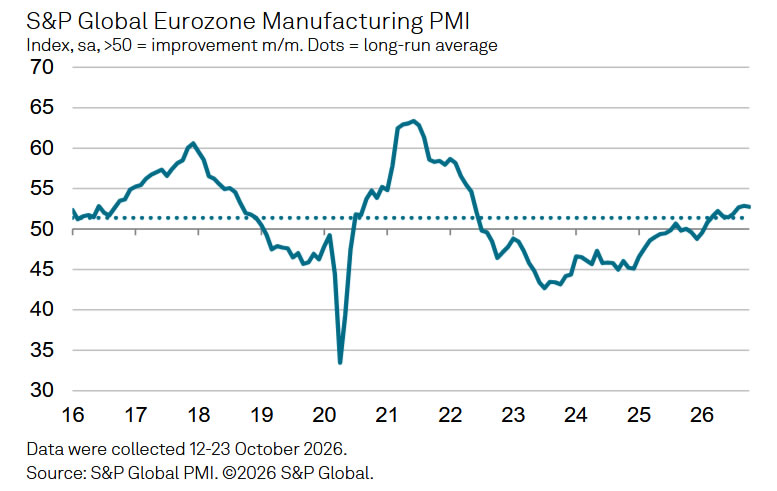
Data Summary
Eurozone PMI Manufacturing — October 2026
| Indicator | Sep | Oct |
|---|---|---|
| PMI Manufacturing | 52.9 | 52.7 |
| PMI Manufacturing Output | 53.6 | 52.8 |
| Germany PMI Manufacturing | 53.9 | 54.2 |
| France PMI Manufacturing | 50.6 | 49.5 |
Components
| Component | October Trend |
|---|---|
| New Orders | Growth slowed |
| Export Orders | Fastest growth in over four years |
| Output | Four-month low, still expanding |
| Employment | Third consecutive monthly increase |
| Backlogs | Joint-fastest growth since May 2022 |
| Purchasing Activity | Fastest growth since May 2022 |
| Stocks of Purchases | First increase since Dec 2022 |
| Supplier Delivery Times | Longest delays since Jun |
| Input Prices | Inflation at five-month high |
| Output Prices | Sharp increases, pace broadly steady |
| Business Confidence | Below long-run average |
Key Takeaways
- Manufacturing expansion remained solid: PMI Manufacturing edged down from 52.9 to 52.7, extending its expansionary streak to nine months. Output growth slowed to a four-month low but stayed above its long-run average.
- Regional divergence widened: Germany’s PMI Manufacturing rose from 53.9 to 54.2, approaching its strongest reading in four-and-a-half years. France slipped back into contraction at 49.5, while Italy also recorded renewed deterioration. Six of the eight surveyed economies continued expanding.
- Export demand provided support: Total new-order growth moderated despite export orders rising at their fastest pace in over four-and-a-half years. This divergence suggests that stronger external demand helped offset softer broader sales momentum.
- Purchasing and inventory accumulation strengthened: Buying activity accelerated to its fastest pace since May 2022, while input inventories increased for the first time since December 2022, partly reflecting precautionary stockbuilding amid supply disruptions.
- Inflation pressures intensified: Supplier delivery delays worsened and input inflation reached a five-month high. Manufacturers continued raising selling prices sharply, highlighting mounting cost pressures despite slower overall demand growth.