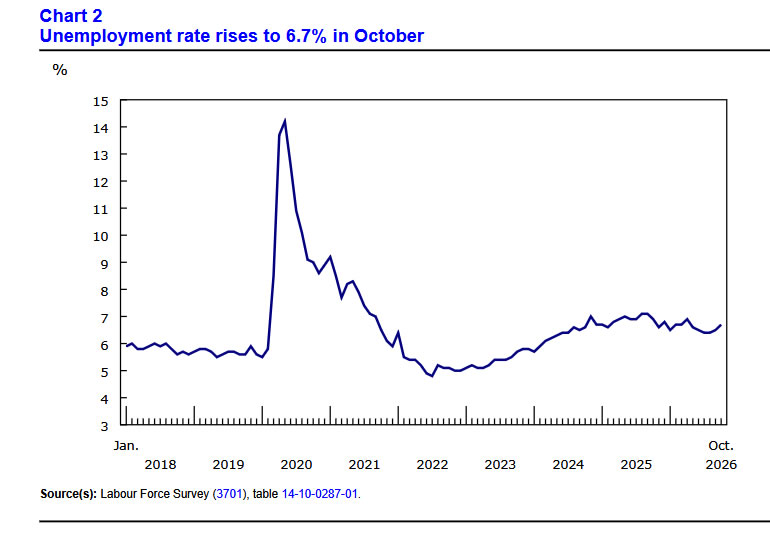
Canada’s employment was little changed in October, declining 4.7K following September’s 68.3K drop, according to Statistics Canada’s Labour Force Survey. The result was better than market expectations for a 12.5K decline, but the unemployment rate rose from 6.5% to 6.7%, exceeding forecasts for an unchanged reading and marking its second consecutive monthly increase. The employment rate also edged down from 60.6% to 60.5%, its third straight monthly decline, while labor force participation held steady at 64.8%. Employment has now fallen by approximately 115K over the past three months, suggesting that the smaller October decline has yet to establish a meaningful recovery in hiring.
The underlying employment breakdown was considerably weaker than the headline suggested, as private-sector employment fell by 53K, or 0.4%, its first monthly decline since February. The loss was largely offset by a 50K increase in public-sector employment, following four consecutive months of public-sector declines totaling 148K. By industry, wholesale and retail trade shed 29K jobs, extending its employment decline over the past 12 months to 113K, or 3.7%. Transportation and warehousing also lost approximately 10K positions. In contrast, construction employment rose 16K and educational services added 15K, while health care and social assistance gained approximately 14K. The divergence suggests that private-sector labor demand remained weak despite the relative stability in overall employment.
Other indicators also pointed to persistent labor-market slack. Youth unemployment rose from 13.0% to 13.7%, while the proportion of unemployed Canadians who found work in October was just 18.9%, below 19.8% a year earlier and the 24.6% pre-pandemic average for comparable months. Average hourly wage growth also eased from 2.3% to 2.2% yoy. The combination of rising unemployment, weak job-finding conditions and declining private-sector employment suggests that Canada’s labor market remains under pressure. Although the headline employment decline moderated considerably in October, the report offers little convincing evidence of a sustained recovery in underlying hiring demand.
Data Summary
Canada Labour Force Survey — October 2026
| Indicator | Sep | Oct | Cons. |
|---|---|---|---|
| Employment change | -68.3K | -4.7K | -12.5K |
| Unemployment rate | 6.5% | 6.7% | 6.5% |
| Employment rate | 60.6% | 60.5% | — |
| Labour force participation | 64.8% | 64.8% | — |
| Average hourly wages, yoy | +2.3% | +2.2% | — |
| Youth unemployment rate | 13.0% | 13.7% | — |
Employment Breakdown
| Category | October change |
|---|---|
| Private-sector employees | -53K |
| Public-sector employees | +50K |
| Self-employment | -2K |
| Full-time employment | -18.1K |
| Part-time employment | +13.4K |
| Total employment | -4.7K |
Employment by Industry
| Industry | October change |
|---|---|
| Wholesale and retail trade | -29K |
| Transportation and warehousing | -10K |
| Accommodation and food services | -8K |
| Construction | +16K |
| Educational services | +15K |
| Health care and social assistance | +14K |
| Manufacturing | +4K |
Source: Statistics Canada, Labour Force Survey, November 6, 2026. Consensus from ActionForex economic calendar. Figures rounded where appropriate.
Key Takeaways
- Headline employment losses moderated: Employment declined by 4.7K in October, following September’s 68.3K drop. The result was better than expectations for a 12.5K decline, but did not represent renewed job growth.
- Unemployment unexpectedly rose: Unemployment rate increased from 6.5% to 6.7%, above the 6.5% consensus, marking its second consecutive monthly increase.
- Employment rate continued to weaken: The employment rate fell from 60.6% to 60.5%, its third consecutive monthly decline, while labour force participation remained unchanged at 64.8%.
- Private-sector employment recorded substantial losses: Private employers shed 53K jobs, or 0.4%, the first monthly decline since February.
- Public-sector hiring largely offset private losses: Public-sector employment increased 50K following four consecutive months of declines totaling 148K. This rebound prevented a considerably larger overall employment contraction.
- Wholesale and retail trade remained particularly weak: Employment fell 29K in October, extending the sector’s annual decline to 113K, or 3.7%.
- Construction and education provided support: Construction added 16K jobs, while educational services gained 15K, partially offsetting employment losses in other industries.
- Youth unemployment climbed sharply: The unemployment rate among Canadians aged 15–24 rose from 13.0% to 13.7%, highlighting persistent difficulties for younger jobseekers.
- Job-finding conditions remained challenging: Only 18.9% of people unemployed in September found employment in October, compared with 19.8% a year earlier and the 24.6% pre-pandemic average for comparable months.
- Wage growth eased slightly: Average hourly wage growth slowed from 2.3% to 2.2% yoy, providing little evidence of strengthening wage pressures.
- Underlying labour demand remained fragile: The smaller headline employment loss was encouraging, but the combination of declining private-sector employment, rising unemployment and weak job-finding conditions suggests that a sustained recovery in hiring has yet to emerge.