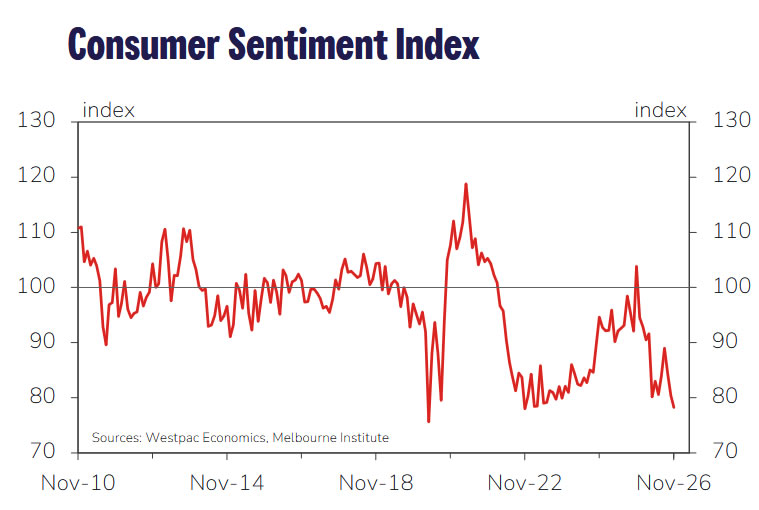
Australia’s Westpac–Melbourne Institute Consumer Sentiment Index fell 2.7% from 80.4 in October to 78.2 in November, its lowest level since late 2022, as inflation and rising borrowing costs continued to undermine household confidence. The deterioration was driven primarily by a sharp weakening in near-term economic expectations, with the outlook for the next 12 months plunging 10.2% to 70.3, its weakest reading since August 2020. Assessments of family finances improved slightly but stayed near historic lows, while the time-to-buy-a-major-item index declined 3.7% to 80.0. Westpac’s Matthew Hassan emphasized that “cost-of-living concerns remain front and centre,” with consumers facing annual inflation of 4.3%, petrol prices approaching A$2.40 per litre and the RBA’s latest 25bps rate increase to 4.85%.
Mortgage holders experienced the sharpest deterioration, with sentiment collapsing 11.6% to 68.1, the lowest reading since records for this group began in 1994. Among respondents surveyed after the RBA’s latest decision, 72% expected mortgage rates to rise further over the following 12 months, although this was below October’s 80%. Housing expectations also weakened significantly, with the House Price Expectations Index plunging 13.4% to 99.6, its first reading below 100 since November 2022. Meanwhile, the Unemployment Expectations Index rose 1.6% to 144.4, indicating gradually increasing concern about job security rather than widespread alarm. The combination suggests that persistent inflation and expectations of further tightening are weighing heavily on household confidence, particularly among borrowers.
The implications for consumption are concerning but not uniformly negative. Some 38% of respondents planned to spend less on Christmas gifts than a year earlier, compared with 36% last year, while 46% intended to spend about the same and 14% more. Among mortgage holders, however, 92% planned to spend no more than last year, reinforcing the pressure on discretionary expenditure. Westpac expects the RBA to pause at its December 7–8 meeting after five rate increases this year, allowing time to assess the cumulative effects of tightening. It sees February as the next likely meeting for active consideration of another hike, although it does not expect one in its central forecast. The survey suggests monetary restraint is increasingly affecting consumer confidence, but spending intentions have not deteriorated to the same extent, leaving the RBA balancing persistent inflation against growing pressure on household demand.
Data Summary — Australia Westpac Consumer Sentiment, November 2026
| Indicator | Nov | Oct | Change |
|---|---|---|---|
| Consumer Sentiment Index | 78.2 | 80.4 | -2.7% |
| Family Finances vs Year Ago | 68.8 | 66.9 | +3.0% |
| Family Finances Next 12 Months | 87.6 | 88.4 | -1.0% |
| Economic Conditions Next 12 Months | 70.3 | 78.3 | -10.2% |
| Economic Conditions Next 5 Years | 84.6 | 85.5 | -1.0% |
| Time to Buy Major Household Item | 80.0 | 83.0 | -3.7% |
| Unemployment Expectations Index | 144.4 | 142.1 | +1.6% |
| House Price Expectations Index | 99.6 | 115.1 | -13.4% |
| Mortgage Rate Expectations Index | 177.8 | 179.7 | -1.1% |
Additional Findings
| Indicator | November Finding |
|---|---|
| Mortgage Holder Sentiment | 68.1, down 11.6%; record low since 1994 |
| Expect Further Mortgage Rate Increases | 72% of post-RBA decision respondents |
| Christmas Spending — Less | 38% of respondents |
| Christmas Spending — Same | 46% of respondents |
| Christmas Spending — More | 14% of respondents |
| Mortgage Holders Spending Same or Less | 92% of respondents |
Key Takeaways
- Australian consumer sentiment fell 2.7% to a four-year low of 78.2, driven by sharply deteriorating expectations for the economy over the next year.
- Mortgage-holder confidence plunged 11.6% to a record low of 68.1 as inflation, higher borrowing costs and expectations of further rate increases pressured households.
- Christmas spending plans suggest caution rather than collapse, while Westpac expects the RBA to pause in December to assess the impact of tightening.