

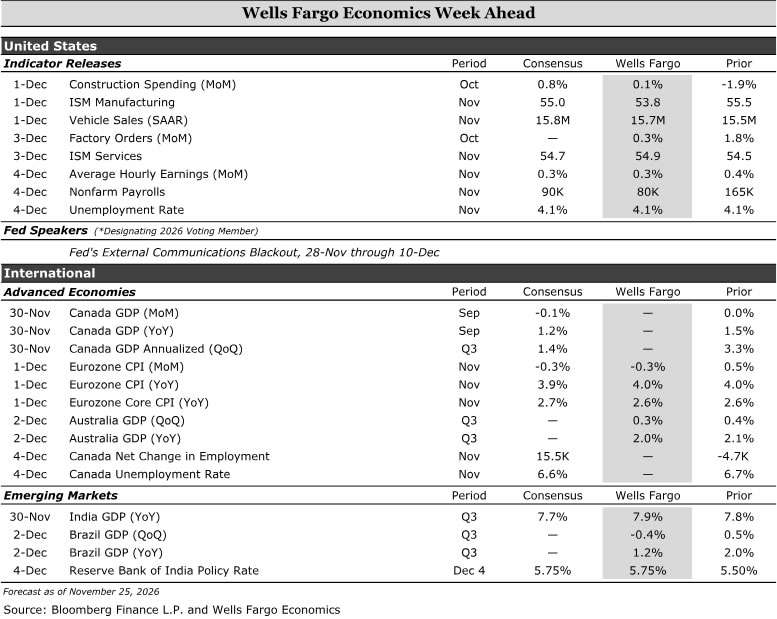
We expect November payrolls to rise 80K, roughly in line with the six-month average, and the unemployment rate to hold at 4.1%. Firming labor-demand indicators point to a healthy labor market that isn’t overheating, which leaves inflation as the Fed’s bigger concern. Meanwhile, the ISM surveys should show both manufacturing and services still expanding, though we expect the more notable signal to remain continued cost and supply-chain pressures.
Abroad, Canada’s Q3 GDP should show growth slowing to around 2% annualized. A stronger print would support our call for a December Bank of Canada hike. The policy picture is unlikely to be changed by the labor backdrop—we expect Canadian hiring to pick up somewhat in November, with unemployment holding steady.
United States:
- ISM Manufacturing & Services (Tue. & Thu.), Employment (Fri.)
Advanced Economies:
- Canada GDP (Mon.), Canada Employment (Fri.)
U.S. Week Ahead
ISM Manufacturing & Services • Tuesday & Thursday
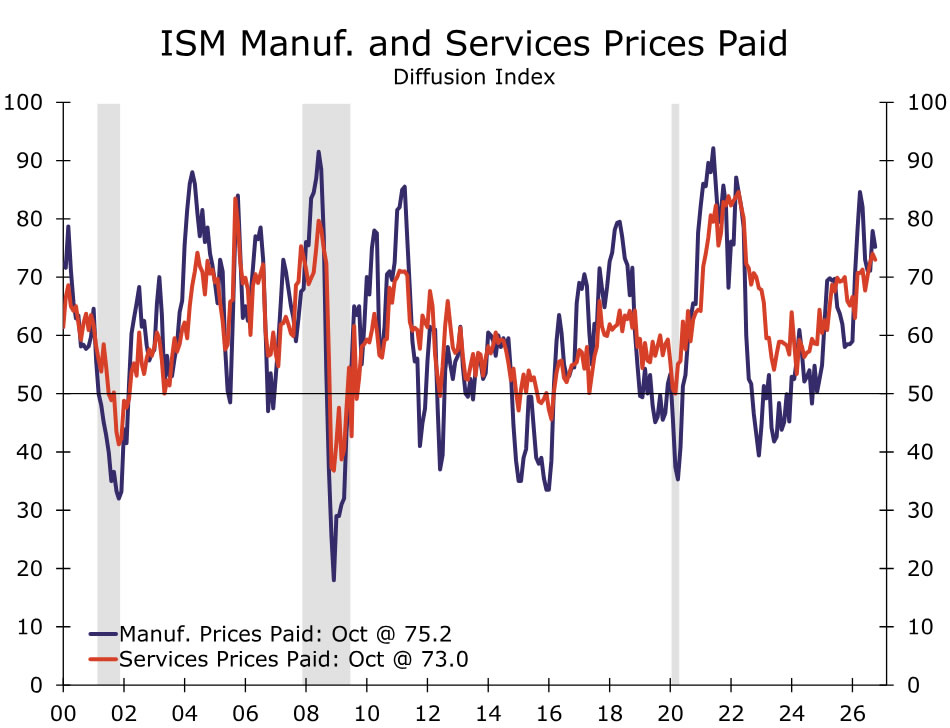
We expect November’s ISM surveys to show continued expansion across both sides of the economy, with manufacturing easing to 53.8 from 55.4 and services rising to 54.9 from 54.5.
Regional Fed bank surveys suggest manufacturing momentum appears to have cooled somewhat after October’s strong reading when softer employment was partially offset by gains in new orders, production and inventories. But recent purchasing manager anecdotes suggest any weakness is far from uniform—demand tied to AI/data centers, semiconductors, defense and infrastructure remains strong, even as customers elsewhere remain reluctant to commit to longer-term investment.
The services sector may prove somewhat firmer. Employment improved in September and lengthier supplier delivery times helped support the headline even as new orders and business activity weakened. Across both surveys, however, the more notable signal is continued pressure on costs and supply chains. Respondents repeatedly cite tariffs, fuel, freight and commodity costs, pointing to a more challenging operating environment headed into year-end.
Employment • Friday
We expect nonfarm payrolls to rise 80K in November, roughly in line with their average pace over the past six months. October’s stronger-than-expected gain was driven in part by an outsized increase in professional & business services employment and a pickup in healthcare hiring, both of which we expect to moderate in November.
Despite the expected slowdown in payroll growth, other indicators suggest underlying labor demand has strengthened. The Conference Board’s labor differential rose to its highest level since May 2025 in November. The improvement is consistent with a steady rise in job postings on Indeed, which have also reached their highest level since May 2025. Meanwhile, initial jobless claims continue to hover near historic lows, suggesting employers remain reluctant to part with existing workers.
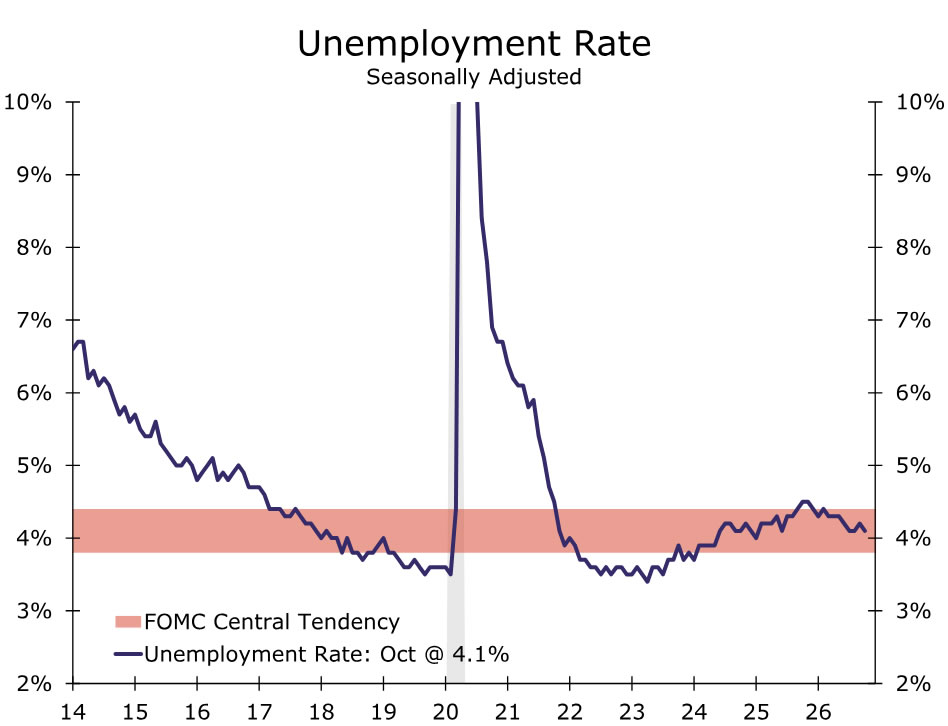
We expect the unemployment rate to hold steady at 4.1%. Employment as measured by the household survey has risen strongly over the past three months, leaving some scope for a pullback in November. A further decline in the number of unemployed, however, should provide an offset. The risks are tilted toward a slight increase in the unemployment rate if unemployment does not fall as much as we anticipate. Even so, the unemployment rate would remain historically low and consistent with a labor market that is broadly in balance.
Average hourly earnings should rise 0.3% in November, putting the year-over-year rate at 3.0% if our forecast is realized. With inflation still running firm, real wage growth remains restrained, tempering household demand and limiting the risk of renewed inflationary pressures. The labor market continues to look healthy without showing signs of overheating, leaving inflation rather than employment as the more pressing concern for the Fed.
Advanced Economies Week Ahead
Canada GDP • Monday
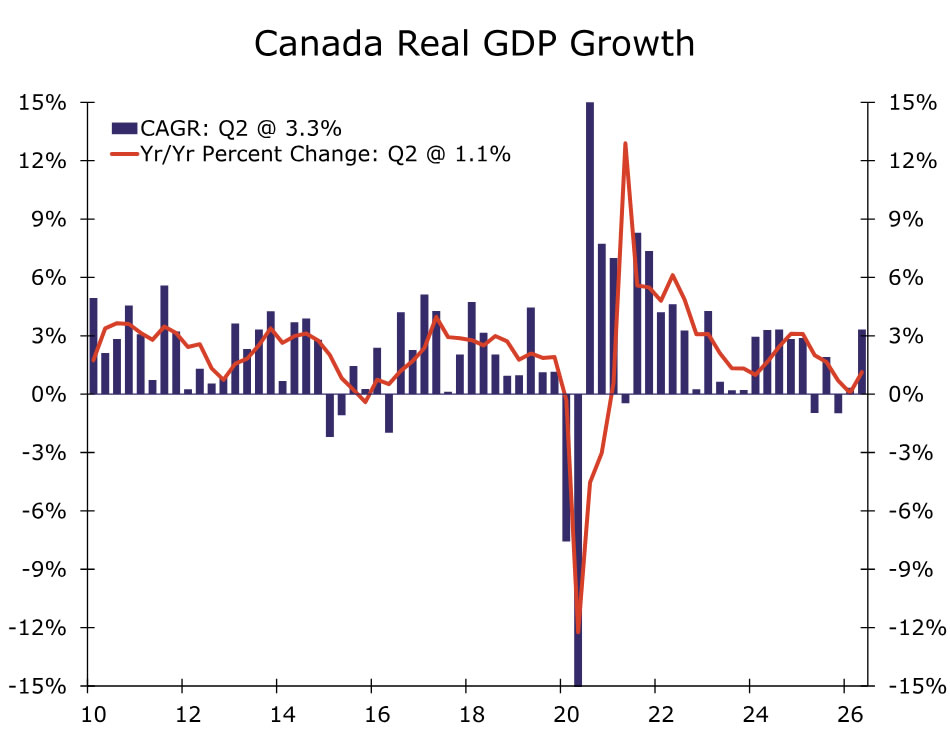
Canada’s third-quarter GDP report is likely to show the economy carried solid momentum into the second half of the year, even as activity lost some steam toward the end of the quarter. Statistics Canada’s preliminary estimate points to a 0.1% decline in monthly GDP in September, and Q3 growth is tracking to rise around 2% annualized, a step-down from the 3.3% pace in Q2 but still relatively firm.
That would be broadly consistent with the Bank of Canada’s view that the economy has proven more resilient—something Governor Tiff Macklem reiterated this week, noting that economic performance has been “modestly better” than expected.
The bigger question is how much of that momentum carried into the fourth quarter. The BoC expects growth to slow toward year-end as renewed U.S. tariffs weigh on activity, before picking back up in 2027. Monday’s report should therefore provide an important read not only on the composition of Q3 growth, but also on the economy’s starting point heading into that anticipated slowdown. A stronger-than-expected print would add to evidence that the economy is absorbing trade-related headwinds relatively well and, alongside elevated inflation, reinforce our view for another BoC rate hike in December.
Canada Employment • Friday
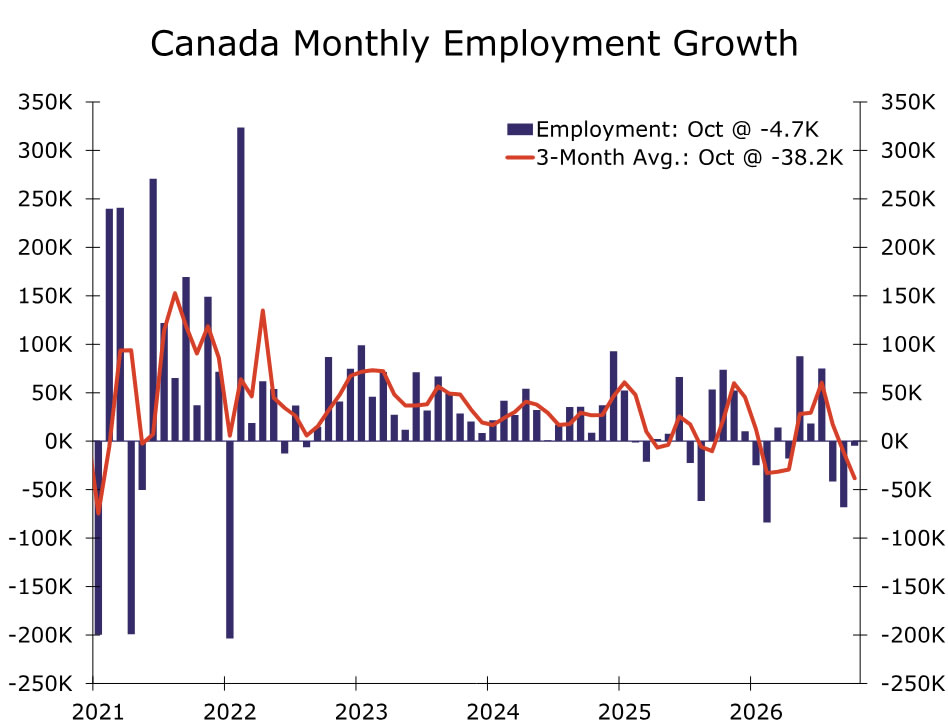
Canada’s labor market remained subdued in October, with employment slipping 4.7K as a decline in full-time positions more than offset an increase in part-time help. We look for hiring to regain some footing in November and for the unemployment rate to hold steady near 6.7%.
The broader picture, however, remains one of relatively soft labor demand rather than outright deterioration. Employment growth has struggled to build sustained momentum in recent months, while the unemployment rate has remained elevated but relatively stable. Slower labor force growth has also helped limit further upward pressure on joblessness, leaving the labor market softer than a year ago but not materially weakening at the margin.
Friday’s report, together with the GDP data earlier in the week, will provide the latest read on underlying growth momentum heading into year-end. Barring a more pronounced deterioration in the labor market, however, we don’t expect the data to materially alter the policy picture with the Bank of Canada increasingly focused on elevated inflation and the risk that price pressures broaden.