

Canadian Highlights
- While gains were made this week, equity markets and oil prices are still down sharply from the highs seen earlier in November.
- In an important speech Tuesday, Governor Macklem emphasized that persistent inflation pressures are likely to pass through to consumer prices, reinforcing the case for another rate hike, likely in December.
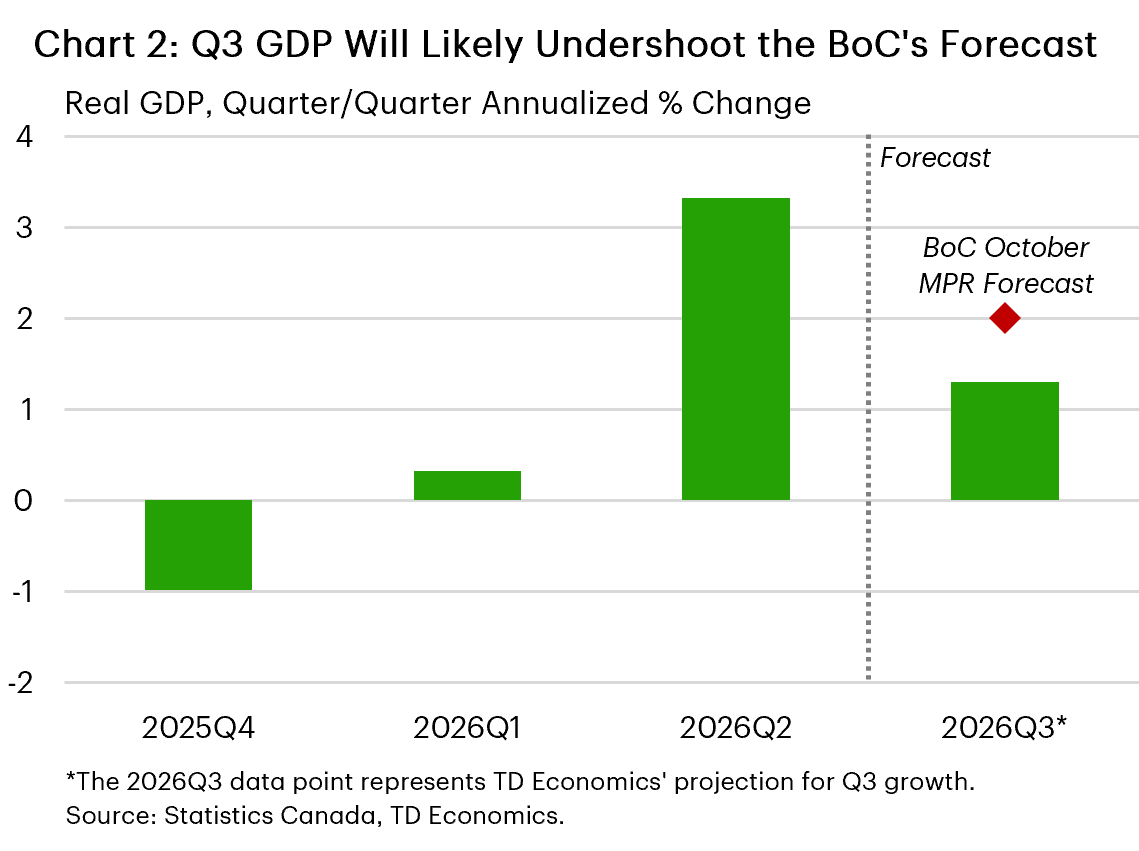
- Next week brings Q3 GDP data. We expect a soft print of just 1.3% annualized, in line with our view that not much monetary tightening should be required to keep inflation contained.
U.S. Highlights
- AI valuation concerns and renewed tariff uncertainty kept markets volatile, even as the S&P 500 and Nasdaq ended the holiday-shortened week higher.
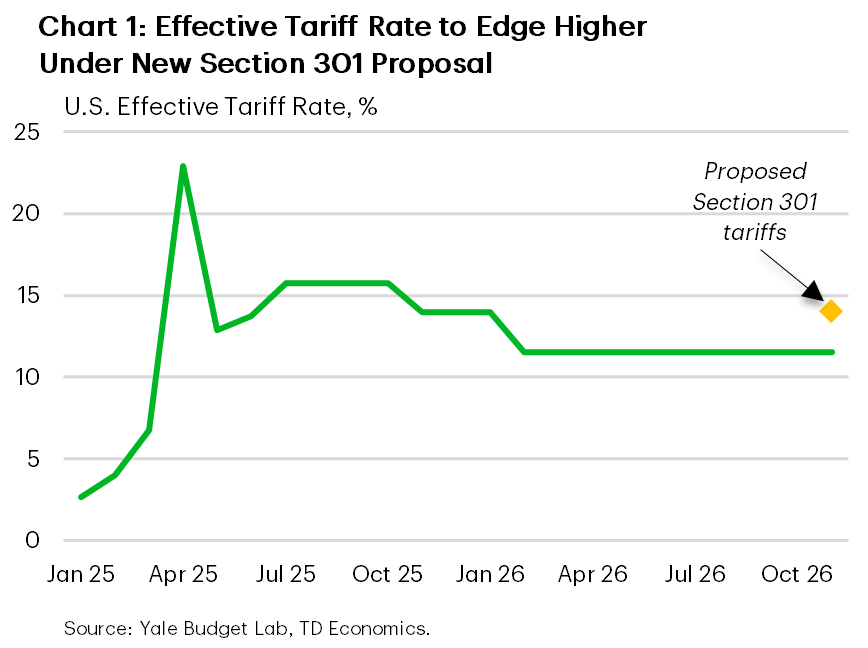
- The proposed tariffs would largely replace or top up existing rates, modestly raising the effective U.S. tariff rate and limiting the incremental growth and inflation impacts.
- Resilient demand and elevated inflation keep further Fed tightening in focus, with next week’s employment report a key test of labor-market strength.
Canada – The Banker’s Speech
Financial markets were mixed this week. Equities partially recouped some of last week’s major losses, keyed by some reversal of the AI selloff. Still, the TSX remained about 5% below the highs of only a few weeks ago. Even with money flowing back into equities – which, all else equal would typically pressure bond yields higher – yields on government debt were still down. This seemingly reflects continued unease about the AI sector’s ability to sustain its momentum.
The key event for Canadian economy watchers was Bank of Canada Governor Macklem’s speech, which discussed the conclusions from the monetary policy framework renewal process that occurs every five years. Macklem took great pains to emphasize that the Bank is targeting headline inflation, and that the Bank’s array of core inflation measures are merely guideposts in their quest to keep overall inflation stable at 2%. On core inflation, the Bank will now emphasize CPI-trim and CPIX, and publish an inflation dashboard with a variety of inflation metrics including breadth measures.
In terms of the near-term outlook, Governor Macklem’s speech reinforced the Bank’s view that inflation pressures have been in the pipeline for several months, and that historical experience and their business surveys suggest increased pass-through of higher energy costs to consumer prices is coming in the months ahead. The Bank also put out research concluding that during a supply shock that causes inflation (like the spike in oil prices), it’s more costly to delay raising rates than to increase rates more than is ultimately needed and have to reverse course later. This stance combined with the overall messaging in Macklem’s speech suggests the Bank is likely to hike rates at its next opportunity on Dec. 9th, and markets agree, pricing in more than an 80% chance of a hike.
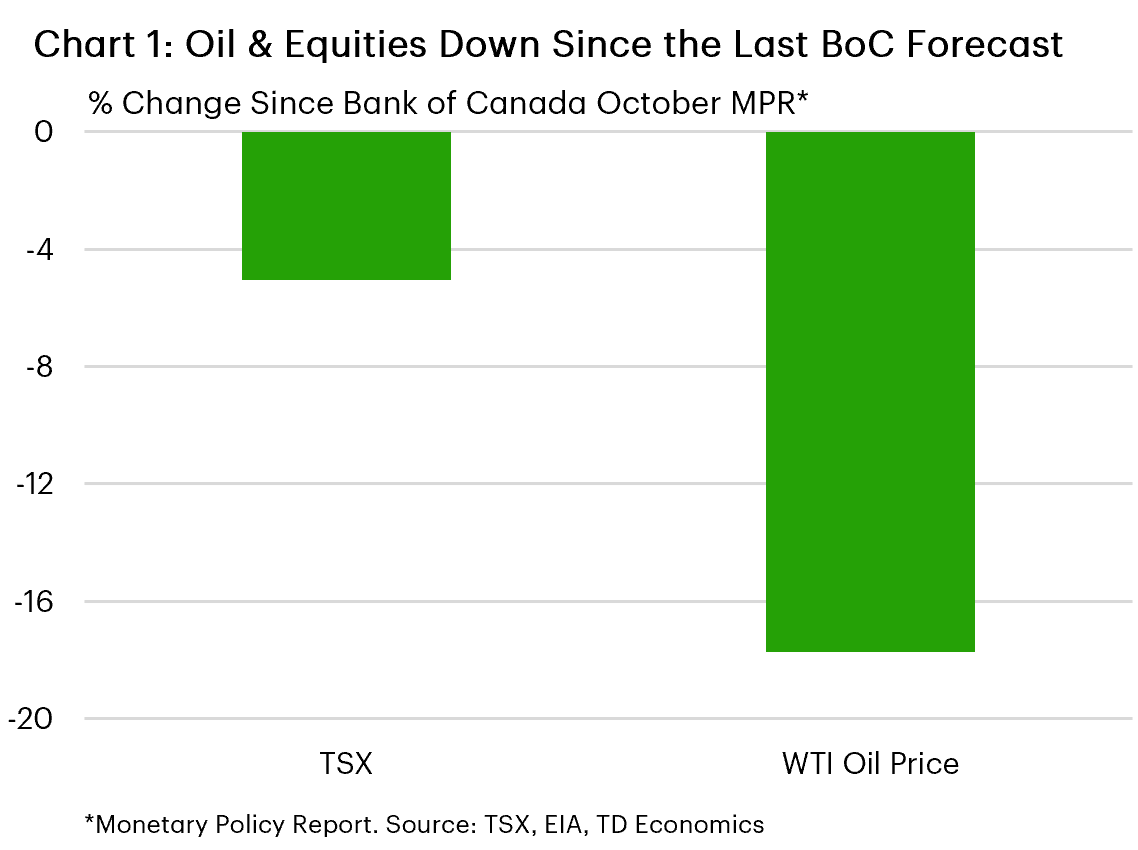
However, since the BoC’s last forecast, equity markets and oil prices are both down (Chart 1). Losses in equity markets sap wealth from Canadian households, potentially risking downward pressure on consumer spending. Lower oil prices should provide relief on the inflation front, and it looks like inflation is likely to undershoot the Bank’s forecast in the fourth quarter. Economic data has generally surprised to the downside, although this week’s payroll employment report did flag some positives, including a rise in hours worked. Still, payroll employment was up a mere 0.7% year-on-year in September. Next week brings Canada’s third quarter GDP and a jobs report for November. For GDP, we’re expecting a subdued 1.3% annualized gain (Chart 2) – weaker than the 2% that the Bank is projecting. All of these developments since the Bank’s Monetary Policy Report suggest that not much tightening should be required to keep inflation contained in Canada.
A December hike seems like a lock at this point. But, the BoC’s near-term forecasts on growth and inflation look likely to be disappointed, lessening the case for further monetary tightening. Therefore, barring a significant upside surprise in economic momentum, we are skeptical that the additional rate hikes markets are expecting will ultimately be required.
U.S. – AI-nxiety Meets a Resilient Economy
Call it a Huangover, Anthro-panic or simply AI-nxiety, financial markets have been on a bit of a roller coaster this week. After Monday’s euphoric rebound gave way to another bout of tech-led selling, investors came back from Thanksgiving in buying mode, with beaten down semiconductor and AI stocks leading the way. But the rebound doesn’t yet warrant the “all-clear”, as lingering questions regarding the sustainability of AI-valuations, the cost of the investment boom and how much higher rates will need to go, haven’t gone away. And, as if markets didn’t have enough on their plate, another helping of tariff uncertainty was served up this week. The S&P 500 and Nasdaq were on track to end the week in the black, but remain below their October highs.
This week’s tariff proposal came as little surprise after the U.S. Trade Representative’s March announcement of a Section 301 investigation into “structural excess capacity” across 16 economies. Wednesday’s announcement advances efforts to rebuild the IEEPA tariff regime struck down by the Supreme Court last February. The proposal targets 14 economies with tariffs generally ranging from 15% to 20%, and higher rates for Singapore, India and Vietnam—the only three without reciprocal trade deals with the U.S. Tariffs would take effect sometime after the January 25, 2027 public hearing. Crucially, most would top up existing rates rather than stack on top. China is the exception: its 20% Section 301 tariff would generally add to its existing 25% rate, bringing the total close to 45%. The incremental increase is modest despite headline rates, as most tariffs replace, formalize or top up existing arrangements. If implemented, the overall U.S. effective tariff rate would rise by 2.5 percentage points to 14% (Chart 1), limiting the growth and inflation impacts.
Even still, the optics of imposing further tariffs at a time when measures of inflation are drifting further from the Fed’s 2% target (Chart 2) aren’t great – especially when underlying demand remains robust. The second revision to third quarter GDP showed that the economy expanded at its fastest pace in three years, with most of the strength coming from household spending and business investment. While spending softened in October, the broader backdrop heading into the holiday shopping season remains encouraging (see report). Solid income growth and a sharp rebound in consumer sentiment in November suggest households retain both the capacity and willingness to spend, supporting a reasonably healthy holiday shopping season.
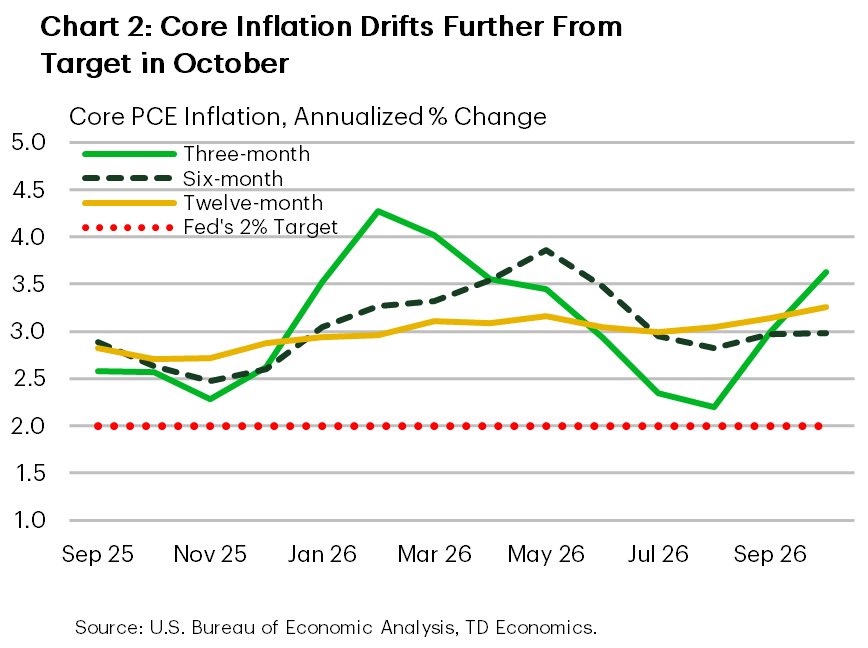
For the Federal Reserve, the combination of resilient demand and still elevated price pressures supports the case for tighter monetary policy. Exactly how much will depend on both the flow of economic data and broader financial conditions. While the recent equity selloff has resulted in a modest tightening in financial conditions, they remain far from stressful levels. Even so, financial conditions will remain a key watchpoint, alongside next week’s employment report. Another month of firm hiring and wage growth would reinforce the message that labor demand remains resilient and could push markets to price in a greater risk of additional Fed tightening.