TL;DR:Will the Fed and BoJ jointly surprise markets this week? USD/JPY, already at a 40-year high above 163, faces amplified two-way risk from their combined policy signals.
Why This Week Matters More Than a Typical Central Bank Cycle
Three major central bank decisions are packed into little more than 60 hours: the Federal Reserve announces policy Wednesday, the Bank of England follows Thursday, and the Bank of Japan concludes its meeting Friday. Markets are unlikely to distribute their attention evenly across all three. The Fed and BoJ have the greatest potential to reshape rate expectations, and the interaction between the two could make USD/JPY the week’s most sensitive pair.
With the pair already trading at a 40-year high, even modest surprises from either central bank could trigger an outsized reaction. That asymmetry — high positioning risk meeting high event risk — is what separates this week from routine policy meetings.
The Fed: A Unanimous Hold, But a Contested Path Ahead
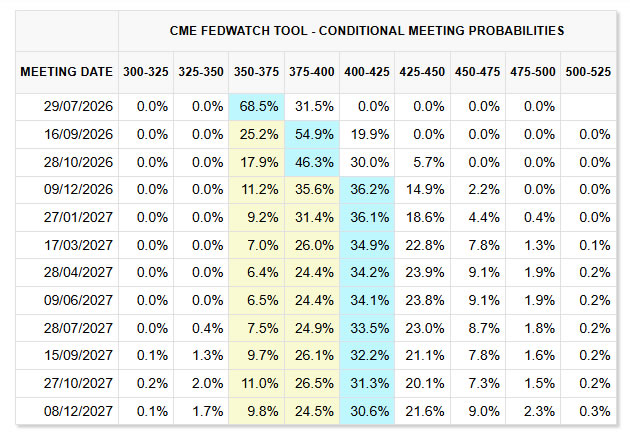
The Fed is universally expected to leave the federal funds target range unchanged at 3.50–3.75% on Wednesday. Reuters’ July 21 survey showed all 104 economists expecting no policy change, while futures markets assign only around a one-third probability of an immediate hike.
Yet that headline consensus masks a more important debate over the path ahead. Futures continue to price:
- Roughly a 75% probability of a September hike
- Better than even odds of two increases before year-end
That pricing is considerably more aggressive than economists’ consensus for rates to hold steady through December — a disconnect that leaves Treasury yields particularly sensitive to any signal that policymakers are growing less comfortable waiting.
What to Watch: The Voting Breakdown and Warsh’s Tone
The meeting’s most important signal may not be the rate decision itself but the voting breakdown. Minutes from the previous FOMC meeting revealed several policymakers were already prepared to support an immediate rate increase before ultimately agreeing to wait for more evidence. Any rise in dissenting votes favoring tightening would give investors a concrete measure of how quickly sentiment inside the Committee is shifting.
Markets will also need to adjust to Chair Kevin Warsh’s communication style. Unlike predecessor Jerome Powell, Warsh has consistently rejected detailed forward guidance. Investors are likely to focus instead on how he characterizes labor market resilience, whether he places greater weight on inflation risk from higher oil prices, and whether he pushes back on the market’s aggressive tightening expectations.
The BoJ: A Quiet Hold With a Loud Subtext
Attention then shifts to Tokyo, where the BoJ is also widely expected to leave its policy rate unchanged at 1.00%. The real focus is the quarterly Outlook Report and Governor Kazuo Ueda’s assessment of whether inflation and growth data justify a faster normalization cycle.
Reuters’ latest survey found an overwhelming majority expecting no move this week but anticipating another hike before year-end, with October and December emerging as the most likely windows. Bloomberg has separately reported that some BoJ officials are becoming more receptive to accelerating the pace of tightening if persistent yen weakness keeps feeding domestic inflation.
Even without immediate action Friday, upward revisions to inflation forecasts or stronger confidence in the outlook would reinforce expectations the Bank could move sooner than markets currently anticipate.
Why USD/JPY Carries Unusually High Event Risk
That combination gives USD/JPY unusually high event risk from both directions:
- On the US side, the key question is whether the Fed signals an approaching rate hike
- On the Japanese side, investors are watching for stronger evidence that policy normalization is gathering pace
A hawkish outcome from either central bank would normally move the exchange rate on its own. If both occur in the same week, the resulting repricing could be considerably larger than either event in isolation.
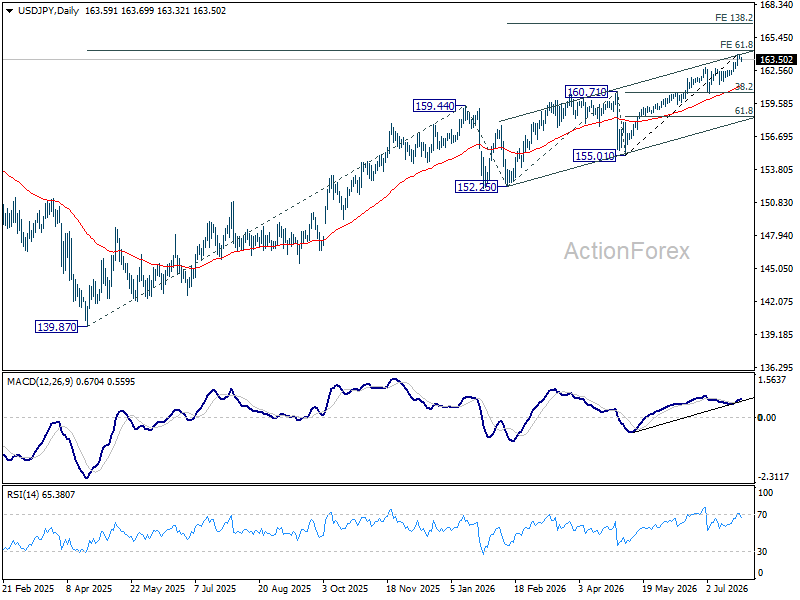
Positioning further amplifies that risk. USD/JPY has already climbed above 163 — its highest level in four decades — despite repeated verbal intervention from Japanese officials. Earlier currency intervention totaling JPY 11.73 trillion only stabilized the exchange rate for roughly six weeks before the broader yen selloff resumed.
ActionForex analysis suggests that experience has made markets increasingly reluctant to challenge the underlying interest-rate differential unless accompanied by a genuine shift in monetary policy — meaning this week’s decisions may prove far more influential than official rhetoric alone.
ActionForex’s Technical View on USD/JPY
Technically, USD/JPY appears to have formed a temporary top at 163.97 following today’s retreat. Any correction should stay relatively shallow and brief as long as the 55 4H EMA, currently at 162.93, continues to hold.
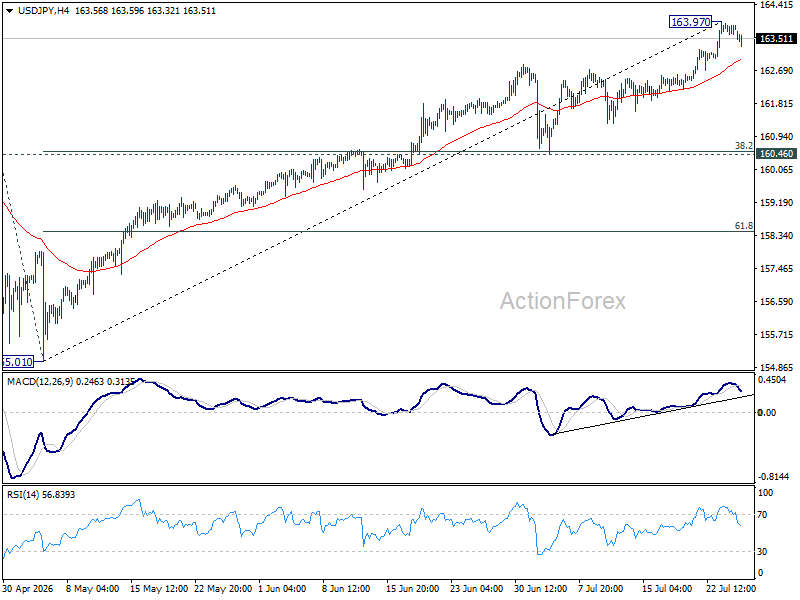
A decisive break above 163.97 would resume the broader uptrend from 155.01 and target 138.2% projection of the 152.25-160.71 advance measured from 155.01 at 166.07.
On the downside, sustained trading below the 55 4H EMA would suggest the rally from 155.01 has entered a corrective phase. That would shift focus toward the 160.46 support cluster, which includes the 38.2% retracement of 155.01 to 163.97.
Key Takeaways
- The Fed is expected to hold rates at 3.50–3.75%, but futures price a 75% chance of a September hike — well ahead of economist consensus
- The voting breakdown and Chair Warsh’s tone on inflation and labor resilience matter more than the headline decision
- The BoJ is expected to hold at 1.00%, but the Outlook Report and Ueda’s language on inflation could signal an accelerated tightening timeline
- USD/JPY, at a 40-year high above 163, faces amplified two-sided risk if both the Fed and BoJ surprise hawkishly in the same week
- 163.97 is the key upside pivot; a break above targets 166.07, while a failure to hold the 55 4H EMA (162.93) opens the 160.46 support zone