


TL;DR: USD/JPY’s rebound from last month’s intervention is stalling just below 160, as reports of an informal US-Japan understanding — support for the Yen in exchange for BoJ hiking room — reshape how traders read the months ahead.
A Rebound Stalling at a Loaded Level
USD/JPY’s sharp rebound from last month’s crash has extended further this week, with the dollar climbing back above 159 against the yen — but the advance is now stalling just below the psychologically loaded 160 level. That hesitation isn’t random, and understanding why means rewinding to late July, when Japan and the United States stepped in together to rescue a currency that had spent this year sliding to lows not seen in decades.
The rescue worked, at first. The dollar plunged from near 164 to around 155 in a matter of days. Then, within about two weeks, most of that move had reversed — which is exactly the rebound now running out of steam near 160.
That fade might look like a failed rescue. But new reporting this week suggests something more interesting: the rescue may never have been designed to work alone in the first place. It may have been the visible half of a bigger deal — one that’s only now becoming clear, and one that could decide whether 160 holds or breaks.
Why Propping Up a Currency Rarely Works Alone
To understand what’s going on, it helps to understand why the yen keeps falling. Japan’s interest rates are far lower than rates in the US and most other major economies. That gap creates an opportunity known as the “carry trade”: investors borrow yen cheaply, since it costs so little in interest, then use that money to buy assets in countries offering much higher returns. It’s a bet that pays off as long as the yen stays weak — and the wider the interest rate gap, the more attractive the bet becomes.
This is exactly why last month’s rescue faded so fast. When intervention pushes the yen higher, it doesn’t fix the underlying interest rate gap — it just creates a better price for investors to place the same bet again. One fund manager told Reuters intervention is “a great opportunity to sell the yen at higher levels.” Traders aren’t defying the rescue. They’re pricing it in and moving on.
Economists have said for months there’s really only one lasting fix: Japan’s central bank, the Bank of Japan, needs to actually raise interest rates and close that gap. A currency rescue can buy time. It can’t buy a permanent solution.
The Deal Behind the Curtain
Here’s where this week’s news comes in — and it’s more significant than it might first appear. Reports now suggest July’s joint currency rescue wasn’t a standalone decision. According to Japanese media, it was made possible by the Bank of Japan’s own governor sounding notably more open to raising rates at the very meeting where the rescue was agreed. Analysts at Mitsubishi UFJ believe this points to something close to an informal understanding: the US would help defend the yen, and in exchange, Japan’s central bank would get political room to keep raising rates.
This week, the government side of that understanding became public. Bloomberg reported that Prime Minister Sanae Takaichi’s government now supports the Bank of Japan raising rates soon — possibly as early as September or October.
That’s a real shift worth pausing on. Takaichi has built her reputation as a big spender who favors looser policy, not tighter. She has previously pushed the central bank to keep buying government bonds to hold down borrowing costs, and several of her closest advisers have openly worried the bank was tightening too quickly. A government with that track record signaling support for a rate hike isn’t a small thing — it looks like exactly the kind of political cover a central bank would need to move faster than usual.
A word of caution, though. Officially, the Prime Minister’s office says interest rate decisions are entirely up to the Bank of Japan — not something the government controls or promises. That’s a meaningful hedge. Supportive words cost nothing; an actual rate hike is the only thing that will really prove this shift is real. It’s also worth noting that markets barely reacted to the report — the yen barely moved — a sign traders had already assumed something like this was coming.
The Countdown to September 18
All of this now points to a single date: the Bank of Japan’s next policy meeting, on September 18. Traders currently see roughly a three-in-four chance of a rate hike then. If it happens, it would be Japan’s third rate increase in under a year — the fastest pace of tightening since 1989, the year Japan’s legendary asset-price bubble peaked.
The next few weeks essentially come down to two paths. If the Bank of Japan delivers the hike, it confirms this week’s story was the real turning point — a government and central bank finally moving together to fix the yen’s real problem, not just paper over it.
If the bank delays again, the disappointment could be worse than any hold before it. Markets have already priced in action. A delay now wouldn’t just be a missed opportunity — it would break an understanding that, by most accounts, the market believes is already in place. Analysts warn that kind of letdown could trigger a sharper, faster bout of yen weakness than anything seen so far this year.
Either way, September 18 is no longer just another item on the calendar. It’s the moment that decides whether this week’s news was the real deal — or just more talk.
ActionForex’s Technical View on USD/JPY
Price action already reflects this stand-off. After crashing from just under 163.97 to 155.22 during the intervention, USD/JPY has clawed back roughly half of that drop, running into resistance in a band that lines up closely with the 160 ceiling analysts believe Japan’s intervention tools are designed to defend. That’s not a coincidence — this level matters both as a chart pattern traders watch and as a real policy line in the sand.
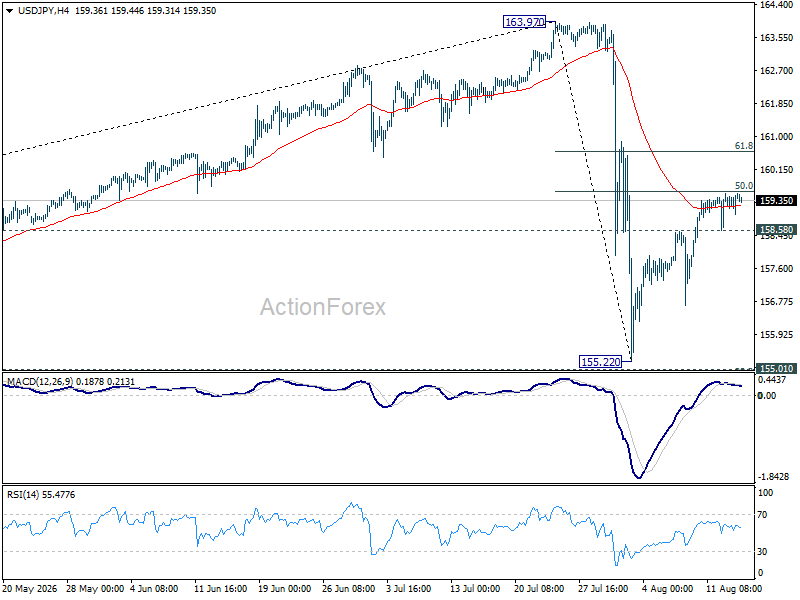
From here, two paths. A rejection at current levels, followed by a break of 158.58 minor support, would suggest BoJ hike expectations are building momentum. If the Bank of Japan actually follows through on next month’s hike, USD/JPY would likely be dragged further down toward the 155.22 low.
On the other hand, USD/JPY could still grind higher if skepticism about the BoJ continues, or on other developments. But the pair will likely lose momentum somewhere between 159.59 and 160.62 — the 50% and 61.8% retracement levels of the 163.97-to-155.22 crash. Traders will likely wait for the BoJ’s verdict before attempting to push USD/JPY through this resistance zone.
Either way, 160 is where the fundamental story and the chart are, for once, telling the exact same story.
Key Takeaways
- USD/JPY’s rebound from the intervention low of 155.22 is stalling near 160, the level analysts believe Japan’s intervention tools are designed to defend.
- The July rescue faded within two weeks because intervention alone doesn’t close the US-Japan interest rate gap driving the yen carry trade.
- Reports suggest July’s intervention was tied to an informal understanding: US support for the Yen in exchange for BoJ room to keep hiking rates.
- PM Takaichi’s government, historically dovish, now reportedly supports a BoJ hike as early as September or October — a notable shift in political cover.
- September 18 is the key date: traders price roughly a 75% chance of a hike, with a delay risking a sharper yen selloff than any seen so far this year.





