


TL;DR: Gold’s fall from 4,697.07 to around 4,423 looks more like a correction than a reversal — Warsh repriced rate timing and trimmed some fiscal-credibility premium, but the longer-run Fed path and US fiscal arithmetic are unchanged, leaving the 4,320-4,338 support cluster as the level that would need to break to challenge that base case.
Warsh Hit Gold Twice
Gold’s fall from last week’s 4,697.07 peak to around 4,423 looks violent enough to raise obvious question: has one of year’s strongest bullish trades finally reversed? Not yet. Roughly 5.8% decline has been concentrated around Friday’s reaction to Fed Chair Warsh’s Jackson Hole speech and Monday’s follow-through, but mechanics of move still look more like a sharp reset than beginning of a new bearish regime.
Warsh delivered two blows at once. First was rates. September hike probability jumped from around 37% to 57%, with odds of at least one hike by December rising to roughly 89%. Treasury curve showed exactly where repricing occurred: 2-year yield surged about 13bp to 4.36%, 10-year rose around 5bp to 4.72%, while 30-year barely moved, up only 1–2bp to 5.21%. Investors moved timing of tightening forward; they did not suddenly price a radically different long-run inflation or rate regime.
Second blow came through debasement trade. Warsh did not mention Bessent, Treasury buybacks or fiscal dominance. But his message was unmistakably discipline-oriented. Short-term rates should be Fed’s predominant tool. Unconventional policy should be used “sparingly, if at all.” Fed should be “committed to a discipline, not to a decision.” Those comments reduced some of institutional-risk premium that had been embedded in Gold as investors worried about monetary policy eventually bending toward fiscal needs. Gold therefore sold off on two fronts at once: higher rates and less urgency to hedge against monetary-fiscal slippage.
Timing Changed More Than Terminal Rate
That sounds bearish, but there is an important limit to what markets have actually repriced. Further out FedWatch curve, 4.00–4.25% remains largest single bucket from around mid-2027 onward, while probabilities attached to three or more additional hikes fade further into horizon. Market has moved toward earlier tightening, not toward an obviously longer tightening campaign.
That distinction is central. A lasting Gold reversal would be easier to justify if Warsh had pushed markets toward a substantially higher terminal path and structurally higher real yields. So far, that has not happened. Investors have restored a hawkish path that had lost conviction in recent weeks rather than discovered an entirely new Fed regime.
In that sense, Gold is paying price for reversion rather than discovery. Warsh gave markets reason to take September seriously again and reduced some credibility risk around Fed. But he has not yet produced evidence that rates will have to rise much further than markets already contemplated.
Warsh Changed Fed Leg, Not Fiscal Arithmetic
Same argument applies to debasement trade. Warsh weakened one part of it, but he did not remove underlying fiscal backdrop.
Treasury buyback program for Sept. 9–Nov. 4 remains live. Fitch still projects federal debt rising from roughly 117% of GDP in 2025 to 128% by 2030. July deficit was $432bn, while interest payments have reached around $963bn. None of those numbers changed because Fed Chair delivered a discipline-first speech.
That matters because debasement trade is broader than Fed independence alone. It also reflects persistent deficits, Treasury financing needs, debt servicing, monetary accommodation risk and confidence in Dollar over longer run. Warsh reduced concern that Fed itself would readily validate fiscal accommodation. Fiscal arithmetic that created those concerns, however, is still there.
For Gold bears, that leaves a higher bar. Either Fed path must become materially more restrictive than currently priced, or fiscal picture itself has to improve enough to remove another leg of structural Gold demand.
ActionForex’s Technical View on Gold: The Real Test Is Still Below the Market
Charts point to same conclusion: Gold has been hit hard, but most important support has not yet been tested.
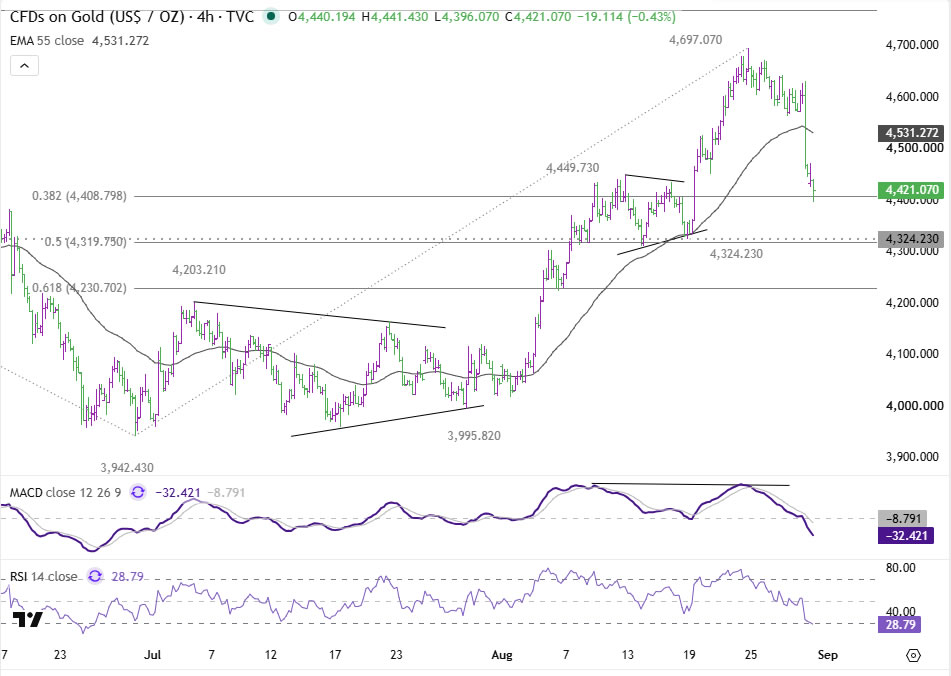
Short-term damage is obvious. Price has fallen through 4H 55 EMA near 4,531, 4H RSI has dropped to roughly 29, and 4H MACD remains firmly negative. Momentum is still pointing down, so there is no technical basis yet to declare correction finished.
Daily chart is different. Gold remains above rising 55-day EMA at 4,338.05, daily RSI is still around 52, and MACD remains above zero even though momentum has turned lower. More importantly, three independent support methods converge in almost same place:
- 55-day EMA at 4,338.05.
- 50% retracement of 3,942.43–4,697.07 rally at 4,319.75.
- Structural support at 4,324.23.
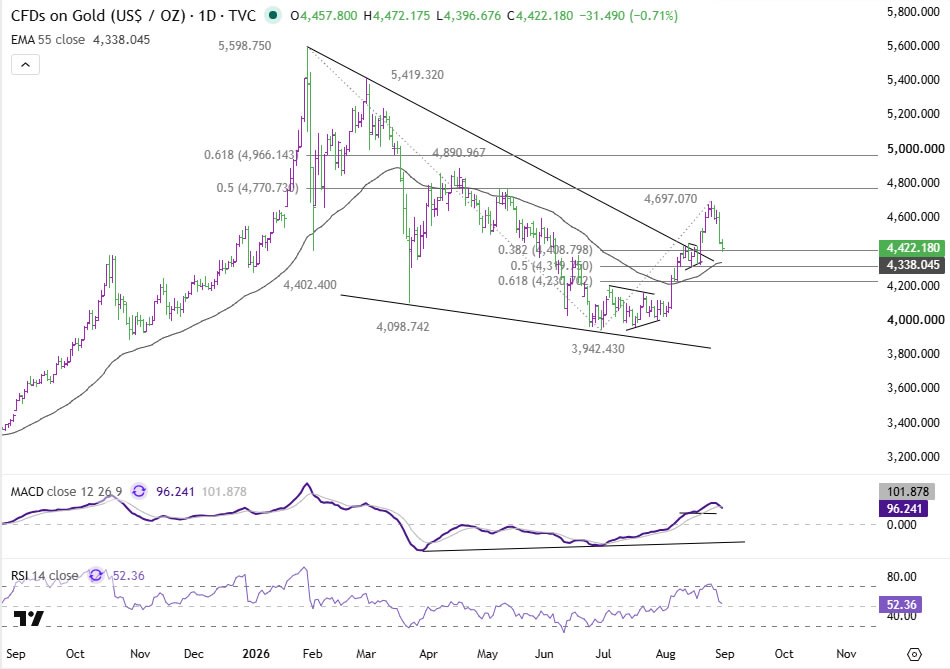
That leaves a tight 4,320–4,338 technical cluster, with 4,300 serving as broader psychological and invalidation line. Current price around 4,423 is still comfortably above it. Support has not held because support has not yet been tested.
If this is only a correction, that zone should begin attracting buyers. Gold could then settle into a wider 4,300–4,700 consolidation, allowing August surge to cool without destroying larger recovery structure. A bounce from support accompanied by 4H RSI turning higher from oversold levels and MACD downside momentum flattening would strengthen that case. A decisive daily break below 4,300 would do opposite.
What Would Make Bears Right?
Most important fundamental warning would not be another jump in September hike odds. It would be Fed curve shifting materially further right in 2027 and beyond. If markets start moving from “one or two hikes brought forward” toward a genuine extended multi-hike campaign, Gold would face a very different real-yield regime. That would be actual policy regime change rather than timing adjustment seen after Warsh.
August CPI and next payrolls report are therefore more important than Friday’s shock itself. Both arrive before Sept. 15–16 FOMC and will test whether Warsh’s hawkish framework is validated by data. A broad upside inflation surprise or exceptionally strong labor reading could force markets to extend tightening expectations beyond September and December.
Brent above $100 could contribute to same process, but only through inflation and rates. Latest escalation around Larak Island and Iranian retaliation against US bases in Jordan keeps that risk alive. A sustained oil shock that broadens inflation pressure could strengthen case for Fed staying restrictive for longer. Oil crossing $100 without changing inflation expectations or Fed curve, however, would not automatically turn Gold bearish.
A more decisive blow would come from fiscal side itself: credible consolidation, a materially improved debt path, or clear evidence that Treasury-financing concerns are fading independently of Fed. That looks less likely near term, but it would attack debasement thesis at source rather than merely reducing fear that Fed will accommodate it.
For now, Gold has suffered a powerful two-channel correction, not a confirmed trend reversal. Warsh moved Fed timing, trimmed credibility premium and pushed short-term momentum sharply lower. What he did not do was rewrite longer-run rate path or US fiscal arithmetic. That leaves chart to decide next stage. Around 4,320–4,338, Gold reaches first serious support. Below 4,300, correction thesis starts to fail.
Key Takeaways
- Gold’s 5.8% decline reflects Warsh’s two-channel hit: higher near-term rate odds (September hike probability to 57%) and reduced fiscal-credibility premium, not a change in longer-run policy.
- The 30-year yield barely moved (+1-2bp) while the 2-year jumped 13bp, confirming markets repriced timing, not the terminal rate or long-run inflation regime.
- US fiscal arithmetic is unchanged: the Treasury buyback program remains live, debt is still projected to rise from 117% to 128% of GDP by 2030, and July’s deficit hit $432bn.
- Three independent support methods converge at 4,320-4,338 (55-day EMA, 50% retracement, structural support), with 4,300 as the key invalidation line for the correction thesis.
- August CPI and the next payrolls report, not Friday’s speech itself, are the real tests of whether Warsh’s hawkish framework gets validated by data before the September FOMC.





