TL;DR: A November BoE hike is 93.2% priced, but economists are far less convinced about what follows—with this week’s UK wages and September CPI data set to decide whether December tightening gets closer to certainty, just as GBP/USD tests the key 1.3341 Fibonacci resistance.
Why This Matters
Financial markets are preparing for a Bank of England tightening cycle extending well into 2027, but economists are considerably less convinced about what follows November. A 25bps increase next month is already 93.2% priced, while expectations for further hikes depend on evidence that inflation pressures are spreading beyond energy costs. This week’s UK wages and CPI data could determine whether markets are getting ahead of the evidence or correctly anticipating a more persistent inflation problem.
Meanwhile, GBP/USD is testing the 1.3341 Fibonacci resistance following its rebound from 1.3135. With much of the recovery driven by Dollar weakness, Sterling may need more than confirmation of November’s widely anticipated hike to sustain further gains. The critical question is whether incoming UK data reinforce expectations for another increase as early as December, or support Governor Andrew Bailey’s more cautious assessment of second-round inflation pressures.
November Hike Nearly Priced, but Markets Expect Much More
Interest rate markets have moved beyond debating whether the BoE will raise rates on November 5. The October 19 OIS snapshot assigns a 93.2% probability to a 25bps hike, implying Bank Rate rising from 3.75% to approximately 3.98%. A Reuters survey published October 15 showed similarly strong expectations among economists, with 54 of 63 forecasting an increase to 4.00%.
However, agreement weakens considerably beyond November. OIS pricing assigns a 51.6% probability to another hike at the December 17 meeting, followed by 75.6% at the February 2027 meeting. These are individual meeting probabilities, rather than cumulative odds. The implied policy rate reaches 4.30% in February and 4.79% by September 2027, equivalent to approximately four cumulative quarter-point increases from the current rate.
- November 5: 93.2% probability of a 25bps hike (3.75% → ~3.98%)
- December 17: 51.6% probability of another hike
- February 2027: 75.6% probability of another hike
- Implied path: ~4.30% by February 2027, ~4.79% by September 2027
Economists are substantially less convinced about the longer tightening cycle. Only 30 of 61 respondents in the Reuters survey expected another increase in the first quarter of 2027. The divergence suggests that markets are pricing a more extended period of monetary tightening than the economist consensus supports. Moreover, the latest implied rate path is marginally below that of a week earlier, indicating that expectations for further hikes have not been strengthening uniformly.
The distinction matters for Sterling. A November hike that is already almost fully priced may provide limited fresh support on its own. The more significant repricing opportunity lies in whether incoming evidence brings December tightening closer to certainty or raises doubts about the broader rate path.
Bailey’s Caution Contrasts With Hawkish MPC Members
The Monetary Policy Committee held Bank Rate at 3.75% in September by a 6–3 vote, with Huw Pill, Megan Greene and Catherine Mann favoring an increase to 4.00%. The split revealed substantial support for further tightening even before the latest inflation developments. However, the majority, including Bailey, preferred to wait for additional evidence.
Speaking in Bangkok on October 16, Bailey described evidence of second-round inflation effects as “quite subdued” so far, while emphasizing that it was too early to reach firm conclusions. Businesses were struggling to pass higher energy costs on to customers and were responding partly through cost reductions and pressure on margins. Bailey also acknowledged that the economy had proved more resilient than previously expected.
His assessment contrasts with warnings from more hawkish MPC members that waiting for clear evidence of persistent inflation could leave policy tightening too late. In particular, wage settlements in early 2027 could reveal second-round pressures only after they have become more firmly established.
The disagreement is therefore not simply about whether inflation is too high, but how quickly the BoE should respond to risks that are not yet fully visible. Bailey’s remarks provide support for a measured pace, while the existing dissenters and persistent inflation concerns underpin expectations for further tightening.
UK Wages and Services CPI Become the Critical Tests
This week’s economic calendar offers several opportunities to test the argument for an extended tightening cycle. Tuesday’s labor-market report will be important for assessing whether domestic wage pressures are becoming more persistent or continuing to ease. The latest available figures showed unemployment at 4.9% and regular pay growth at 3.5%, with private-sector regular pay growth having slowed substantially from a year earlier.
Private-sector wages and payroll employment deserve particular attention. Stronger pay growth would reinforce concerns that businesses face persistent labor costs, potentially increasing the risk of broader price pressures. Conversely, softer wage growth and continued employment weakness would strengthen the case for allowing existing monetary restraint more time to work through the economy.
Wednesday’s September CPI report is likely to carry even greater weight. Headline inflation stood at 3.1% in August, with core inflation at 2.6% and services inflation at 3.4%. Forecasts point to headline inflation rising toward approximately 3.4–3.5%, largely reflecting higher energy costs. Such an increase would not, by itself, establish that underlying inflation pressures are becoming more persistent.
The more important test is whether services and core inflation accelerate beyond the previous readings, particularly if accompanied by resilient private-sector pay. That combination would strengthen the argument for another increase soon after November. If headline inflation rises mainly because of energy while underlying measures remain contained, Bailey’s more cautious position would gain support.
Friday’s retail sales and flash PMI releases will provide additional information on domestic demand and business pricing conditions. Their significance will depend particularly on whether activity and price components point to persistent inflation or weakening demand. Thursday’s scheduled remarks from Bailey may also offer further clarification, although the speaking timetable requires confirmation.
- Unemployment: 4.9%; regular pay growth: 3.5%
- Headline CPI (August): 3.1%
- Core CPI: 2.6%
- Services CPI: 3.4%
- September CPI forecast: ~3.4–3.5%
Economic Resilience Meets Growth and Fiscal Constraints
Recent UK activity data have provided some support for the BoE’s tightening outlook. August GDP increased 0.1% mom, compared with expectations for a 0.1% contraction, while growth over the three months to August strengthened to 0.7%. Manufacturing output increased 1.2%, suggesting that the economy has been more resilient than anticipated.
However, the recovery remains uneven. Services output was flat in August, construction continued to weaken, and payroll employment has shown signs of deterioration. The combination of modest growth and softer labor demand complicates the case for a prolonged tightening cycle, particularly if inflation pressures remain concentrated in energy rather than spreading into wages and services.
Fiscal developments add another layer of uncertainty. Chancellor Rachel Healey is scheduled to deliver the Autumn Budget on October 28, accompanied by updated Office for Budget Responsibility forecasts. Elevated gilt yields and concerns about limited fiscal headroom could constrain government policy choices and influence broader financial conditions.
For Sterling, this means further BoE tightening is not automatically positive. Higher interest rates may support the currency through yield differentials, but an extended cycle could also weigh more heavily on growth and financial conditions. The balance between inflation persistence and economic resilience will determine how much support additional tightening expectations can provide.
ActionForex’s Technical View: GBP/USD 1.3341 Holds the Reversal Key
GBP/USD has rebounded strongly from the 1.3135 short-term bottom established on October 14. The recovery has been accompanied by improving momentum on the four-hour chart, where MACD has strengthened alongside a rising momentum trendline. Daily momentum has also improved, although the larger bullish reversal remains unconfirmed.
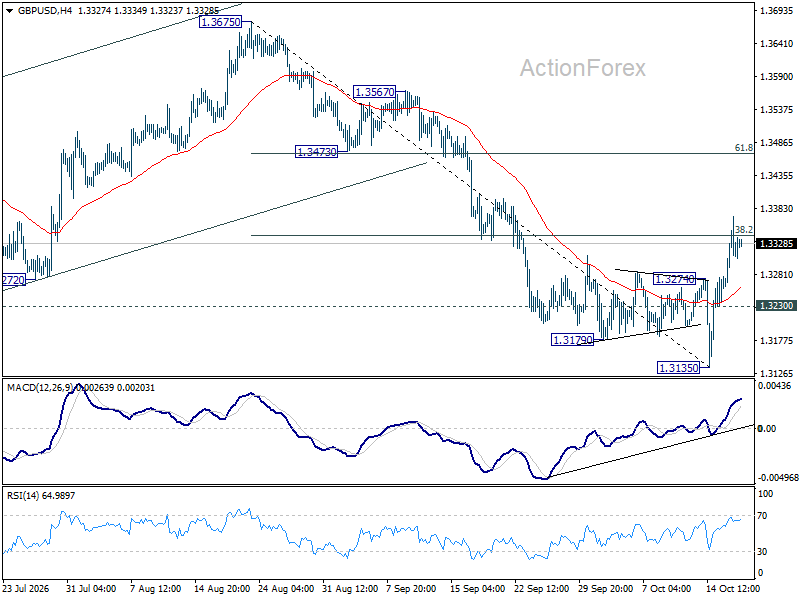
The immediate focus is 1.3341, the 38.2% retracement of the decline from 1.3675 to 1.3135. Decisive break above this resistance would increase the likelihood that the fall from 1.3675 has completed. That would shift the next upside target to the 61.8% retracement at 1.3469, close to the former 1.3473 swing level.
Under this bullish scenario, the rebound from 1.3135 could develop into another upward leg within the broader medium-term sideways pattern from 1.3867. Sustained strength beyond 1.3469 would improve the possibility of a further rally through 1.3675 toward the 1.3867 high.
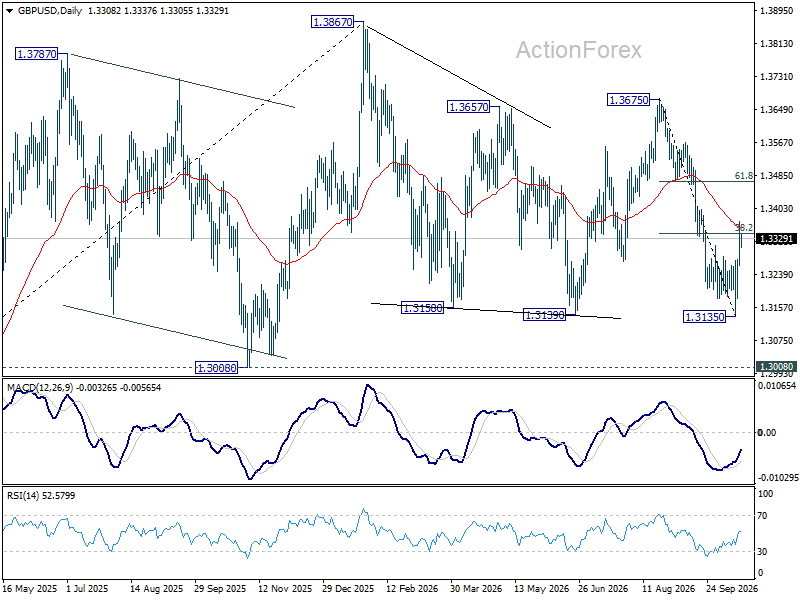
However, failure to overcome 1.3341 would keep the recovery vulnerable to renewed selling. Initial support lies around 1.3274, followed by 1.3230. Break below 1.3230 would indicate rejection by the Fibonacci resistance and the daily 55 EMA region, suggesting that the rebound from 1.3135 was merely corrective. That would keep the decline from 1.3675 intact and shift the near-term bias back to the downside.
The technical setup aligns closely with the fundamental outlook. Stronger-than-expected UK wages and underlying inflation could provide the Sterling-specific catalyst for a decisive break above 1.3341. Nevertheless, extending the recovery beyond 1.3469 would likely require more convincing evidence that the BoE tightening cycle will continue after November.
The Next BoE Hike May Matter Less Than What Follows
The immediate market question is whether this week’s UK data can sustain expectations for a second rate increase as early as December. Stronger services inflation accompanied by resilient private-sector wages would reinforce the case for continued tightening. Softer underlying inflation and further labor-market easing would instead favor a more measured approach, potentially shifting expectations for the next increase toward February.
The November 5 meeting will then provide the decisive policy test. The MPC vote split, updated inflation forecasts and guidance will reveal whether policymakers see a need for relatively rapid successive increases or prefer to assess the impact of November’s anticipated move before tightening again.
For GBP/USD, the 1.3341 Fibonacci resistance provides the immediate technical dividing line, but the larger question is whether Sterling can develop strength independent of Dollar weakness. A confirmed breakout supported by stronger UK inflation evidence and a more hawkish BoE outlook would strengthen the bullish reversal case.
Until then, the recovery from 1.3135 remains vulnerable to disappointment. November tightening is largely priced; the direction of Sterling’s next substantial move may depend on whether the market’s expectations for the rest of the cycle can survive the coming inflation and policy tests.
Key Takeaways
- A November BoE hike is 93.2% priced, but conviction drops sharply beyond that—only 30 of 61 economists expect another increase in Q1 2027, versus a much steeper market-implied path.
- Wednesday’s September CPI is the critical test: a rise driven mainly by energy would support Bailey’s cautious stance, while accelerating services and core inflation would strengthen the case for a December hike.
- Tuesday’s wages data, particularly private-sector pay growth, will show whether labor cost pressures are persisting or continuing to ease alongside softening payroll employment.
- GBP/USD’s near-term path hinges on 1.3341 resistance: a break opens 1.3469 and potentially 1.3675, while failure risks a slide back through 1.3274 and 1.3230 toward 1.3135.
- The Autumn Budget on October 28 adds fiscal uncertainty that could complicate BoE policy choices even as evidence builds for or against further tightening after November.