

Live Comments
BoJ Raises Rate to 1.25%, Yet Dovish Dissents Cloud Next Move
The Bank of Japan raised its policy rate by 25bp from 1.00% to 1.25%, its highest level since 1995, but the 7–2 vote exposed a widening political and policy divide over further normalization. The increase, effective September 24, was widely anticipated. Yen weakened after the announcement while the 10-year Japanese government bond yield fell, suggesting that markets focused less on the delivered hike than on the two dovish dissents and the uncertain pace of subsequent tightening.
The BoJ nevertheless retained a clear tightening bias. It said underlying CPI inflation was approaching 2%, financial conditions were still accommodative and the policy rate would continue to rise if economic activity and prices developed in line with its outlook. Core inflation is projected to accelerate clearly above 2% from the second half of fiscal 2026 as higher crude oil prices, Yen depreciation and AI-related demand lift energy, goods and semiconductor costs. The Bank also warned that underlying inflation could overshoot its target as firms become more willing to raise wages and prices and longer-term inflation expectations increase.
The two dissenters, Policy Board members Toichiro Asada and Ayano Sato, preferred to keep the rate at 1.00%. Asada pointed to core inflation below 2% and questioned whether the economy was strong enough to absorb another increase. Sato argued that economic and price conditions had not accelerated sufficiently to justify tightening. Both were appointed by Prime Minister Sanae Takaichi’s administration, and their positions broadly reflected the government’s preference for accommodative monetary policy alongside fiscal support. They remain independent board members, but the dissent indicates that future hikes could become more politically and institutionally contested.
The split was not uniformly dovish, however. Policy Board members Hajime Takata and Naoki Tamura, who supported the hike, objected to the BoJ’s inflation description because they believed underlying inflation had already reached a level consistent with the 2% target. The board therefore contained two members who opposed tightening and two who viewed inflation as stronger than the central assessment suggested. That leaves the BoJ on a further-hike path, but with the timing constrained by a widening internal divide—explaining why a nominally hawkish decision failed to deliver immediate support to Yen.
Key takeaways
- The BoJ raised its policy rate by 25bp from 1.00% to 1.25%, the highest level since 1995, with the new rate taking effect on September 24.
- The decision passed by a 7–2 vote, with Policy Board members Toichiro Asada and Ayano Sato preferring to keep the rate at 1.00%.
- Both dissenters were appointed by Prime Minister Sanae Takaichi’s administration. Their caution broadly aligns with the government’s preference for accommodative monetary policy, although they remain independent board members.
- The BoJ retained a clear tightening bias, stating that it would continue raising the policy rate as economic activity, inflation and financial conditions evolve.
- The Bank said underlying CPI inflation was approaching 2% and warned that stronger wage and price-setting behavior could eventually push it above the target.
- Core inflation is expected to rise clearly above 2% from the second half of fiscal 2026, driven by higher oil prices, Yen depreciation and AI-related demand.
- The board was divided in both directions. Hajime Takata and Naoki Tamura supported the hike but argued that underlying inflation had already reached a level consistent with the 2% target.
- Yen’s initial weakness reflected a hike that was already priced in, the two dovish dissents and uncertainty over the timing of the next move—not an abandonment of the BoJ’s normalization path.
Japan Core CPI Slips to 1.7%, but Underlying Inflation Holds at 1.9%
Japan’s headline CPI was unchanged at 1.9% y/y in August, while the seasonally adjusted index was flat on the month. CPI excluding fresh food slowed from 1.8% to 1.7% y/y, undershooting the 1.8% consensus and remaining below 2% for an eighth consecutive month. By contrast, CPI excluding fresh food and energy held at 1.9% y/y and rose 0.3% m/m, pointing to steadier underlying pressure.
Energy accounted for much of the slowdown in the standard core measure. Energy inflation fell from 0.6% to -0.7%, as electricity prices declined 2.4% and gasoline prices dropped 2.6% from a year earlier. Government measures affecting gasoline and household energy reduced headline inflation by an estimated 0.62 percentage points. Food inflation also moderated: prices excluding fresh food slowed from 3.0% to 2.7%, although snacks, prepared meals, beverages and dining-out costs continued to rise.
The release therefore showed selective disinflation rather than a broad retreat in prices. Government-supported energy relief and slower food inflation pulled the core rate lower, while the measure excluding both fresh food and energy stayed close to 2% and recorded a solid monthly increase. With recent global oil prices considerably higher than those reflected in the August data, part of the current energy drag could also prove temporary.
Data summary
| Inflation measure | Aug y/y | Jul y/y | Result |
|---|---|---|---|
| Headline CPI | 1.9% | 1.9% | Unchanged |
| CPI excluding fresh food | 1.7% | 1.8% | Below 1.8% forecast |
| CPI excluding fresh food and energy | 1.9% | 1.9% | Unchanged |
| Inflation measure | Aug m/m, seasonally adjusted |
|---|---|
| Headline CPI | 0.0% |
| CPI excluding fresh food | +0.1% |
| CPI excluding fresh food and energy | +0.3% |
| Key component | Aug y/y | Jul y/y |
|---|---|---|
| Energy | -0.7% | +0.6% |
| Electricity | -2.4% | -0.1% |
| Gasoline | -2.6% | -1.8% |
| Food excluding fresh food | +2.7% | +3.0% |
| Fresh food | +6.0% | +7.0% |
| Government measure | Estimated contribution to CPI |
|---|---|
| Overall energy measures | -0.62 percentage points |
| Gasoline measures | -0.38 percentage points |
| Electricity measures | -0.17 percentage points |
| City gas measures | -0.03 percentage points |
| Kerosene measures | -0.04 percentage points |
Key takeaways
- Japan’s standard core CPI slowed from 1.8% to 1.7%, missing the 1.8% consensus and remaining below 2% for an eighth consecutive month.
- Headline inflation held at 1.9%, while the measure excluding fresh food and energy also remained at 1.9%.
- Underlying monthly momentum was firmer than the annual readings imply: CPI excluding fresh food and energy rose a seasonally adjusted 0.3% m/m.
- Energy was the main source of disinflation. Its annual rate reversed from +0.6% to -0.7%, led by falling electricity and gasoline prices.
- Government support had a significant effect, reducing energy’s estimated contribution to overall CPI by 0.62 percentage points. The softer core rate therefore partly reflected administered relief rather than broad-based disinflation.
- Food pressure moderated but remained evident. Inflation in food excluding fresh items eased from 3.0% to 2.7%, while fresh-food inflation slowed from 7.0% to 6.0%.
- The figures suggest selective disinflation rather than a decisive retreat in underlying prices. The recent increase in global energy costs could also reverse some of August’s energy relief in coming months.
US Jobless Claims Drop to 196k as Labor Market Resilience Continues
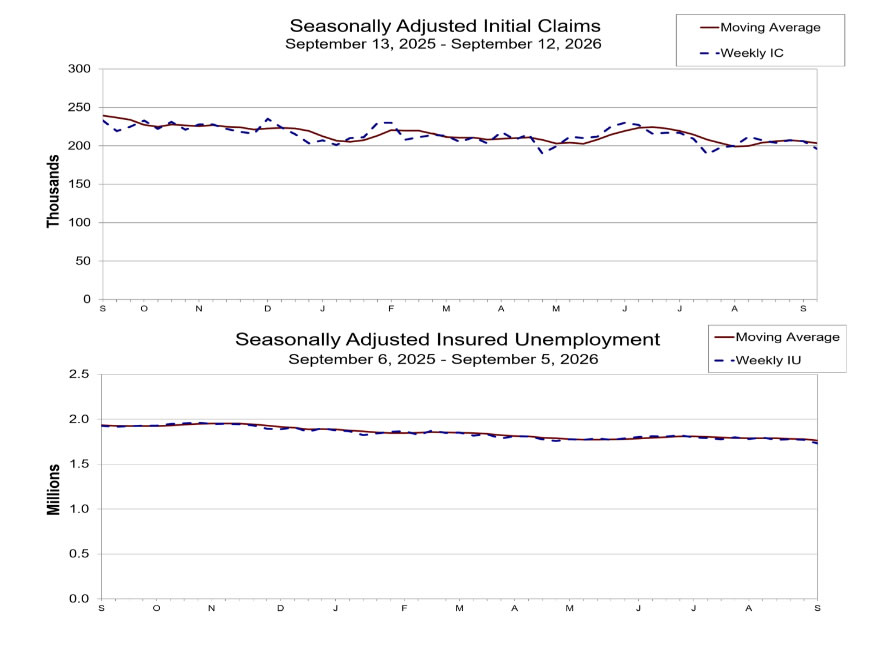
US initial jobless claims fell from 206k to 196k in the week ending September 12, substantially below the 209k expectation. The four-week moving average declined from 206k to 203.25k, indicating that the improvement was not limited to the latest weekly reading. Unadjusted claims dropped 13.9%, compared with the 9.3% decline anticipated by seasonal factors.
Continuing claims also fell sharply, from a downwardly revised 1.769m to 1.730m in the week ending September 5. The previous figure was initially reported at 1.774m. The four-week average of continuing claims declined from 1.778m to 1.761m, while the insured unemployment rate fell from 1.2% to 1.1%. Compared with a year earlier, initial claims were down from 233k and continuing claims from 1.925m.
The report points to limited new layoffs and a declining stock of workers receiving unemployment benefits. Weekly claims remain volatile, but the simultaneous improvement in initial claims, continuing claims and their moving averages provides a consistent signal of labor-market resilience. Coming one day after the Fed raised rates, the data offer policymakers little employment-based reason to abandon further tightening while inflation remains elevated.
Data summary
Headline data
| Indicator | Actual | Expected | Previous |
|---|---|---|---|
| Initial jobless claims | 196k | 209k | 206k |
Supporting claims data
| Indicator | Current | Previous | Change |
|---|---|---|---|
| Initial claims, four-week average | 203.25k | 206.00k | -2.75k |
| Continuing claims | 1.730m | 1.769m | -39k |
| Continuing claims, four-week average | 1.761m | 1.778m | -16.5k |
| Insured unemployment rate | 1.1% | 1.2% | -0.1pp |
| Unadjusted initial claims | 152.29k | 176.92k | -24.63k |
The previous continuing-claims reading was revised from 1.774m to 1.769m.
Key takeaways
- Initial claims fell from 206k to 196k, undershooting the 209k expectation by 13k.
- The four-week average declined to 203.25k, confirming that the improvement was not confined to one volatile weekly reading.
- Continuing claims dropped by 39k to 1.730m, while the insured unemployment rate declined from 1.2% to 1.1%.
- Unadjusted claims fell 13.9%, compared with the 9.3% decline anticipated by normal seasonal patterns.
- Initial claims were 233k in the comparable week of 2025, while continuing claims stood at 1.925m, indicating considerably lower benefit use than a year earlier.
- The simultaneous decline in new and continuing claims points to a resilient labor market and offers the Fed little employment-based reason to halt tightening after one hike.
- Weekly claims can be volatile, but the consistency across the headline, moving averages and insured unemployment strengthens the signal.