

Live Comments
UK Construction PMI Improves to 44.7, but Sector Remains in Prolonged Contraction
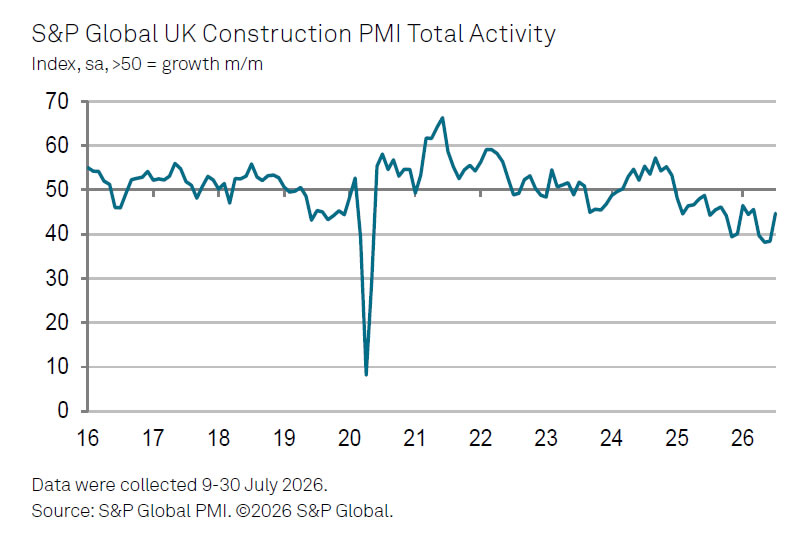
The UK construction sector showed further signs of stabilizing in July, although activity remained firmly in contraction for a nineteenth consecutive month. The S&P Global UK Construction PMI rose to 44.7 from 38.4 in June, its highest level in four months but still below the 50 threshold that separates expansion from contraction. While the reading points to another decline in overall activity, it also suggests the sharp downturn seen through the second quarter has begun to ease.
The improvement was broad-based across the sector. Commercial construction proved the most resilient, with its activity index rising to 46.8, while house building recorded its least severe contraction since October 2025 at 41.8. Civil engineering remained the weakest segment at 38.3, though even there the pace of decline moderated. According to S&P Global, the slower contraction reflected the smallest fall in new orders since September 2025, with some firms reporting improving client enquiries and a revival in tender opportunities despite generally subdued market conditions.
Encouragingly, business optimism strengthened to its highest level since February as firms became more confident about activity over the coming year. Construction companies also benefited from improving supplier performance and the slowest rise in input costs for five months. Although respondents continued to cite higher fuel and raw material costs linked to the Middle East conflict, easing cost pressures and tentative signs of recovering demand suggest the sector may be moving beyond its weakest phase, even if a sustained recovery has yet to take hold.
Data Summary
| Component | July | June | Trend |
|---|---|---|---|
| Construction PMI | 44.7 | 38.4 | ▲ Four-month high |
| Commercial Activity | 46.8 | N/A | ▲ Slowest contraction |
| House Building | 41.8 | N/A | ▲ Least severe decline since Oct 2025 |
| Civil Engineering | 38.3 | N/A | ▲ Contraction eased but remained weakest |
| Overall Activity | < 50 | < 50 | ▼ 19th consecutive month of contraction |
Key Takeaways
- UK Construction PMI rose to 44.7 in July from 38.4, reaching a four-month high and signalling that the sector's downturn is easing, although activity remains in contraction.
- The sector has now contracted continuously since January 2025, marking its longest period of decline since the Global Financial Crisis.
- All three major segments improved, with commercial construction proving the most resilient (46.8), while house building recorded its mildest contraction since October 2025.
- Survey respondents reported early signs of improving client demand and more tender opportunities, resulting in the smallest decline in new orders since September 2025.
- Business confidence climbed to its highest level since February, suggesting firms expect activity to improve over the coming year.
- Cost pressures eased to a five-month low, although companies continued to cite higher fuel and raw material prices linked to the Middle East conflict.
Fed’s Daly: Businesses Have Limited Ability to Raise Prices
San Francisco Fed President Mary Daly said there are growing reasons to believe inflation will moderate without additional monetary tightening, arguing that businesses are finding it increasingly difficult to pass higher costs on to consumers. Speaking at an economics conference in Tokyo, Daly said she was "completely supportive" of last week's decision to keep interest rates unchanged, stressing that policymakers still need more evidence before deciding whether inflation is being driven by temporary supply shocks or more persistent forces. "We have a lot of information we need to collect" ahead of the September FOMC meeting, she said.
Daly pointed to several factors that could help ease inflation in the months ahead. Most notably, she argued that businesses now have "limited pricing power" and will struggle to pass rising input costs through to customers. She also said there are "good reasons" to believe the supply-driven shocks that have fueled inflation "will not have a lasting impact," adding that an eventual end to the Middle East conflict should lower oil prices and reduce one of the public's biggest inflation concerns. Together, those developments support the case for allowing more time to assess incoming data before adjusting policy.
Even so, Daly emphasized that patience should not be mistaken for complacency. She warned the Fed must remain "vigilant to watch the information as it comes in, but be very prepared to take action" if inflation proves more persistent than expected. While she acknowledged concerns that renewed inflation could become embedded in public expectations, her remarks place her firmly among the policymakers who believe the current evidence still justifies waiting rather than preemptively raising interest rates.
Key Takeaways
- San Francisco Fed President Mary Daly fully supported last week's decision to keep interest rates unchanged, saying policymakers need more data before deciding whether inflation pressures are temporary or persistent.
- Daly argued that businesses now have limited ability to pass higher costs on to consumers, suggesting pricing power is weakening and inflation could moderate without additional tightening.
- She also cited three supportive factors for disinflation: fading supply shocks, the prospect of lower oil prices if Middle East tensions ease, and consumers' sensitivity to energy prices.
- Despite her relatively optimistic outlook, Daly stressed the Fed must remain "vigilant" and "be very prepared to take action" if inflation momentum begins building again.
- Her comments place her firmly in the Fed's wait-and-see majority, contrasting with officials who have recently advocated resuming rate hikes immediately.
Cook Says Fed Can’t Afford to Wait Forever on Inflation
Federal Reserve Governor Lisa Cook said policymakers cannot afford to be complacent after more than five years of above-target inflation, warning that patience has limits if price pressures fail to ease. Speaking on Wednesday, Cook reiterated that "inflation is too high" despite some improvement in June, stressing that she would "not put too much weight on a single data point" given the highly uncertain environment. While she supported leaving interest rates unchanged at last week's FOMC meeting, she made clear that "I am prepared to act by raising rates, if necessary."
Cook argued that inflation risks continue to outweigh labor market risks, citing elevated energy prices linked to the Middle East conflict and AI-driven investment as two unexpected sources of upward pressure on prices. Together, she said, these developments "have shifted the balance of risks toward inflation and away from the labor market." At the same time, she characterized employment as stable in a "low-hire, low-fire environment," with subdued hiring offset by historically low layoffs. That backdrop, in her view, allows the Fed to remain focused on restoring price stability.
Even so, Cook explained why she supported holding rates for now. She pointed to three disinflationary forces already emerging: fading tariff effects, the prospect of lower oil prices later this year, and easing AI-related goods inflation as supply chains adjust. Those factors could help bring inflation back toward target without further tightening. However, she warned that "if I do not see signs of continued disinflation soon, I am prepared to act," adding that "we do not have that luxury" of waiting indefinitely because prolonged above-target inflation risks becoming entrenched in wage- and price-setting behavior.
Key Takeaways
- Fed Governor Lisa Cook said inflation remains "too high" and the Fed "can't afford to wait forever" if price pressures fail to continue easing.
- While she supported keeping rates unchanged last week, Cook stressed she is "prepared to act by raising rates, if necessary" should disinflation stall.
- Cook argued that inflation risks currently outweigh labor market risks, citing higher energy prices from the Middle East conflict and AI-related investment as key drivers of persistent inflation.
- She described the labor market as a "low-hire, low-fire environment," with stable unemployment reflecting subdued hiring but also historically low layoffs.
- Cook identified three potential disinflationary forces—fading tariff effects, lower oil prices later this year, and easing AI-related supply constraints—as reasons to remain on hold for now.
- However, she warned that prolonged above-target inflation risks becoming entrenched, leaving the Fed with less room to wait if inflation progress stalls.